Thiosulfuric Acid
Thiosulfuric acid and its sodium salt (sodium thiosulfate) function as sulfur donors and reducing agents that react with cyanide to form non-toxic thiocyanate in the liver via the enzyme rhodanese, providing life-saving antidotal therapy for cyanide poisoning. Sodium thiosulfate is also used to reduce the nephrotoxicity of cisplatin in hyperthermic intraperitoneal chemotherapy, reduce calciphylaxis lesions, and as a topical antifungal. Its role in cancer care stems from its ability to neutralize cisplatin-induced nephrotoxicity without compromising antitumor efficacy when administered systemically after intraperitoneal cisplatin.
الوزن الجزيئي
114,1500 g/mol
LogP
0,30
TPSA
98,00 Ų
قاعدة ليبينسكي للخمسة
ناجح
المجالات العلاجية
آلية العمل
Applied directly to the skin or mucous membranes, where it exerts its therapeutic effect locally at the site of application with minimal systemic absorption.
Pharmacokinetics (PK)
Pharmacodynamics (PD)
Applied directly to the skin or mucous membranes, where it exerts its therapeutic effect locally at the site of application with minimal systemic absorption.
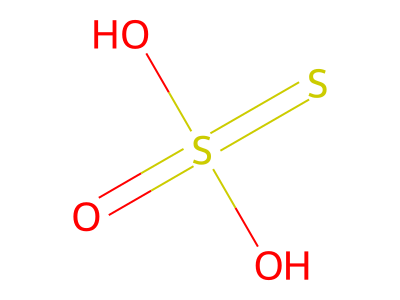
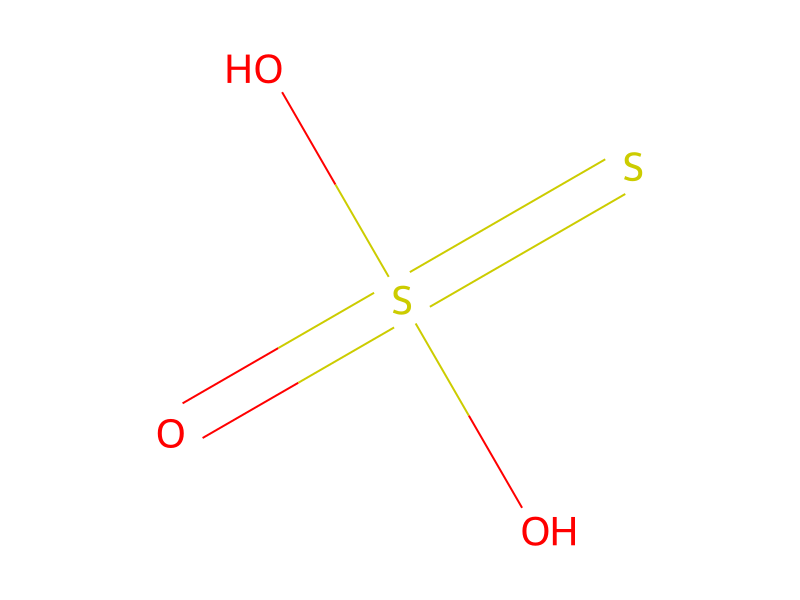
البنية ثنائية الأبعاد
Cite this structure
Embed this structure
SMILES
O=S(O)(O)=S
InChI
InChI=1S/H2O3S2/c1-5(2,3)4/h(H2,1,2,3,4)
Molecular Formula
H2O3S2
HBD / HBA
2 / 4
الروابط القابلة للدوران
0
الذرات الثقيلة
5
No targets recorded
Target interaction data is not yet available for this drug.
No interactions recorded
Drug interaction data is not yet available for this compound.
No side effects recorded
Side effect data is not yet available for this drug.
الأسئلة الشائعة
Thiosulfuric acid and its sodium salt (sodium thiosulfate) function as sulfur donors and reducing agents that react with cyanide to form non-toxic thiocyanate in the liver via the enzyme rhodanese, providing life-saving antidotal therapy for cyanide poisoning. Sodium thiosulfate is also used to reduce the nephrotoxicity of cisplatin in hyperthermic intraperitoneal chemotherapy, reduce calciphylaxis lesions, and as a topical antifungal. Its role in cancer care stems from its ability to neutralize cisplatin-induced nephrotoxicity without compromising antitumor efficacy when administered systemically …
Applied directly to the skin or mucous membranes, where it exerts its therapeutic effect locally at the site of application with minimal systemic absorption.
Yes, Thiosulfuric Acid is an approved drug. It has reached clinical phase 4. It is classified as a Small molecule.
References & Data Sources
- ChEMBL — European Bioinformatics Institute (EBI). CHEMBL1208642. Open-access bioactivity database.
- PubChem — National Center for Biotechnology Information (NCBI). CID 24478. Chemical information database.
Data aggregated from publicly available pharmacological databases. Last updated 2026-03-28.
Embed This Widget
Add the script tag and a data attribute to embed this widget.
<script src="https://cdn.jsdelivr.net/npm/drugfyi-embed@1/dist/embed.min.js" defer></script>
<div data-drugfyi="drug" data-slug="thiosulfuric-acid"></div>Embed via iframe for maximum compatibility.
<iframe src="https://drugfyi.com/iframe/drug/thiosulfuric-acid/" width="420" height="400" frameborder="0" style="border:0;border-radius:10px;max-width:100%" loading="lazy"></iframe>Paste this URL in WordPress, Medium, or any oEmbed-compatible platform.
https://drugfyi.com/drug/thiosulfuric-acid/Add a dynamic SVG badge to your README or docs.
<a href="https://drugfyi.com/drug/thiosulfuric-acid/" rel="nofollow noopener"><img src="https://drugfyi.com/badge/entity/thiosulfuric-acid.svg" alt="DrugFYI"></a>Use the native HTML custom element.
<script src="https://cdn.jsdelivr.net/npm/drugfyi-embed@1/dist/embed.min.js" defer></script>
<drugfyi-drug slug="thiosulfuric-acid"></drugfyi-drug>