Ticrynafen
Ticrynafen (tienilic acid) is a uricosuric diuretic and antihypertensive agent that inhibits renal tubular reabsorption of urate while also blocking sodium and chloride reabsorption. It was withdrawn from the market due to severe hepatotoxicity, including fatal hepatic necrosis associated with drug-metabolite-induced autoimmune liver injury. Its combined uricosuric and antihypertensive properties were clinically attractive, but the idiosyncratic hepatotoxic mechanism involving CYP2C9-generated reactive metabolites made it unsafe.
الوزن الجزيئي
331,2000 g/mol
LogP
4,10
TPSA
91,80 Ų
قاعدة ليبينسكي للخمسة
ناجح
Pharmacokinetics (PK)
Pharmacodynamics (PD)
البنية ثنائية الأبعاد
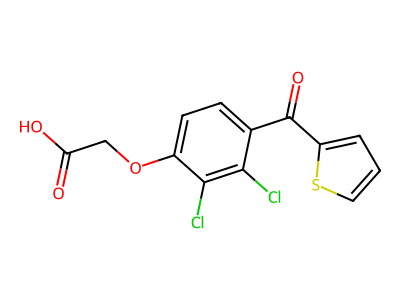
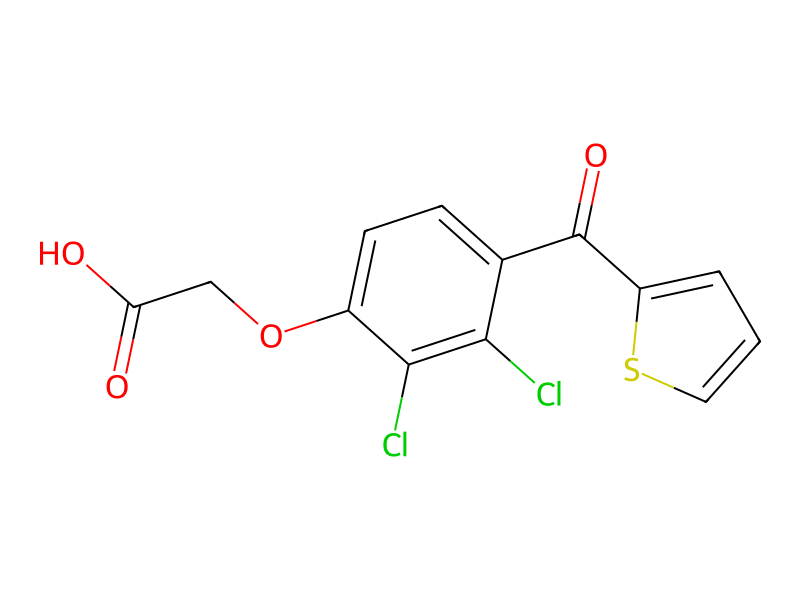
Cite this structure
Embed this structure
SMILES
O=C(O)COc1ccc(C(=O)c2cccs2)c(Cl)c1Cl
InChI
InChI=1S/C13H8Cl2O4S/c14-11-7(13(18)9-2-1-5-20-9)3-4-8(12(11)15)19-6-10(16)17/h1-5H,6H2,(H,16,17)
Molecular Formula
C13H8Cl2O4S
HBD / HBA
1 / 5
الروابط القابلة للدوران
5
الذرات الثقيلة
20
No targets recorded
Target interaction data is not yet available for this drug.
No interactions recorded
Drug interaction data is not yet available for this compound.
No side effects recorded
Side effect data is not yet available for this drug.
الأسئلة الشائعة
Ticrynafen (tienilic acid) is a uricosuric diuretic and antihypertensive agent that inhibits renal tubular reabsorption of urate while also blocking sodium and chloride reabsorption. It was withdrawn from the market due to severe hepatotoxicity, including fatal hepatic necrosis associated with drug-metabolite-induced autoimmune liver injury. Its combined uricosuric and antihypertensive properties were clinically attractive, but the idiosyncratic hepatotoxic mechanism involving CYP2C9-generated reactive metabolites made it unsafe.
Yes, Ticrynafen is an approved drug. It has reached clinical phase 4. It is classified as a Small molecule.
References & Data Sources
- ChEMBL — European Bioinformatics Institute (EBI). CHEMBL267744. Open-access bioactivity database.
- PubChem — National Center for Biotechnology Information (NCBI). CID 38409. Chemical information database.
Data aggregated from publicly available pharmacological databases. Last updated 2026-03-28.
Embed This Widget
Add the script tag and a data attribute to embed this widget.
<script src="https://cdn.jsdelivr.net/npm/drugfyi-embed@1/dist/embed.min.js" defer></script>
<div data-drugfyi="drug" data-slug="ticrynafen"></div>Embed via iframe for maximum compatibility.
<iframe src="https://drugfyi.com/iframe/drug/ticrynafen/" width="420" height="400" frameborder="0" style="border:0;border-radius:10px;max-width:100%" loading="lazy"></iframe>Paste this URL in WordPress, Medium, or any oEmbed-compatible platform.
https://drugfyi.com/drug/ticrynafen/Add a dynamic SVG badge to your README or docs.
[](https://drugfyi.com/drug/ticrynafen/)Use the native HTML custom element.
<script src="https://cdn.jsdelivr.net/npm/drugfyi-embed@1/dist/embed.min.js" defer></script>
<drugfyi-drug slug="ticrynafen"></drugfyi-drug>