Cetirizine
Cetirizine is a second-generation antihistamine that selectively blocks peripheral H1 receptors to relieve allergic rhinitis, chronic hives, and other allergic conditions. Because it penetrates the central nervous system only slightly, it causes less drowsiness than older antihistamines. Sold over the counter as Zyrtec and Reactine, it has the formula C21H25ClN2O3 and ranks among the most widely used allergy medications worldwide.
A second-generation antihistamine that selectively blocks peripheral H1 receptors to relieve symptoms of allergic rhinitis, chronic urticaria, and other allergic conditions. Unlike first-generation antihistamines, it has low CNS penetration, resulting in less sedation in most patients. It is available over the counter and is one of the most widely used allergy medications worldwide.
Molekularmasse
388,8900 g/mol
LogP
1,70
TPSA
53,00 Ų
Lipinski-Regel der Fünf
Bestanden
Arzneimittelklassen
Wirkmechanismus
Second-generation H1 antihistamine.
Pharmacokinetics (PK)
Pharmacodynamics (PD)
Second-generation H1 antihistamine.
2D-Struktur
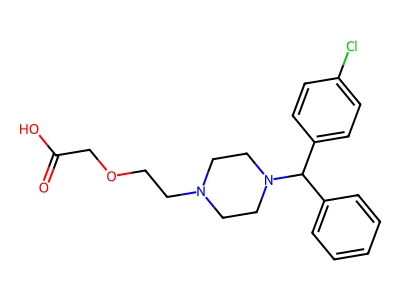
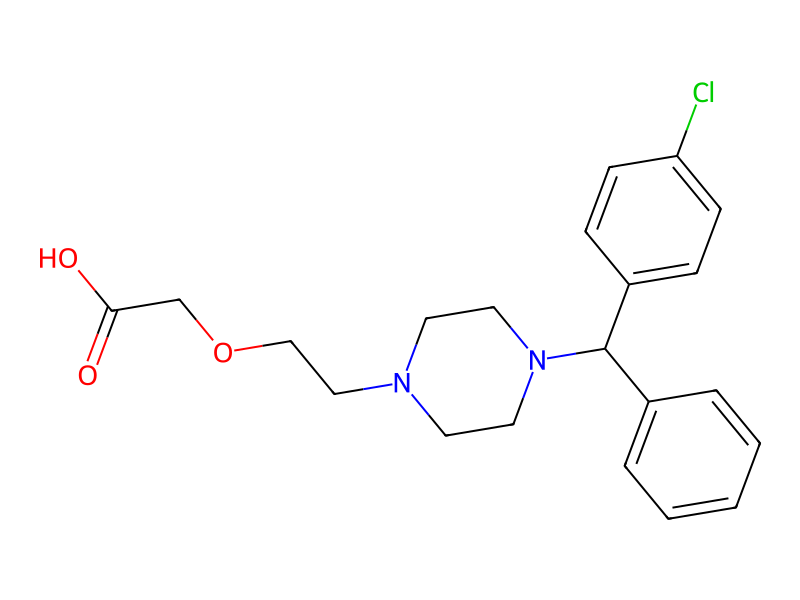
Cite this structure
Embed this structure
SMILES
O=C(O)COCCN1CCN(C(c2ccccc2)c2ccc(Cl)cc2)CC1
InChI
InChI=1S/C21H25ClN2O3/c22-19-8-6-18(7-9-19)21(17-4-2-1-3-5-17)24-12-10-23(11-13-24)14-15-27-16-20(25)26/h1-9,21H,10-16H2,(H,25,26)
Molecular Formula
C21H25ClN2O3
HBD / HBA
1 / 5
Rotierbare Bindungen
8
Schwere Atome
27
Concurrent use of cetirizine and oxycodone may produce additive CNS and respiratory depression, increasing the risk of sedation and, at higher doses, respiratory compromise.
Cetirizine may add to morphine-induced CNS depression, increasing sedation and potentially enhancing respiratory depression, particularly with higher doses of either agent.
Cetirizine has mild CNS depressant properties that can be additive with the sedative effects of alprazolam, increasing the risk of excessive sedation, psychomotor impairment, and respiratory depression.
No side effects recorded
Side effect data is not yet available for this drug.
Häufig gestellte Fragen
A second-generation antihistamine that selectively blocks peripheral H1 receptors to relieve symptoms of allergic rhinitis, chronic urticaria, and other allergic conditions. Unlike first-generation antihistamines, it has low CNS penetration, resulting in less sedation in most patients. It is available over the counter and is one of the most widely used allergy medications worldwide.
Second-generation H1 antihistamine.
Key pharmacokinetic parameters for Cetirizine: Half-life: 6.5-10 hours.
Yes, Cetirizine is an approved drug. It has reached clinical phase 4. It is classified as a Small molecule.
Related Drugs
Same Drug Class
References & Data Sources
- ChEMBL — European Bioinformatics Institute (EBI). CHEMBL1000. Open-access bioactivity database.
- PubChem — National Center for Biotechnology Information (NCBI). CID 2678. Chemical information database.
Data aggregated from publicly available pharmacological databases. Last updated 2026-03-04.
Medizinischer Haftungsausschluss
This content is for educational and informational purposes only. It is not a substitute for professional medical advice, diagnosis, or treatment. Always consult a qualified healthcare provider before making medication decisions.
Embed This Widget
Add the script tag and a data attribute to embed this widget.
<script src="https://cdn.jsdelivr.net/npm/drugfyi-embed@1/dist/embed.min.js" defer></script>
<div data-drugfyi="drug" data-slug="cetirizine"></div>Embed via iframe for maximum compatibility.
<iframe src="https://drugfyi.com/iframe/drug/cetirizine/" width="420" height="400" frameborder="0" style="border:0;border-radius:10px;max-width:100%" loading="lazy"></iframe>Paste this URL in WordPress, Medium, or any oEmbed-compatible platform.
https://drugfyi.com/drug/cetirizine/Add a dynamic SVG badge to your README or docs.
<a href="https://drugfyi.com/drug/cetirizine/" rel="nofollow noopener"><img src="https://drugfyi.com/badge/entity/cetirizine.svg" alt="DrugFYI"></a>Use the native HTML custom element.
<script src="https://cdn.jsdelivr.net/npm/drugfyi-embed@1/dist/embed.min.js" defer></script>
<drugfyi-drug slug="cetirizine"></drugfyi-drug>