Metformin
Metformin is the standard first-line oral treatment for type 2 diabetes, lowering blood glucose chiefly by reducing the liver's glucose production while improving the body's sensitivity to insulin. It activates AMP-activated protein kinase, a cellular energy sensor, and unlike many diabetes drugs it does not itself stimulate insulin release, so it carries little risk of causing low blood sugar on its own. Beyond diabetes, it is used off-label for weight management and polycystic ovary syndrome. A compact biguanide molecule (C4H11N5) with a half-life of roughly 4 to 9 hours, it is not metabolized and leaves the body largely unchanged through the kidneys. That renal clearance shapes how it is managed in people with reduced kidney function. Metformin is an approved, foundational agent in diabetes care.
A widely used first-line oral medication for type 2 diabetes that lowers blood sugar by reducing glucose production in the liver and improving insulin sensitivity. It is also used off-label for weight management and polycystic ovary syndrome (PCOS).
Molekularmasse
129,1640 g/mol
LogP
-1,30
TPSA
91,50 Ų
Lipinski-Regel der Fünf
Bestanden
Therapeutische Bereiche
Arzneimittelklassen
Pharmacokinetics (PK)
Pharmacodynamics (PD)
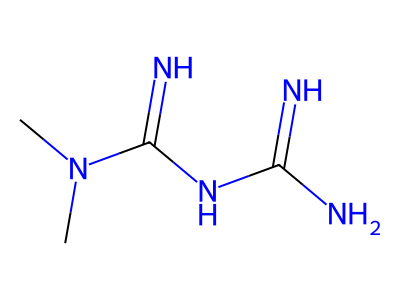
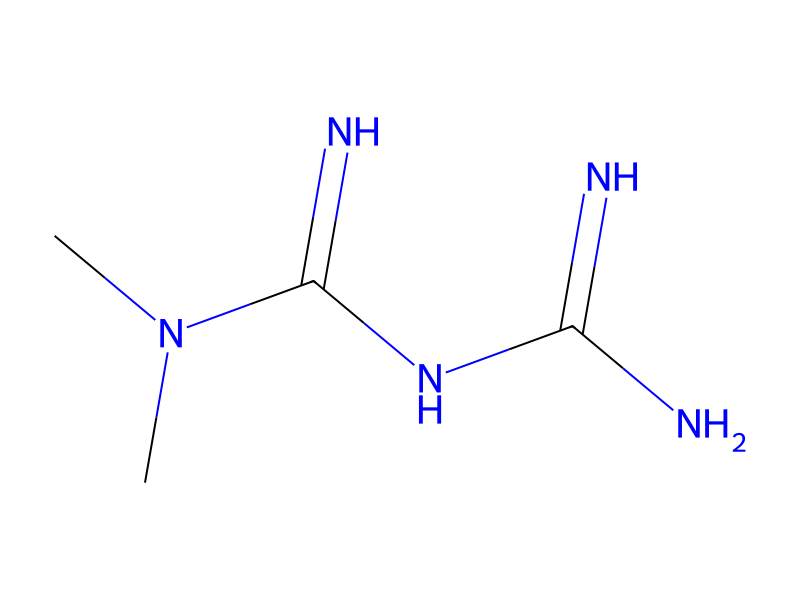
2D-Struktur
Cite this structure
Embed this structure
SMILES
CN(C)C(=N)NC(=N)N
InChI
InChI=1S/C4H11N5/c1-9(2)4(7)8-3(5)6/h1-2H3,(H5,5,6,7,8)
Molecular Formula
C4H11N5
HBD / HBA
3 / 1
Rotierbare Bindungen
2
Schwere Atome
9
No targets recorded
Target interaction data is not yet available for this drug.
Ranitidine competitively inhibits OCT2-mediated renal tubular secretion of metformin, modestly increasing metformin plasma concentrations.
Topiramate can cause metabolic acidosis through carbonic anhydrase inhibition, which may increase the risk of lactic acidosis in patients on metformin.
Trimethoprim inhibits OCT2-mediated renal secretion of metformin, increasing metformin plasma concentrations and potentially raising the risk of lactic acidosis in susceptible patients.
Prednisone causes dose-dependent hyperglycaemia that can overcome metformin's glucose-lowering capacity, resulting in poorly controlled blood glucose, particularly postprandially.
ACE inhibitors may increase insulin sensitivity and reduce blood glucose, occasionally causing hypoglycemia in diabetic patients also using antidiabetic agents including metformin.
Carbamazepine may modestly affect glucose homeostasis and potentially interact with metformin's antidiabetic effect through metabolic mechanisms.
Memantine may compete with metformin for renal tubular cationic secretion, potentially increasing metformin plasma concentrations modestly.
Doxycycline may slightly enhance the glucose-lowering effect of metformin by improving insulin sensitivity through anti-inflammatory mechanisms, occasionally causing mild hypoglycaemia.
Hydroxychloroquine has intrinsic insulin-sensitising properties that may augment the glucose-lowering effect of metformin, occasionally producing hypoglycaemia.
Long-term metformin use has been associated with modest reductions in TSH levels independent of levothyroxine dose, potentially complicating thyroid function monitoring in diabetic patients.
Cephalexin competes with metformin for renal tubular secretion via OCT2 and MATE transporters, which can modestly increase metformin plasma concentrations and its renal clearance.
Furosemide can increase metformin plasma concentrations and potentially contribute to lactic acidosis by reducing renal function; furosemide also impairs glucose metabolism and may worsen glycaemic control.
No side effects recorded
Side effect data is not yet available for this drug.
Häufig gestellte Fragen
A widely used first-line oral medication for type 2 diabetes that lowers blood sugar by reducing glucose production in the liver and improving insulin sensitivity. It is also used off-label for weight management and polycystic ovary syndrome (PCOS).
Key pharmacokinetic parameters for Metformin: Half-life: 4-9 hours.
Yes, Metformin is an approved drug. It has reached clinical phase 4. It is classified as a Small molecule.
Related Drugs
References & Data Sources
- ChEMBL — European Bioinformatics Institute (EBI). CHEMBL1431. Open-access bioactivity database.
- PubChem — National Center for Biotechnology Information (NCBI). CID 4091. Chemical information database.
Data aggregated from publicly available pharmacological databases. Last updated 2026-08-20.
Medizinischer Haftungsausschluss
This content is for educational and informational purposes only. It is not a substitute for professional medical advice, diagnosis, or treatment. Always consult a qualified healthcare provider before making medication decisions.
Embed This Widget
Add the script tag and a data attribute to embed this widget.
<script src="https://cdn.jsdelivr.net/npm/drugfyi-embed@1/dist/embed.min.js" defer></script>
<div data-drugfyi="drug" data-slug="metformin"></div>Embed via iframe for maximum compatibility.
<iframe src="https://drugfyi.com/iframe/drug/metformin/" width="420" height="400" frameborder="0" style="border:0;border-radius:10px;max-width:100%" loading="lazy"></iframe>Paste this URL in WordPress, Medium, or any oEmbed-compatible platform.
https://drugfyi.com/drug/metformin/Add a dynamic SVG badge to your README or docs.
[](https://drugfyi.com/drug/metformin/)Use the native HTML custom element.
<script src="https://cdn.jsdelivr.net/npm/drugfyi-embed@1/dist/embed.min.js" defer></script>
<drugfyi-drug slug="metformin"></drugfyi-drug>