Methenamine Hippurate
A hippurate salt form of methenamine used to prevent recurrent urinary tract infections by releasing antibacterial formaldehyde in the bladder.
Molekularmasse
319,3600 g/mol
TPSA
79,40 Ų
Therapeutische Bereiche
Pharmacokinetics (PK)
Pharmacodynamics (PD)
2D-Struktur
Cite this structure
Embed this structure
SMILES
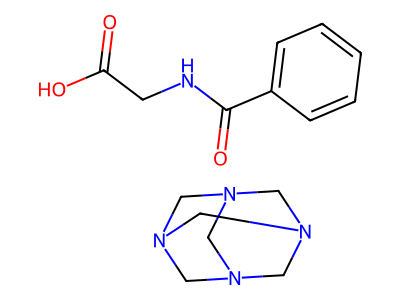
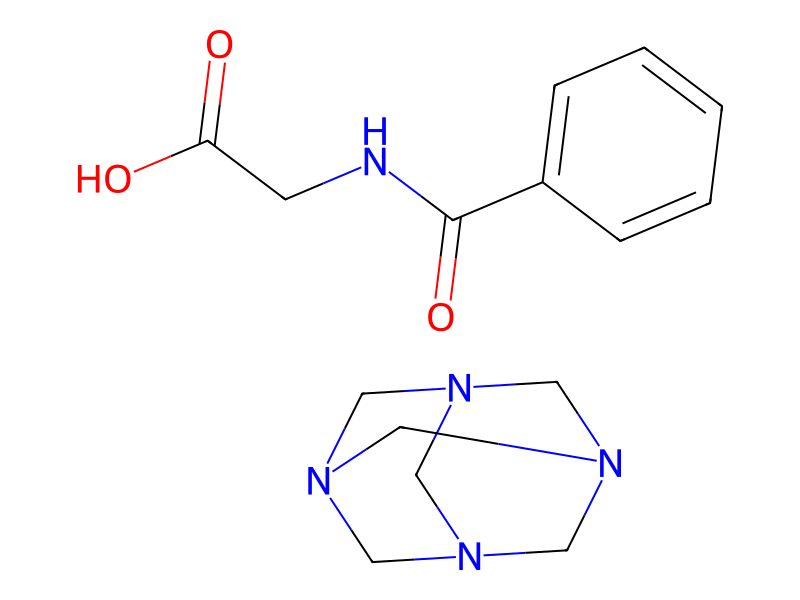
C1N2CN3CN1CN(C2)C3.O=C(O)CNC(=O)c1ccccc1
InChI
InChI=1S/C9H9NO3.C6H12N4/c11-8(12)6-10-9(13)7-4-2-1-3-5-7;1-7-2-9-4-8(1)5-10(3-7)6-9/h1-5H,6H2,(H,10,13)(H,11,12);1-6H2
Molecular Formula
C15H21N5O3
HBD / HBA
2 / 7
Rotierbare Bindungen
3
Schwere Atome
23
No targets recorded
Target interaction data is not yet available for this drug.
No interactions recorded
Drug interaction data is not yet available for this compound.
No side effects recorded
Side effect data is not yet available for this drug.
Häufig gestellte Fragen
A hippurate salt form of methenamine used to prevent recurrent urinary tract infections by releasing antibacterial formaldehyde in the bladder.
Yes, Methenamine Hippurate is an approved drug. It has reached clinical phase 4. It is classified as a Small molecule.
References & Data Sources
- ChEMBL — European Bioinformatics Institute (EBI). CHEMBL1201104. Open-access bioactivity database.
- PubChem — National Center for Biotechnology Information (NCBI). CID 21945. Chemical information database.
Data aggregated from publicly available pharmacological databases. Last updated 2026-03-28.
Medizinischer Haftungsausschluss
This content is for educational and informational purposes only. It is not a substitute for professional medical advice, diagnosis, or treatment. Always consult a qualified healthcare provider before making medication decisions.
Embed This Widget
Add the script tag and a data attribute to embed this widget.
<script src="https://cdn.jsdelivr.net/npm/drugfyi-embed@1/dist/embed.min.js" defer></script>
<div data-drugfyi="drug" data-slug="methenamine-hippurate"></div>Embed via iframe for maximum compatibility.
<iframe src="https://drugfyi.com/iframe/drug/methenamine-hippurate/" width="420" height="400" frameborder="0" style="border:0;border-radius:10px;max-width:100%" loading="lazy"></iframe>Paste this URL in WordPress, Medium, or any oEmbed-compatible platform.
https://drugfyi.com/drug/methenamine-hippurate/Add a dynamic SVG badge to your README or docs.
[](https://drugfyi.com/drug/methenamine-hippurate/)Use the native HTML custom element.
<script src="https://cdn.jsdelivr.net/npm/drugfyi-embed@1/dist/embed.min.js" defer></script>
<drugfyi-drug slug="methenamine-hippurate"></drugfyi-drug>