Talaporfin
Mono-L-aspartyl chlorin e6, known as talaporfin, is a second-generation chlorin photosensitiser used in photodynamic therapy. Illumination at 664 nm activates the accumulated compound, which generates singlet oxygen and other reactive oxygen species; these induce apoptosis and shut down the vasculature within the illuminated field, confining destruction to tissue that has been both sensitised and lit. Established applications are early-stage central lung cancer and early-stage oesophageal cancer, with investigation extending to age-related macular degeneration and benign prostatic hyperplasia. The chlorin structure absorbs near-infrared light more strongly than porphyrin photosensitisers and permits a shorter drug-to-light interval. The formula is C38H41N5O9, near 711.8 g/mol.
Talaporfin (mono-l-aspartyl chlorin e6) is a second-generation chlorin-based photosensitizer used in photodynamic therapy (PDT) for early-stage central lung cancer, early-stage esophageal cancer, and investigation in AMD and BPH. Upon activation by 664 nm red light, it generates cytotoxic singlet oxygen and reactive oxygen species that induce apoptosis and vascular shutdown in the illuminated target tissue. Its chlorin-based structure provides stronger near-infrared light absorption and shorter drug-to-light intervals than porphyrin-based photosensitizers.
Molekularmasse
711,8000 g/mol
LogP
3,50
TPSA
236,00 Ų
Lipinski-Regel der Fünf
Nicht bestanden
Therapeutische Bereiche
Wirkmechanismus
Accumulates in target tissues and generates reactive oxygen species upon activation by specific wavelengths of light, causing localized cellular damage and destruction of pathological tissue.
Pharmacokinetics (PK)
Pharmacodynamics (PD)
Accumulates in target tissues and generates reactive oxygen species upon activation by specific wavelengths of light, causing localized cellular damage and destruction of pathological tissue.
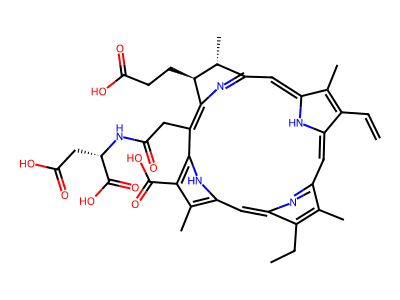
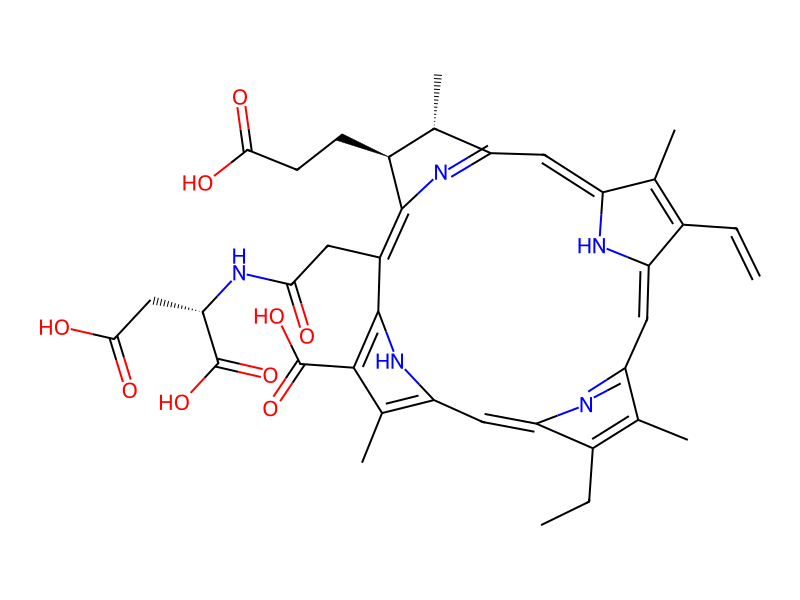
2D-Struktur
Cite this structure
Embed this structure
SMILES
C=Cc1c(C)c2cc3nc(c(CC(=O)N[C@@H](CC(=O)O)C(=O)O)c4[nH]c(cc5nc(cc1[nH]2)C(C)=C5CC)c(C)c4C(=O)O)[C@@H](CCC(=O)O)[C@@H]3C
InChI
InChI=1S/C38H41N5O9/c1-7-20-16(3)24-12-26-18(5)22(9-10-32(45)46)35(42-26)23(11-31(44)41-30(37(49)50)15-33(47)48)36-34(38(51)52)19(6)27(43-36)14-29-21(8-2)17(4)25(40-29)13-28(20)39-24/h7,12-14,18,22,30,39,43H,1,8-11,15H2,2-6H3,(H,41,44)(H,45,46)(H,47,48)(H,49,50)(H,51,52)/b24-12-,25-13-,26-12-,27-14-,28-13-,29-14-,35-23-,36-23-/t18-,22-,30-/m0/s1
Molecular Formula
C38H41N5O9
HBD / HBA
7 / 11
Rotierbare Bindungen
12
Schwere Atome
52
No targets recorded
Target interaction data is not yet available for this drug.
No interactions recorded
Drug interaction data is not yet available for this compound.
No side effects recorded
Side effect data is not yet available for this drug.
Häufig gestellte Fragen
Talaporfin (mono-l-aspartyl chlorin e6) is a second-generation chlorin-based photosensitizer used in photodynamic therapy (PDT) for early-stage central lung cancer, early-stage esophageal cancer, and investigation in AMD and BPH. Upon activation by 664 nm red light, it generates cytotoxic singlet oxygen and reactive oxygen species that induce apoptosis and vascular shutdown in the illuminated target tissue. Its chlorin-based structure provides stronger near-infrared light absorption and shorter drug-to-light intervals than porphyrin-based photosensitizers.
Accumulates in target tissues and generates reactive oxygen species upon activation by specific wavelengths of light, causing localized cellular damage and destruction of pathological tissue.
Yes, Talaporfin is an approved drug. It has reached clinical phase 4. It is classified as a Small molecule.
References & Data Sources
- ChEMBL — European Bioinformatics Institute (EBI). CHEMBL2111186. Open-access bioactivity database.
- PubChem — National Center for Biotechnology Information (NCBI). CID 5486799. Chemical information database.
Data aggregated from publicly available pharmacological databases. Last updated 2026-08-20.
Medizinischer Haftungsausschluss
This content is for educational and informational purposes only. It is not a substitute for professional medical advice, diagnosis, or treatment. Always consult a qualified healthcare provider before making medication decisions.
Embed This Widget
Add the script tag and a data attribute to embed this widget.
<script src="https://cdn.jsdelivr.net/npm/drugfyi-embed@1/dist/embed.min.js" defer></script>
<div data-drugfyi="drug" data-slug="talaporfin"></div>Embed via iframe for maximum compatibility.
<iframe src="https://drugfyi.com/iframe/drug/talaporfin/" width="420" height="400" frameborder="0" style="border:0;border-radius:10px;max-width:100%" loading="lazy"></iframe>Paste this URL in WordPress, Medium, or any oEmbed-compatible platform.
https://drugfyi.com/drug/talaporfin/Add a dynamic SVG badge to your README or docs.
[](https://drugfyi.com/drug/talaporfin/)Use the native HTML custom element.
<script src="https://cdn.jsdelivr.net/npm/drugfyi-embed@1/dist/embed.min.js" defer></script>
<drugfyi-drug slug="talaporfin"></drugfyi-drug>