Chlorpromazine
The first antipsychotic medication, introduced in the 1950s, that blocks dopamine D2 receptors and multiple other neurotransmitter receptors, used for the treatment of schizophrenia, mania, nausea, and intractable hiccups. Its discovery revolutionized psychiatry and led to the deinstitutionalization of many psychiatric patients. It carries significant risks of extrapyramidal symptoms, tardive dyskinesia, metabolic effects, and sedation.
Peso molecular
318,9000 g/mol
LogP
5,20
TPSA
31,80 Ų
Regla de cinco de Lipinski
Cumple
Áreas terapéuticas
Mecanismo de acción
Blocks dopamine D2 receptors in the mesolimbic pathway, reducing excessive dopaminergic neurotransmission associated with psychotic symptoms. Many also antagonize serotonin 5-HT2A receptors, which may improve negative symptoms and reduce extrapyramidal side effects.
Pharmacokinetics (PK)
Pharmacodynamics (PD)
Blocks dopamine D2 receptors in the mesolimbic pathway, reducing excessive dopaminergic neurotransmission associated with psychotic symptoms. Many also antagonize serotonin 5-HT2A receptors, which may improve negative symptoms and reduce extrapyramidal …
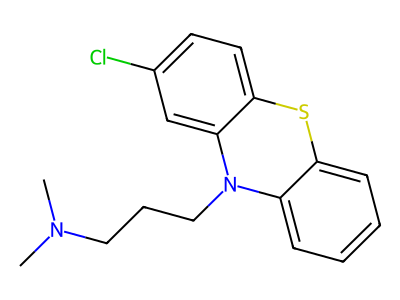
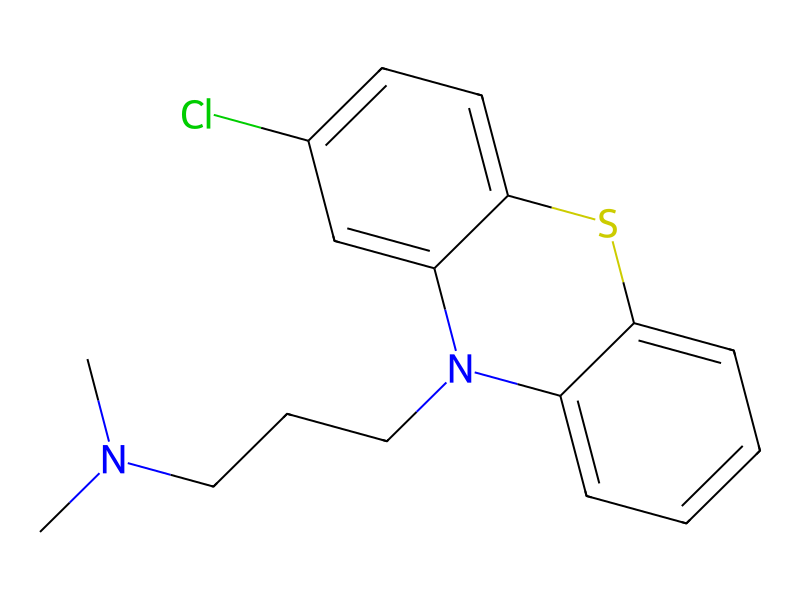
Estructura 2D
Cite this structure
Embed this structure
SMILES
CN(C)CCCN1c2ccccc2Sc2ccc(Cl)cc21
InChI
InChI=1S/C17H19ClN2S/c1-19(2)10-5-11-20-14-6-3-4-7-16(14)21-17-9-8-13(18)12-15(17)20/h3-4,6-9,12H,5,10-11H2,1-2H3
Molecular Formula
C17H19ClN2S
HBD / HBA
- / 3
Enlaces Rotables
4
Átomos Pesados
21
No targets recorded
Target interaction data is not yet available for this drug.
No interactions recorded
Drug interaction data is not yet available for this compound.
No side effects recorded
Side effect data is not yet available for this drug.
Preguntas frecuentes
The first antipsychotic medication, introduced in the 1950s, that blocks dopamine D2 receptors and multiple other neurotransmitter receptors, used for the treatment of schizophrenia, mania, nausea, and intractable hiccups. Its discovery revolutionized psychiatry and led to the deinstitutionalization of many psychiatric patients. It carries significant risks of extrapyramidal symptoms, tardive dyskinesia, metabolic effects, and sedation.
Blocks dopamine D2 receptors in the mesolimbic pathway, reducing excessive dopaminergic neurotransmission associated with psychotic symptoms. Many also antagonize serotonin 5-HT2A receptors, which may improve negative symptoms and reduce extrapyramidal side effects.
Yes, Chlorpromazine is an approved drug. It has reached clinical phase 4. It is classified as a Small molecule.
References & Data Sources
- ChEMBL — European Bioinformatics Institute (EBI). CHEMBL71. Open-access bioactivity database.
- PubChem — National Center for Biotechnology Information (NCBI). CID 2726. Chemical information database.
Data aggregated from publicly available pharmacological databases. Last updated 2026-03-04.
Embed This Widget
Add the script tag and a data attribute to embed this widget.
<script src="https://cdn.jsdelivr.net/npm/drugfyi-embed@1/dist/embed.min.js" defer></script>
<div data-drugfyi="drug" data-slug="chlorpromazine"></div>Embed via iframe for maximum compatibility.
<iframe src="https://drugfyi.com/iframe/drug/chlorpromazine/" width="420" height="400" frameborder="0" style="border:0;border-radius:10px;max-width:100%" loading="lazy"></iframe>Paste this URL in WordPress, Medium, or any oEmbed-compatible platform.
https://drugfyi.com/drug/chlorpromazine/Add a dynamic SVG badge to your README or docs.
<a href="https://drugfyi.com/drug/chlorpromazine/" rel="nofollow noopener"><img src="https://drugfyi.com/badge/entity/chlorpromazine.svg" alt="DrugFYI"></a>Use the native HTML custom element.
<script src="https://cdn.jsdelivr.net/npm/drugfyi-embed@1/dist/embed.min.js" defer></script>
<drugfyi-drug slug="chlorpromazine"></drugfyi-drug>