Disulfiram
A medication used as a deterrent in the treatment of alcoholism by causing an extremely unpleasant reaction (flushing, nausea, vomiting, palpitations, and hypotension) when alcohol is consumed while taking it. It works by inhibiting aldehyde dehydrogenase, causing accumulation of toxic acetaldehyde when alcohol is metabolized. It requires patient motivation and should only be used in fully abstinent patients who understand the consequences of drinking.
Peso molecular
296,5000 g/mol
LogP
3,90
TPSA
121,00 Ų
Regla de cinco de Lipinski
Cumple
Pharmacokinetics (PK)
Pharmacodynamics (PD)
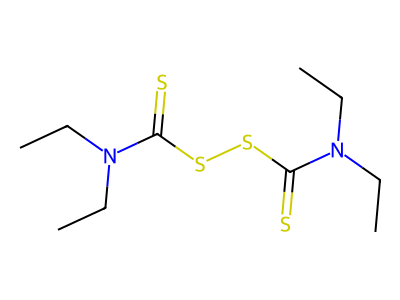
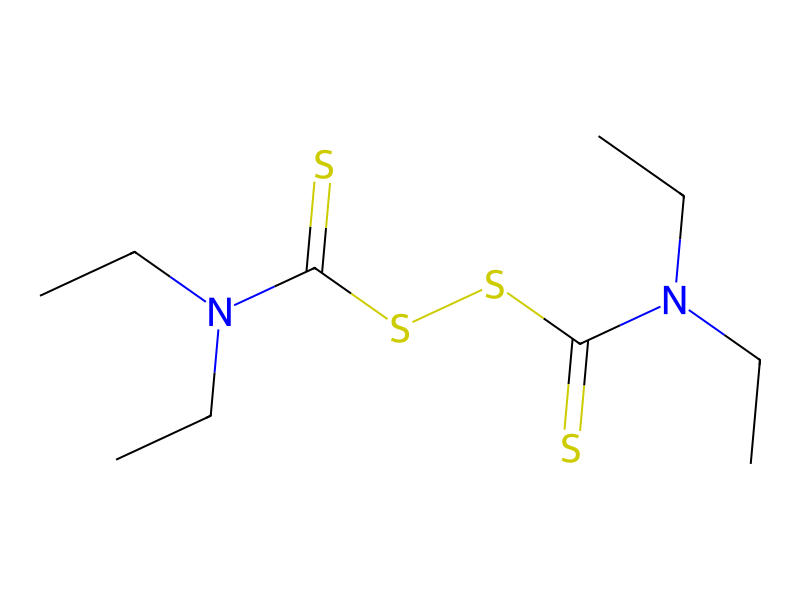
Estructura 2D
Cite this structure
Embed this structure
SMILES
CCN(CC)C(=S)SSC(=S)N(CC)CC
InChI
InChI=1S/C10H20N2S4/c1-5-11(6-2)9(13)15-16-10(14)12(7-3)8-4/h5-8H2,1-4H3
Molecular Formula
C10H20N2S4
HBD / HBA
- / 4
Enlaces Rotables
7
Átomos Pesados
16
No targets recorded
Target interaction data is not yet available for this drug.
No interactions recorded
Drug interaction data is not yet available for this compound.
No side effects recorded
Side effect data is not yet available for this drug.
Preguntas frecuentes
A medication used as a deterrent in the treatment of alcoholism by causing an extremely unpleasant reaction (flushing, nausea, vomiting, palpitations, and hypotension) when alcohol is consumed while taking it. It works by inhibiting aldehyde dehydrogenase, causing accumulation of toxic acetaldehyde when alcohol is metabolized. It requires patient motivation and should only be used in fully abstinent patients who understand the consequences of drinking.
Yes, Disulfiram is an approved drug. It has reached clinical phase 4. It is classified as a Small molecule.
References & Data Sources
- ChEMBL — European Bioinformatics Institute (EBI). CHEMBL964. Open-access bioactivity database.
- PubChem — National Center for Biotechnology Information (NCBI). CID 3117. Chemical information database.
Data aggregated from publicly available pharmacological databases. Last updated 2026-03-04.
Embed This Widget
Add the script tag and a data attribute to embed this widget.
<script src="https://cdn.jsdelivr.net/npm/drugfyi-embed@1/dist/embed.min.js" defer></script>
<div data-drugfyi="drug" data-slug="disulfiram"></div>Embed via iframe for maximum compatibility.
<iframe src="https://drugfyi.com/iframe/drug/disulfiram/" width="420" height="400" frameborder="0" style="border:0;border-radius:10px;max-width:100%" loading="lazy"></iframe>Paste this URL in WordPress, Medium, or any oEmbed-compatible platform.
https://drugfyi.com/drug/disulfiram/Add a dynamic SVG badge to your README or docs.
<a href="https://drugfyi.com/drug/disulfiram/" rel="nofollow noopener"><img src="https://drugfyi.com/badge/entity/disulfiram.svg" alt="DrugFYI"></a>Use the native HTML custom element.
<script src="https://cdn.jsdelivr.net/npm/drugfyi-embed@1/dist/embed.min.js" defer></script>
<drugfyi-drug slug="disulfiram"></drugfyi-drug>