Ioxitalamic Acid
This iodinated contrast medium was used to enhance X-ray visualization of body structures, particularly the urinary tract. Like other ionic contrast agents of its era, it has been largely replaced by safer nonionic alternatives.
Peso molecular
643,9400 g/mol
LogP
1,20
TPSA
116,00 Ų
Regla de cinco de Lipinski
Cumple
Áreas terapéuticas
Mecanismo de acción
Enhances the contrast of specific tissues or structures during medical imaging procedures by altering the local signal intensity or X-ray absorption characteristics.
Pharmacokinetics (PK)
Pharmacodynamics (PD)
Enhances the contrast of specific tissues or structures during medical imaging procedures by altering the local signal intensity or X-ray absorption characteristics.
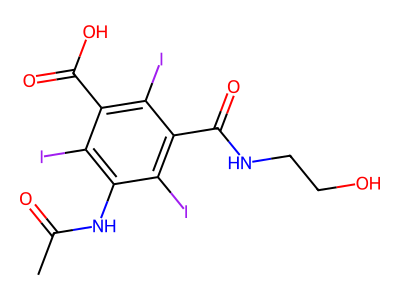
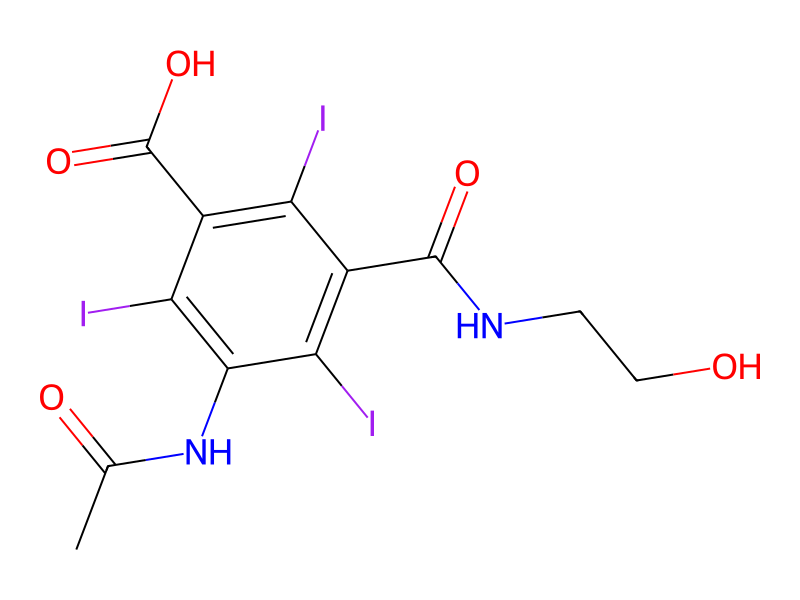
Estructura 2D
Cite this structure
Embed this structure
SMILES
CC(=O)Nc1c(I)c(C(=O)O)c(I)c(C(=O)NCCO)c1I
InChI
InChI=1S/C12H11I3N2O5/c1-4(19)17-10-8(14)5(11(20)16-2-3-18)7(13)6(9(10)15)12(21)22/h18H,2-3H2,1H3,(H,16,20)(H,17,19)(H,21,22)
Molecular Formula
C12H11I3N2O5
HBD / HBA
4 / 5
Enlaces Rotables
5
Átomos Pesados
22
No targets recorded
Target interaction data is not yet available for this drug.
No interactions recorded
Drug interaction data is not yet available for this compound.
No side effects recorded
Side effect data is not yet available for this drug.
Preguntas frecuentes
This iodinated contrast medium was used to enhance X-ray visualization of body structures, particularly the urinary tract. Like other ionic contrast agents of its era, it has been largely replaced by safer nonionic alternatives.
Enhances the contrast of specific tissues or structures during medical imaging procedures by altering the local signal intensity or X-ray absorption characteristics.
Yes, Ioxitalamic Acid is an approved drug. It has reached clinical phase 4. It is classified as a Small molecule.
References & Data Sources
- ChEMBL — European Bioinformatics Institute (EBI). CHEMBL2107239. Open-access bioactivity database.
- PubChem — National Center for Biotechnology Information (NCBI). CID 34536. Chemical information database.
Data aggregated from publicly available pharmacological databases. Last updated 2026-03-04.
Embed This Widget
Add the script tag and a data attribute to embed this widget.
<script src="https://cdn.jsdelivr.net/npm/drugfyi-embed@1/dist/embed.min.js" defer></script>
<div data-drugfyi="drug" data-slug="ioxitalamic-acid"></div>Embed via iframe for maximum compatibility.
<iframe src="https://drugfyi.com/iframe/drug/ioxitalamic-acid/" width="420" height="400" frameborder="0" style="border:0;border-radius:10px;max-width:100%" loading="lazy"></iframe>Paste this URL in WordPress, Medium, or any oEmbed-compatible platform.
https://drugfyi.com/drug/ioxitalamic-acid/Add a dynamic SVG badge to your README or docs.
<a href="https://drugfyi.com/drug/ioxitalamic-acid/" rel="nofollow noopener"><img src="https://drugfyi.com/badge/entity/ioxitalamic-acid.svg" alt="DrugFYI"></a>Use the native HTML custom element.
<script src="https://cdn.jsdelivr.net/npm/drugfyi-embed@1/dist/embed.min.js" defer></script>
<drugfyi-drug slug="ioxitalamic-acid"></drugfyi-drug>