Azithromycin
A defining feature of azithromycin is how long it lingers in the body. This macrolide antibiotic binds the bacterial 50S ribosomal subunit, halting the protein synthesis that microbes require to grow, and it concentrates heavily inside tissues and immune cells. Its half-life of roughly 68 hours allows short courses and once-daily dosing while sustaining activity for days after the last dose. It treats respiratory, skin, and sexually transmitted infections, among others. A large macrolide molecule (C38H72N2O12) built on an azalide ring system, it selectively targets the bacterial ribosome, which differs from its human counterpart. That difference underlies its favorable balance of antibacterial reach and tolerability. Azithromycin is an approved agent widely relied upon for community-acquired infections.
A macrolide antibiotic that inhibits bacterial protein synthesis by binding to the 50S ribosomal subunit, effective against a wide range of respiratory, skin, and sexually transmitted infections. Its long half-life allows short-course and once-daily dosing.
Masse moléculaire
748,9840 g/mol
LogP
4,00
TPSA
180,00 Ų
Règle des 5 de Lipinski
Non conforme
Aires thérapeutiques
Classes de médicaments
Mécanisme d'action
Binds 50S ribosomal subunit, inhibiting bacterial protein synthesis.
Pharmacokinetics (PK)
Pharmacodynamics (PD)
Binds 50S ribosomal subunit, inhibiting bacterial protein synthesis.
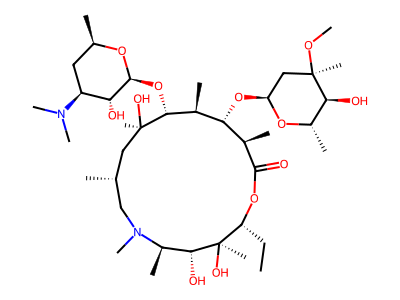
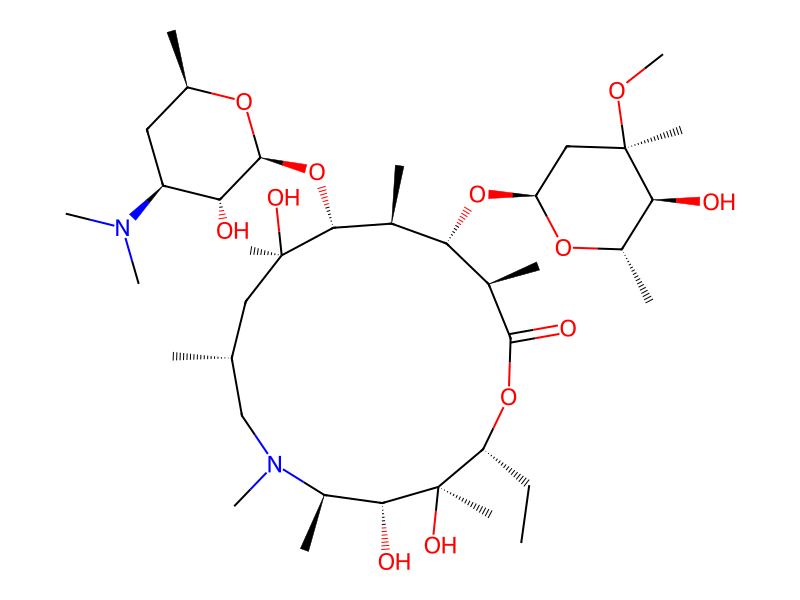
Structure 2D
Cite this structure
Embed this structure
SMILES
CC[C@H]1OC(=O)[C@H](C)[C@@H](O[C@H]2C[C@@](C)(OC)[C@@H](O)[C@H](C)O2)[C@H](C)[C@@H](O[C@@H]2O[C@H](C)C[C@H](N(C)C)[C@H]2O)[C@](C)(O)C[C@@H](C)CN(C)[C@H](C)[C@@H](O)[C@]1(C)O
InChI
InChI=1S/C38H72N2O12/c1-15-27-38(10,46)31(42)24(6)40(13)19-20(2)17-36(8,45)33(52-35-29(41)26(39(11)12)16-21(3)48-35)22(4)30(23(5)34(44)50-27)51-28-18-37(9,47-14)32(43)25(7)49-28/h20-33,35,41-43,45-46H,15-19H2,1-14H3/t20-,21-,22+,23-,24-,25+,26+,27-,28+,29-,30+,31-,32+,33-,35+,36-,37-,38-/m1/s1
Molecular Formula
C38H72N2O12
HBD / HBA
5 / 14
Liaisons Rotatives
7
Atomes Lourds
52
No targets recorded
Target interaction data is not yet available for this drug.
Both azithromycin and hydroxychloroquine independently prolong the cardiac QT interval; concurrent use substantially raises the risk of torsades de pointes and sudden cardiac death.
Azithromycin and ondansetron both prolong the cardiac QT interval; their combination substantially increases the risk of torsades de pointes.
Azithromycin and escitalopram each prolong the QT interval; co-administration meaningfully increases the risk of torsades de pointes.
Azithromycin and quetiapine both prolong the QT interval via hERG blockade; concurrent use significantly increases the risk of life-threatening arrhythmias.
Both azithromycin and ciprofloxacin prolong the QT interval; concurrent or overlapping use significantly increases torsades de pointes risk.
Azithromycin is a weak CYP3A4 inhibitor that can modestly raise loratadine plasma levels; the clinical impact is minimal given loratadine's wide therapeutic index and low cardiac risk.
Azithromycin inhibits P-glycoprotein and CYP3A4-mediated metabolism of colchicine, increasing colchicine plasma concentrations and the risk of colchicine toxicity, including neuromuscular and gastrointestinal toxicity.
Azithromycin can potentiate the anticoagulant effect of warfarin, leading to elevated INR and increased bleeding risk during and shortly after the antibiotic course.
Azithromycin may interact modestly with adalimumab-treated patients through immunomodulatory properties, though direct pharmacokinetic interaction is minimal and the combination is used routinely in clinical practice.
Azithromycin inhibits CYP3A4-mediated aripiprazole metabolism, potentially increasing aripiprazole exposure; both drugs have modest QT-prolonging effects.
No side effects recorded
Side effect data is not yet available for this drug.
Foire aux questions
A macrolide antibiotic that inhibits bacterial protein synthesis by binding to the 50S ribosomal subunit, effective against a wide range of respiratory, skin, and sexually transmitted infections. Its long half-life allows short-course and once-daily dosing.
Binds 50S ribosomal subunit, inhibiting bacterial protein synthesis.
Key pharmacokinetic parameters for Azithromycin: Half-life: 68 hours.
Yes, Azithromycin is an approved drug. It has reached clinical phase 4. It is classified as a Small molecule.
Related Drugs
References & Data Sources
- ChEMBL — European Bioinformatics Institute (EBI). CHEMBL529. Open-access bioactivity database.
- PubChem — National Center for Biotechnology Information (NCBI). CID 447043. Chemical information database.
Data aggregated from publicly available pharmacological databases. Last updated 2026-03-04.
Embed This Widget
Add the script tag and a data attribute to embed this widget.
<script src="https://cdn.jsdelivr.net/npm/drugfyi-embed@1/dist/embed.min.js" defer></script>
<div data-drugfyi="drug" data-slug="azithromycin"></div>Embed via iframe for maximum compatibility.
<iframe src="https://drugfyi.com/iframe/drug/azithromycin/" width="420" height="400" frameborder="0" style="border:0;border-radius:10px;max-width:100%" loading="lazy"></iframe>Paste this URL in WordPress, Medium, or any oEmbed-compatible platform.
https://drugfyi.com/drug/azithromycin/Add a dynamic SVG badge to your README or docs.
[](https://drugfyi.com/drug/azithromycin/)Use the native HTML custom element.
<script src="https://cdn.jsdelivr.net/npm/drugfyi-embed@1/dist/embed.min.js" defer></script>
<drugfyi-drug slug="azithromycin"></drugfyi-drug>