Dihydrocodeine
Roughly twice the potency of codeine characterises dihydrocodeine, a semi-synthetic opioid used for moderate to severe pain and as a cough suppressant. Its activity arises at mu, kappa and delta opioid receptors, G-protein-coupled receptors whose activation inhibits transmission of pain signals and modifies the affective response to pain. As with codeine, part of the analgesic effect follows partial metabolic conversion to morphine, so individual response varies with that conversion. The opioid class hazards apply in full: dependence, constipation and respiratory depression. The compound is a small molecule with the formula C18H23NO3 and a molecular weight of about 301.4 g/mol, approved and developed through the final clinical phase.
A semi-synthetic opioid analgesic approximately twice as potent as codeine, used to treat moderate to severe pain and as a cough suppressant. Like codeine, part of its effects are due to partial conversion to morphine in the body. It carries the same risks of dependence, constipation, and respiratory depression as other opioids.
Masse moléculaire
301,4000 g/mol
LogP
2,20
TPSA
41,90 Ų
Règle des 5 de Lipinski
Conforme
Aires thérapeutiques
Mécanisme d'action
Binds to mu (μ), kappa (κ), and/or delta (δ) opioid receptors in the central and peripheral nervous system, mimicking endogenous endorphins. Activation of these G-protein-coupled receptors inhibits pain signal transmission and modulates the emotional response to pain.
Pharmacokinetics (PK)
Pharmacodynamics (PD)
Binds to mu (μ), kappa (κ), and/or delta (δ) opioid receptors in the central and peripheral nervous system, mimicking endogenous endorphins. Activation of these G-protein-coupled receptors inhibits pain signal transmission …
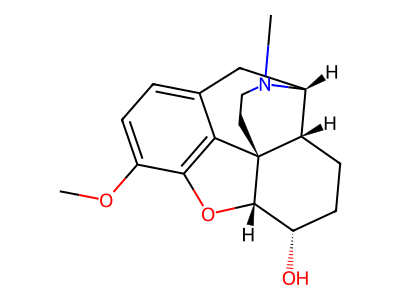
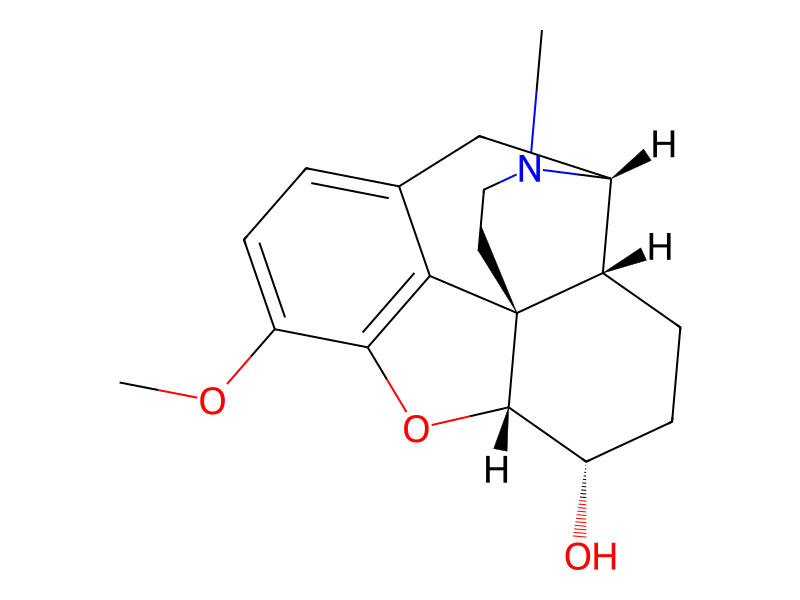
Structure 2D
Cite this structure
Embed this structure
SMILES
COc1ccc2c3c1O[C@H]1[C@@H](O)CC[C@H]4[C@@H](C2)N(C)CC[C@@]341
InChI
InChI=1S/C18H23NO3/c1-19-8-7-18-11-4-5-13(20)17(18)22-16-14(21-2)6-3-10(15(16)18)9-12(11)19/h3,6,11-13,17,20H,4-5,7-9H2,1-2H3/t11-,12+,13-,17-,18-/m0/s1
Molecular Formula
C18H23NO3
HBD / HBA
1 / 4
Liaisons Rotatives
1
Atomes Lourds
22
No targets recorded
Target interaction data is not yet available for this drug.
No interactions recorded
Drug interaction data is not yet available for this compound.
No side effects recorded
Side effect data is not yet available for this drug.
Foire aux questions
A semi-synthetic opioid analgesic approximately twice as potent as codeine, used to treat moderate to severe pain and as a cough suppressant. Like codeine, part of its effects are due to partial conversion to morphine in the body. It carries the same risks of dependence, constipation, and respiratory depression as other opioids.
Binds to mu (μ), kappa (κ), and/or delta (δ) opioid receptors in the central and peripheral nervous system, mimicking endogenous endorphins. Activation of these G-protein-coupled receptors inhibits pain signal transmission and modulates the emotional response to pain.
Yes, Dihydrocodeine is an approved drug. It has reached clinical phase 4. It is classified as a Small molecule.
References & Data Sources
- ChEMBL — European Bioinformatics Institute (EBI). CHEMBL1595. Open-access bioactivity database.
- PubChem — National Center for Biotechnology Information (NCBI). CID 5284543. Chemical information database.
Data aggregated from publicly available pharmacological databases. Last updated 2026-08-20.
Embed This Widget
Add the script tag and a data attribute to embed this widget.
<script src="https://cdn.jsdelivr.net/npm/drugfyi-embed@1/dist/embed.min.js" defer></script>
<div data-drugfyi="drug" data-slug="dihydrocodeine"></div>Embed via iframe for maximum compatibility.
<iframe src="https://drugfyi.com/iframe/drug/dihydrocodeine/" width="420" height="400" frameborder="0" style="border:0;border-radius:10px;max-width:100%" loading="lazy"></iframe>Paste this URL in WordPress, Medium, or any oEmbed-compatible platform.
https://drugfyi.com/drug/dihydrocodeine/Add a dynamic SVG badge to your README or docs.
[](https://drugfyi.com/drug/dihydrocodeine/)Use the native HTML custom element.
<script src="https://cdn.jsdelivr.net/npm/drugfyi-embed@1/dist/embed.min.js" defer></script>
<drugfyi-drug slug="dihydrocodeine"></drugfyi-drug>