Diphenoxylate
An opioid-related antidiarrheal agent used to reduce intestinal motility and treat acute and chronic diarrhea. It is combined with a small amount of atropine in commercial preparations (e.g., Lomotil) to discourage abuse, as the atropine causes unpleasant effects if large doses are taken. At recommended doses, very little is absorbed systemically.
Masse moléculaire
452,6000 g/mol
LogP
5,70
TPSA
53,30 Ų
Règle des 5 de Lipinski
Conforme
Aires thérapeutiques
Mécanisme d'action
Binds to mu (μ), kappa (κ), and/or delta (δ) opioid receptors in the central and peripheral nervous system, mimicking endogenous endorphins. Activation of these G-protein-coupled receptors inhibits pain signal transmission and modulates the emotional response to pain.
Pharmacokinetics (PK)
Pharmacodynamics (PD)
Binds to mu (μ), kappa (κ), and/or delta (δ) opioid receptors in the central and peripheral nervous system, mimicking endogenous endorphins. Activation of these G-protein-coupled receptors inhibits pain signal transmission …
Structure 2D
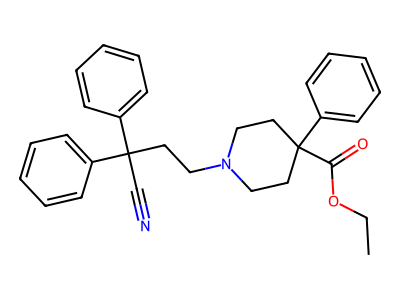
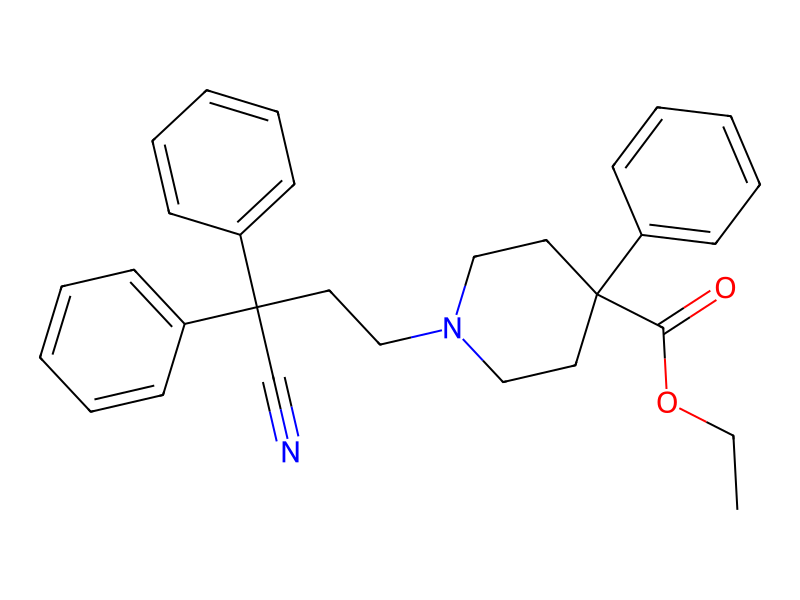
Cite this structure
Embed this structure
SMILES
CCOC(=O)C1(c2ccccc2)CCN(CCC(C#N)(c2ccccc2)c2ccccc2)CC1
InChI
InChI=1S/C30H32N2O2/c1-2-34-28(33)29(25-12-6-3-7-13-25)18-21-32(22-19-29)23-20-30(24-31,26-14-8-4-9-15-26)27-16-10-5-11-17-27/h3-17H,2,18-23H2,1H3
Molecular Formula
C30H32N2O2
HBD / HBA
- / 4
Liaisons Rotatives
9
Atomes Lourds
34
No targets recorded
Target interaction data is not yet available for this drug.
No interactions recorded
Drug interaction data is not yet available for this compound.
No side effects recorded
Side effect data is not yet available for this drug.
Foire aux questions
An opioid-related antidiarrheal agent used to reduce intestinal motility and treat acute and chronic diarrhea. It is combined with a small amount of atropine in commercial preparations (e.g., Lomotil) to discourage abuse, as the atropine causes unpleasant effects if large doses are taken. At recommended doses, very little is absorbed systemically.
Binds to mu (μ), kappa (κ), and/or delta (δ) opioid receptors in the central and peripheral nervous system, mimicking endogenous endorphins. Activation of these G-protein-coupled receptors inhibits pain signal transmission and modulates the emotional response to pain.
Yes, Diphenoxylate is an approved drug. It has reached clinical phase 4. It is classified as a Small molecule.
References & Data Sources
- ChEMBL — European Bioinformatics Institute (EBI). CHEMBL1201294. Open-access bioactivity database.
- PubChem — National Center for Biotechnology Information (NCBI). CID 13505. Chemical information database.
Data aggregated from publicly available pharmacological databases. Last updated 2026-03-04.
Embed This Widget
Add the script tag and a data attribute to embed this widget.
<script src="https://cdn.jsdelivr.net/npm/drugfyi-embed@1/dist/embed.min.js" defer></script>
<div data-drugfyi="drug" data-slug="diphenoxylate"></div>Embed via iframe for maximum compatibility.
<iframe src="https://drugfyi.com/iframe/drug/diphenoxylate/" width="420" height="400" frameborder="0" style="border:0;border-radius:10px;max-width:100%" loading="lazy"></iframe>Paste this URL in WordPress, Medium, or any oEmbed-compatible platform.
https://drugfyi.com/drug/diphenoxylate/Add a dynamic SVG badge to your README or docs.
[](https://drugfyi.com/drug/diphenoxylate/)Use the native HTML custom element.
<script src="https://cdn.jsdelivr.net/npm/drugfyi-embed@1/dist/embed.min.js" defer></script>
<drugfyi-drug slug="diphenoxylate"></drugfyi-drug>