Infigratinib
This oral fibroblast growth factor receptor (FGFR) inhibitor is used to treat FGFR2 fusion-positive, locally advanced or metastatic intrahepatic cholangiocarcinoma (bile duct cancer). It works by blocking FGFR2 signaling that drives tumor cell proliferation in patients with specific genetic alterations. Hyperphosphatemia (elevated blood phosphate) is a common side effect due to FGFR1 inhibition.
Masse moléculaire
560,5000 g/mol
LogP
4,70
TPSA
95,10 Ų
Règle des 5 de Lipinski
Conforme
Aires thérapeutiques
Pharmacokinetics (PK)
Pharmacodynamics (PD)
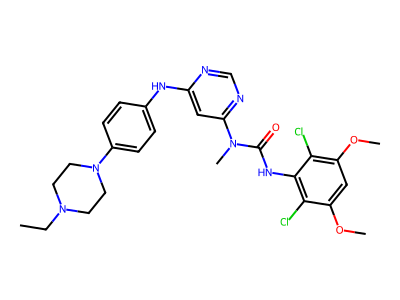
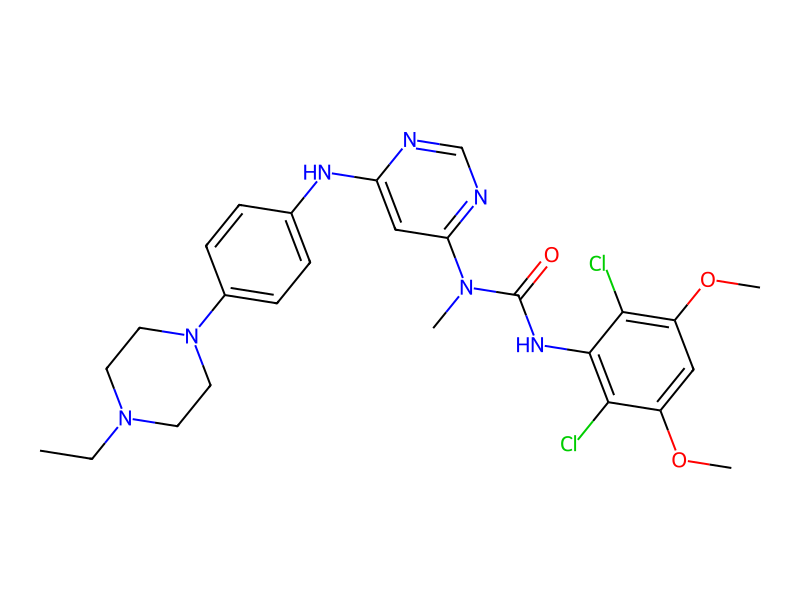
Structure 2D
Cite this structure
Embed this structure
SMILES
CCN1CCN(c2ccc(Nc3cc(N(C)C(=O)Nc4c(Cl)c(OC)cc(OC)c4Cl)ncn3)cc2)CC1
InChI
InChI=1S/C26H31Cl2N7O3/c1-5-34-10-12-35(13-11-34)18-8-6-17(7-9-18)31-21-15-22(30-16-29-21)33(2)26(36)32-25-23(27)19(37-3)14-20(38-4)24(25)28/h6-9,14-16H,5,10-13H2,1-4H3,(H,32,36)(H,29,30,31)
Molecular Formula
C26H31Cl2N7O3
HBD / HBA
2 / 8
Liaisons Rotatives
8
Atomes Lourds
38
No targets recorded
Target interaction data is not yet available for this drug.
No interactions recorded
Drug interaction data is not yet available for this compound.
No side effects recorded
Side effect data is not yet available for this drug.
Foire aux questions
This oral fibroblast growth factor receptor (FGFR) inhibitor is used to treat FGFR2 fusion-positive, locally advanced or metastatic intrahepatic cholangiocarcinoma (bile duct cancer). It works by blocking FGFR2 signaling that drives tumor cell proliferation in patients with specific genetic alterations. Hyperphosphatemia (elevated blood phosphate) is a common side effect due to FGFR1 inhibition.
Yes, Infigratinib is an approved drug. It has reached clinical phase 4. It is classified as a Small molecule.
References & Data Sources
- ChEMBL — European Bioinformatics Institute (EBI). CHEMBL1852688. Open-access bioactivity database.
- PubChem — National Center for Biotechnology Information (NCBI). CID 53235510. Chemical information database.
Data aggregated from publicly available pharmacological databases. Last updated 2026-03-04.
Embed This Widget
Add the script tag and a data attribute to embed this widget.
<script src="https://cdn.jsdelivr.net/npm/drugfyi-embed@1/dist/embed.min.js" defer></script>
<div data-drugfyi="drug" data-slug="infigratinib"></div>Embed via iframe for maximum compatibility.
<iframe src="https://drugfyi.com/iframe/drug/infigratinib/" width="420" height="400" frameborder="0" style="border:0;border-radius:10px;max-width:100%" loading="lazy"></iframe>Paste this URL in WordPress, Medium, or any oEmbed-compatible platform.
https://drugfyi.com/drug/infigratinib/Add a dynamic SVG badge to your README or docs.
[](https://drugfyi.com/drug/infigratinib/)Use the native HTML custom element.
<script src="https://cdn.jsdelivr.net/npm/drugfyi-embed@1/dist/embed.min.js" defer></script>
<drugfyi-drug slug="infigratinib"></drugfyi-drug>