Methylhomatropine
This antimuscarinic agent acts similarly to atropine but with some differences in potency and selectivity, used historically in eye drops to dilate pupils and in gastrointestinal preparations to reduce spasm and secretions. It blocks the neurotransmitter acetylcholine at muscarinic receptors.
Aires thérapeutiques
Mécanisme d'action
Competitively blocks muscarinic acetylcholine receptors, reducing parasympathetic nervous system activity. Effects include decreased secretions, bronchodilation, and relaxation of smooth muscle.
Pharmacokinetics (PK)
Pharmacodynamics (PD)
Competitively blocks muscarinic acetylcholine receptors, reducing parasympathetic nervous system activity. Effects include decreased secretions, bronchodilation, and relaxation of smooth muscle.
Structure 2D
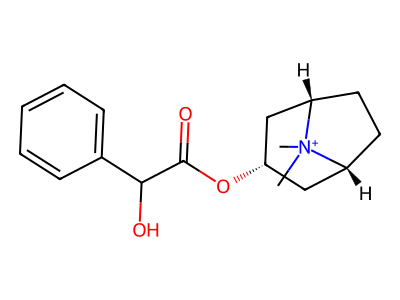
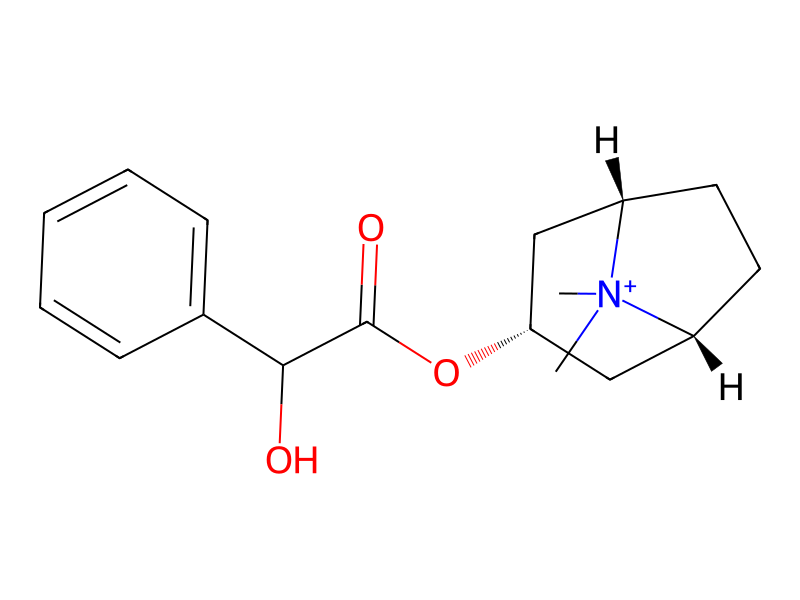
Cite this structure
Embed this structure
SMILES
C[N+]1(C)[C@@H]2CC[C@H]1C[C@@H](OC(=O)C(O)c1ccccc1)C2
InChI
InChI=1S/C17H24NO3/c1-18(2)13-8-9-14(18)11-15(10-13)21-17(20)16(19)12-6-4-3-5-7-12/h3-7,13-16,19H,8-11H2,1-2H3/q+1/t13-,14+,15+,16?
HBD / HBA
- / -
No targets recorded
Target interaction data is not yet available for this drug.
No interactions recorded
Drug interaction data is not yet available for this compound.
No side effects recorded
Side effect data is not yet available for this drug.
Foire aux questions
This antimuscarinic agent acts similarly to atropine but with some differences in potency and selectivity, used historically in eye drops to dilate pupils and in gastrointestinal preparations to reduce spasm and secretions. It blocks the neurotransmitter acetylcholine at muscarinic receptors.
Competitively blocks muscarinic acetylcholine receptors, reducing parasympathetic nervous system activity. Effects include decreased secretions, bronchodilation, and relaxation of smooth muscle.
Yes, Methylhomatropine is an approved drug. It has reached clinical phase 4. It is classified as a Small molecule.
References & Data Sources
- ChEMBL — European Bioinformatics Institute (EBI). CHEMBL1201235. Open-access bioactivity database.
Data aggregated from publicly available pharmacological databases. Last updated 2026-02-27.
Embed This Widget
Add the script tag and a data attribute to embed this widget.
<script src="https://cdn.jsdelivr.net/npm/drugfyi-embed@1/dist/embed.min.js" defer></script>
<div data-drugfyi="drug" data-slug="methylhomatropine"></div>Embed via iframe for maximum compatibility.
<iframe src="https://drugfyi.com/iframe/drug/methylhomatropine/" width="420" height="400" frameborder="0" style="border:0;border-radius:10px;max-width:100%" loading="lazy"></iframe>Paste this URL in WordPress, Medium, or any oEmbed-compatible platform.
https://drugfyi.com/drug/methylhomatropine/Add a dynamic SVG badge to your README or docs.
[](https://drugfyi.com/drug/methylhomatropine/)Use the native HTML custom element.
<script src="https://cdn.jsdelivr.net/npm/drugfyi-embed@1/dist/embed.min.js" defer></script>
<drugfyi-drug slug="methylhomatropine"></drugfyi-drug>