Sorivudine
Sorivudine is a nucleoside analog with potent antiviral activity against varicella-zoster virus (VZV) and Epstein-Barr virus, used for the treatment of herpes zoster (shingles) and investigated in breast cancer patients with herpes complications. It is phosphorylated by viral thymidine kinase to its active triphosphate form, which selectively inhibits viral DNA polymerase and terminates viral DNA chain elongation. A severe drug interaction with fluorouracil-based chemotherapy limits its use in cancer patients.
Masse moléculaire
349,1300 g/mol
LogP
-0,90
TPSA
119,00 Ų
Règle des 5 de Lipinski
Conforme
Aires thérapeutiques
Mécanisme d'action
Functions as a nucleoside analog that is incorporated into viral or cellular DNA/RNA during replication, causing chain termination or coding errors that inhibit pathogen proliferation.
Pharmacokinetics (PK)
Pharmacodynamics (PD)
Functions as a nucleoside analog that is incorporated into viral or cellular DNA/RNA during replication, causing chain termination or coding errors that inhibit pathogen proliferation.
Structure 2D
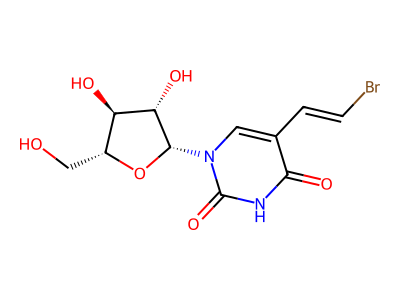
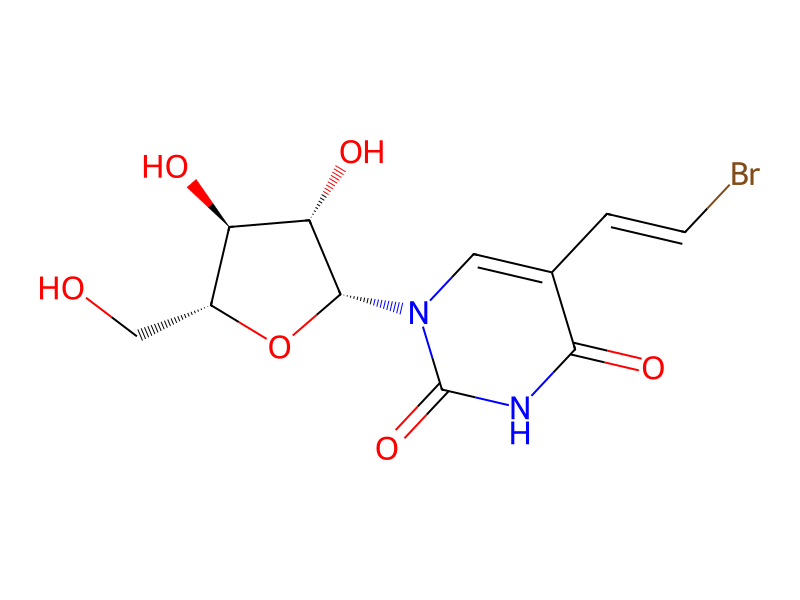
Cite this structure
Embed this structure
SMILES
O=c1[nH]c(=O)n([C@@H]2O[C@H](CO)[C@@H](O)[C@@H]2O)cc1/C=C/Br
InChI
InChI=1S/C11H13BrN2O6/c12-2-1-5-3-14(11(19)13-9(5)18)10-8(17)7(16)6(4-15)20-10/h1-3,6-8,10,15-17H,4H2,(H,13,18,19)/b2-1+/t6-,7-,8+,10-/m1/s1
Molecular Formula
C11H13BrN2O6
HBD / HBA
4 / 6
Liaisons Rotatives
3
Atomes Lourds
20
No targets recorded
Target interaction data is not yet available for this drug.
No interactions recorded
Drug interaction data is not yet available for this compound.
No side effects recorded
Side effect data is not yet available for this drug.
Foire aux questions
Sorivudine is a nucleoside analog with potent antiviral activity against varicella-zoster virus (VZV) and Epstein-Barr virus, used for the treatment of herpes zoster (shingles) and investigated in breast cancer patients with herpes complications. It is phosphorylated by viral thymidine kinase to its active triphosphate form, which selectively inhibits viral DNA polymerase and terminates viral DNA chain elongation. A severe drug interaction with fluorouracil-based chemotherapy limits its use in cancer patients.
Functions as a nucleoside analog that is incorporated into viral or cellular DNA/RNA during replication, causing chain termination or coding errors that inhibit pathogen proliferation.
Yes, Sorivudine is an approved drug. It has reached clinical phase 4. It is classified as a Small molecule.
References & Data Sources
- ChEMBL — European Bioinformatics Institute (EBI). CHEMBL70046. Open-access bioactivity database.
- PubChem — National Center for Biotechnology Information (NCBI). CID 5282192. Chemical information database.
Data aggregated from publicly available pharmacological databases. Last updated 2026-03-28.
Embed This Widget
Add the script tag and a data attribute to embed this widget.
<script src="https://cdn.jsdelivr.net/npm/drugfyi-embed@1/dist/embed.min.js" defer></script>
<div data-drugfyi="drug" data-slug="sorivudine"></div>Embed via iframe for maximum compatibility.
<iframe src="https://drugfyi.com/iframe/drug/sorivudine/" width="420" height="400" frameborder="0" style="border:0;border-radius:10px;max-width:100%" loading="lazy"></iframe>Paste this URL in WordPress, Medium, or any oEmbed-compatible platform.
https://drugfyi.com/drug/sorivudine/Add a dynamic SVG badge to your README or docs.
[](https://drugfyi.com/drug/sorivudine/)Use the native HTML custom element.
<script src="https://cdn.jsdelivr.net/npm/drugfyi-embed@1/dist/embed.min.js" defer></script>
<drugfyi-drug slug="sorivudine"></drugfyi-drug>