Acarbose
Carbohydrate digestion in the small intestine is slowed by acarbose, which blocks the alpha-glucosidase enzymes that break complex sugars into absorbable monosaccharides. Because glucose then enters the circulation more gradually, the postprandial rise is blunted, and this luminal action means the drug does not itself provoke hypoglycaemia. It is used alongside diet and exercise in type 2 diabetes, chiefly to control after-meal glucose excursions. Undigested carbohydrate reaching the colon is fermented by bacteria, which accounts for the flatulence and bloating common early in treatment and for their tendency to lessen with time. The oligosaccharide has the formula C25H43NO18, near 645.6 g/mol.
An oral medication that slows the digestion of carbohydrates in the intestine by blocking enzymes that break down complex sugars, resulting in a more gradual rise in blood glucose after meals. It is used alongside diet and exercise to manage type 2 diabetes and lowers after-meal blood sugar spikes without causing low blood sugar on its own. Digestive side effects such as gas and bloating are common, especially early in treatment, and tend to improve over time.
आणविक भार
645.6000 g/mol
LogP
-8.80
TPSA
329.00 Ų
लिपिंस्की RO5
अनुत्तीर्ण
चिकित्सीय क्षेत्र
क्रिया का तंत्र
An alpha-glucosidase inhibitor. Acarbose competitively and reversibly inhibits the brush-border alpha-glucosidases of the small intestine, and to a lesser extent pancreatic alpha-amylase, delaying the hydrolysis of starch and disaccharides into absorbable monosaccharides. Carbohydrate absorption is spread across a longer stretch of intestine, which blunts the post-meal rise in blood glucose without stimulating insulin secretion.
Pharmacokinetics (PK)
Pharmacodynamics (PD)
An alpha-glucosidase inhibitor. Acarbose competitively and reversibly inhibits the brush-border alpha-glucosidases of the small intestine, and to a lesser extent pancreatic alpha-amylase, delaying the hydrolysis of starch and disaccharides into …
2D संरचना
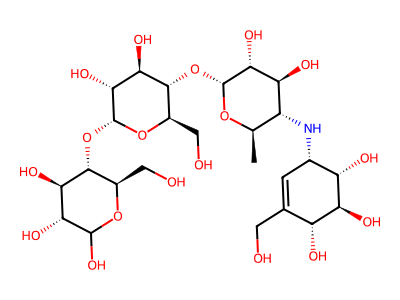
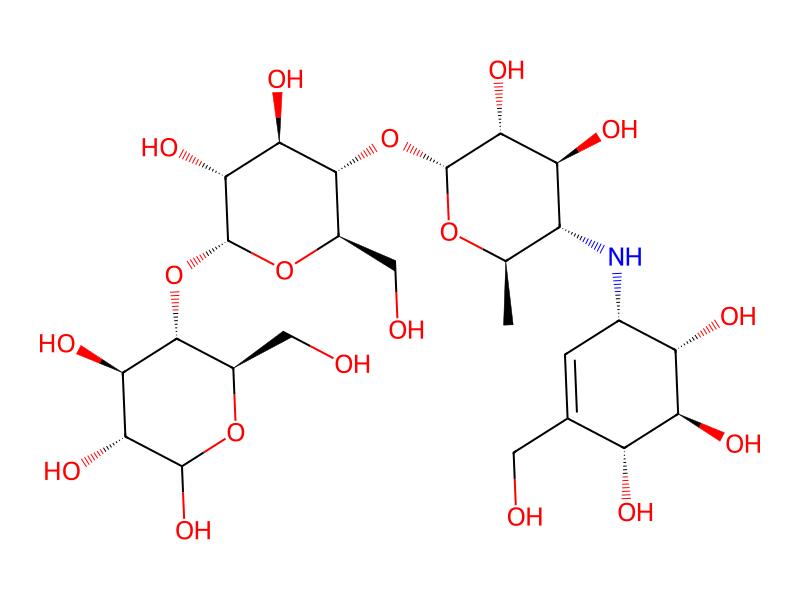
Cite this structure
Embed this structure
SMILES
C[C@H]1O[C@H](O[C@H]2[C@H](O)[C@@H](O)[C@@H](O[C@H]3[C@H](O)[C@@H](O)C(O)O[C@@H]3CO)O[C@@H]2CO)[C@H](O)[C@@H](O)[C@@H]1N[C@H]1C=C(CO)[C@@H](O)[C@H](O)[C@H]1O
InChI
InChI=1S/C25H43NO18/c1-6-11(26-8-2-7(3-27)12(30)15(33)13(8)31)14(32)19(37)24(40-6)43-22-10(5-29)42-25(20(38)17(22)35)44-21-9(4-28)41-23(39)18(36)16(21)34/h2,6,8-39H,3-5H2,1H3/t6-,8+,9-,10-,11-,12-,13+,14+,15+,16-,17-,18-,19-,20-,21-,22-,23?,24-,25-/m1/s1
Molecular Formula
C25H43NO18
HBD / HBA
14 / 19
घूर्णनीय बंधन
13
भारी परमाणु
44
No targets recorded
Target interaction data is not yet available for this drug.
No interactions recorded
Drug interaction data is not yet available for this compound.
No side effects recorded
Side effect data is not yet available for this drug.
अक्सर पूछे जाने वाले प्रश्न
An oral medication that slows the digestion of carbohydrates in the intestine by blocking enzymes that break down complex sugars, resulting in a more gradual rise in blood glucose after meals. It is used alongside diet and exercise to manage type 2 diabetes and lowers after-meal blood sugar spikes without causing low blood sugar on its own. Digestive side effects such as gas and bloating are common, especially early in treatment, and tend to improve over time.
An alpha-glucosidase inhibitor. Acarbose competitively and reversibly inhibits the brush-border alpha-glucosidases of the small intestine, and to a lesser extent pancreatic alpha-amylase, delaying the hydrolysis of starch and disaccharides into absorbable monosaccharides. Carbohydrate absorption is spread across a longer stretch of intestine, which blunts the post-meal rise in blood glucose without stimulating insulin secretion.
Yes, Acarbose is an approved drug. It has reached clinical phase 4. It is classified as a Oligosaccharide.
References & Data Sources
- ChEMBL — European Bioinformatics Institute (EBI). CHEMBL404271. Open-access bioactivity database.
- PubChem — National Center for Biotechnology Information (NCBI). CID 9811704. Chemical information database.
Data aggregated from publicly available pharmacological databases. Last updated 2026-08-20.
Embed This Widget
Add the script tag and a data attribute to embed this widget.
<script src="https://cdn.jsdelivr.net/npm/drugfyi-embed@1/dist/embed.min.js" defer></script>
<div data-drugfyi="drug" data-slug="acarbose"></div>Embed via iframe for maximum compatibility.
<iframe src="https://drugfyi.com/iframe/drug/acarbose/" width="420" height="400" frameborder="0" style="border:0;border-radius:10px;max-width:100%" loading="lazy"></iframe>Paste this URL in WordPress, Medium, or any oEmbed-compatible platform.
https://drugfyi.com/drug/acarbose/Add a dynamic SVG badge to your README or docs.
[](https://drugfyi.com/drug/acarbose/)Use the native HTML custom element.
<script src="https://cdn.jsdelivr.net/npm/drugfyi-embed@1/dist/embed.min.js" defer></script>
<drugfyi-drug slug="acarbose"></drugfyi-drug>