Mupirocin
Topical application defines the therapeutic use of mupirocin, supplied as a cream or ointment for bacterial infections of the skin such as impetigo and infected wounds. The drug prevents bacteria from synthesising the proteins required for survival, an action exerted locally at the site of application with minimal systemic absorption. That confinement to the skin surface is deliberate, since it limits systemic exposure while concentrating the agent where the organisms reside. Its structure is unusual among antibacterial agents, C26H44O9 with a molecular weight near 500.6 g/mol and no beta-lactam ring. The compound is approved and has completed the final phase of clinical development.
This topical antibiotic cream or ointment is applied directly to the skin to treat bacterial skin infections such as impetigo and infected wounds. It works by stopping bacteria from making essential proteins they need to survive, clearing the infection within a week or two of regular application.
आणविक भार
500.6000 g/mol
LogP
3.00
TPSA
146.00 Ų
लिपिंस्की RO5
उत्तीर्ण
चिकित्सीय क्षेत्र
क्रिया का तंत्र
Mupirocin reversibly binds bacterial isoleucyl-tRNA synthetase, preventing the charging of transfer RNA with isoleucine and halting bacterial protein synthesis. The bacterial enzyme differs enough from its human counterpart to give selective toxicity, and no other antibacterial class shares the target, so cross-resistance is uncommon.
Pharmacokinetics (PK)
Pharmacodynamics (PD)
Mupirocin reversibly binds bacterial isoleucyl-tRNA synthetase, preventing the charging of transfer RNA with isoleucine and halting bacterial protein synthesis. The bacterial enzyme differs enough from its human counterpart to give …
2D संरचना
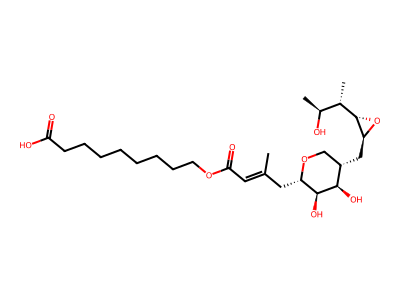
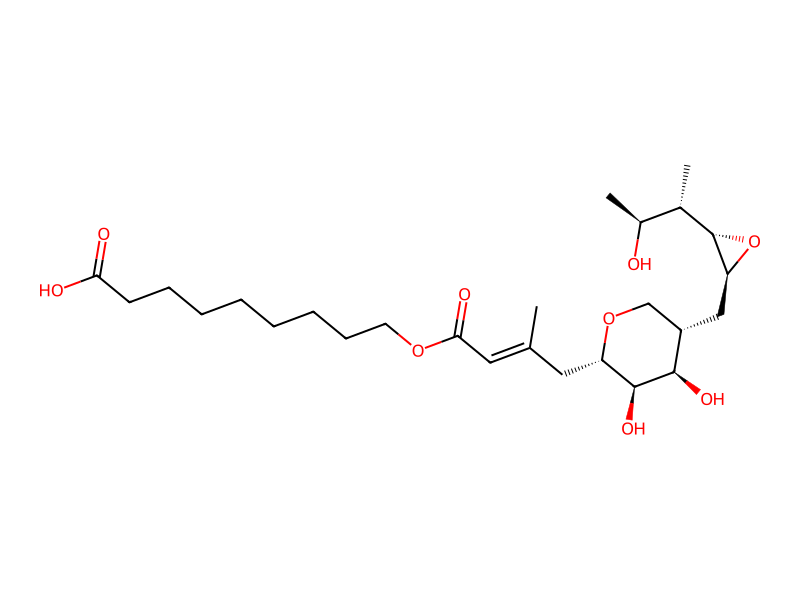
Cite this structure
Embed this structure
SMILES
C/C(=C\C(=O)OCCCCCCCCC(=O)O)C[C@@H]1OC[C@H](C[C@@H]2O[C@H]2[C@@H](C)[C@H](C)O)[C@@H](O)[C@H]1O
InChI
InChI=1S/C26H44O9/c1-16(13-23(30)33-11-9-7-5-4-6-8-10-22(28)29)12-20-25(32)24(31)19(15-34-20)14-21-26(35-21)17(2)18(3)27/h13,17-21,24-27,31-32H,4-12,14-15H2,1-3H3,(H,28,29)/b16-13+/t17-,18-,19-,20-,21-,24+,25-,26-/m0/s1
Molecular Formula
C26H44O9
HBD / HBA
4 / 9
घूर्णनीय बंधन
17
भारी परमाणु
35
No targets recorded
Target interaction data is not yet available for this drug.
No interactions recorded
Drug interaction data is not yet available for this compound.
No side effects recorded
Side effect data is not yet available for this drug.
अक्सर पूछे जाने वाले प्रश्न
This topical antibiotic cream or ointment is applied directly to the skin to treat bacterial skin infections such as impetigo and infected wounds. It works by stopping bacteria from making essential proteins they need to survive, clearing the infection within a week or two of regular application.
Mupirocin reversibly binds bacterial isoleucyl-tRNA synthetase, preventing the charging of transfer RNA with isoleucine and halting bacterial protein synthesis. The bacterial enzyme differs enough from its human counterpart to give selective toxicity, and no other antibacterial class shares the target, so cross-resistance is uncommon.
Yes, Mupirocin is an approved drug. It has reached clinical phase 4. It is classified as a Small molecule.
References & Data Sources
- ChEMBL — European Bioinformatics Institute (EBI). CHEMBL719. Open-access bioactivity database.
- PubChem — National Center for Biotechnology Information (NCBI). CID 446596. Chemical information database.
Data aggregated from publicly available pharmacological databases. Last updated 2026-08-20.
Embed This Widget
Add the script tag and a data attribute to embed this widget.
<script src="https://cdn.jsdelivr.net/npm/drugfyi-embed@1/dist/embed.min.js" defer></script>
<div data-drugfyi="drug" data-slug="mupirocin"></div>Embed via iframe for maximum compatibility.
<iframe src="https://drugfyi.com/iframe/drug/mupirocin/" width="420" height="400" frameborder="0" style="border:0;border-radius:10px;max-width:100%" loading="lazy"></iframe>Paste this URL in WordPress, Medium, or any oEmbed-compatible platform.
https://drugfyi.com/drug/mupirocin/Add a dynamic SVG badge to your README or docs.
[](https://drugfyi.com/drug/mupirocin/)Use the native HTML custom element.
<script src="https://cdn.jsdelivr.net/npm/drugfyi-embed@1/dist/embed.min.js" defer></script>
<drugfyi-drug slug="mupirocin"></drugfyi-drug>