Oxycodone
A semisynthetic opioid, oxycodone treats moderate to severe pain by activating mu-opioid receptors in the brain and spinal cord, blunting the transmission and perception of pain. Its potency places it among the stronger opioid analgesics. A small molecule (C18H21NO4) with a half-life of about 3 to 5 hours, it is often formulated in extended-release preparations to provide steady relief for continuous pain. The mu-receptor activity that relieves pain also produces sedation, constipation, and, in excess, dangerous respiratory depression, and repeated use can lead to tolerance and dependence. These features place its prescribing under close scrutiny. Oxycodone is an approved analgesic used for pain that requires opioid-level relief.
A potent opioid pain reliever for moderate to severe pain, binding to opioid receptors in the brain.
आणविक भार
315.3640 g/mol
LogP
1.20
TPSA
59.00 Ų
लिपिंस्की RO5
उत्तीर्ण
चिकित्सीय क्षेत्र
दवा वर्ग
क्रिया का तंत्र
Semisynthetic mu-opioid receptor agonist.
Pharmacokinetics (PK)
Pharmacodynamics (PD)
Semisynthetic mu-opioid receptor agonist.
2D संरचना
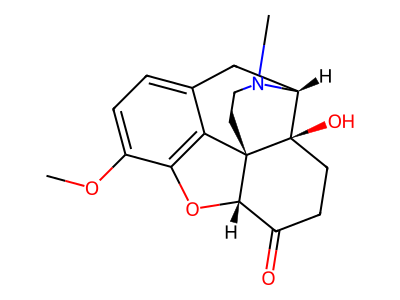
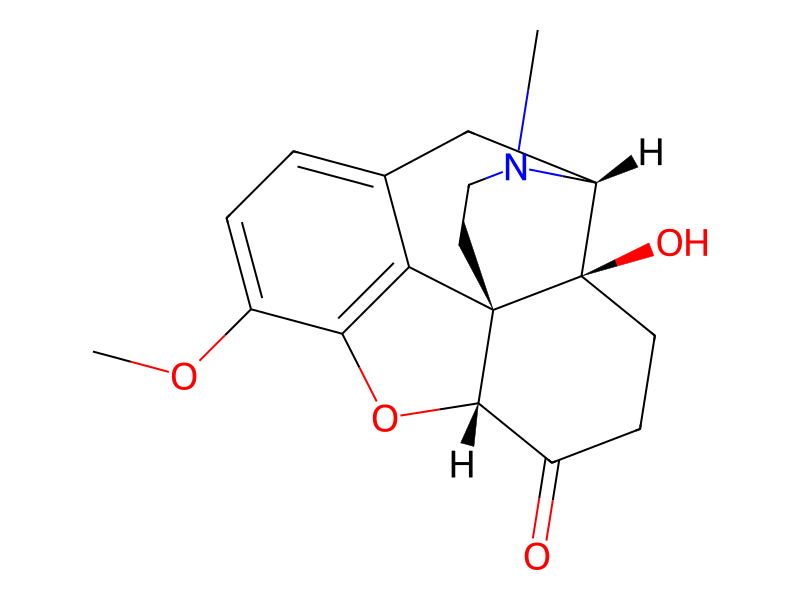
Cite this structure
Embed this structure
SMILES
COc1ccc2c3c1O[C@H]1C(=O)CC[C@@]4(O)[C@@H](C2)N(C)CC[C@]314
InChI
InChI=1S/C18H21NO4/c1-19-8-7-17-14-10-3-4-12(22-2)15(14)23-16(17)11(20)5-6-18(17,21)13(19)9-10/h3-4,13,16,21H,5-9H2,1-2H3/t13-,16+,17+,18-/m1/s1
Molecular Formula
C18H21NO4
HBD / HBA
1 / 5
घूर्णनीय बंधन
1
भारी परमाणु
23
Pregabalin combined with oxycodone produces synergistic respiratory and CNS depression, substantially elevating overdose risk.
Quetiapine substantially potentiates oxycodone-induced CNS and respiratory depression, and both drugs prolong the QT interval.
Gabapentin and oxycodone together produce enhanced CNS and respiratory depression beyond what either drug causes alone, with risk of fatal overdose.
Diphenhydramine, a sedating antihistamine, substantially increases CNS and respiratory depression when combined with opioids like oxycodone.
The combination of alprazolam and oxycodone carries an FDA boxed warning for profound CNS depression, respiratory depression, and death.
Concurrent use of diazepam and oxycodone dramatically increases the risk of fatal respiratory depression, per FDA boxed warning.
Concurrent use of cetirizine and oxycodone may produce additive CNS and respiratory depression, increasing the risk of sedation and, at higher doses, respiratory compromise.
No side effects recorded
Side effect data is not yet available for this drug.
अक्सर पूछे जाने वाले प्रश्न
A potent opioid pain reliever for moderate to severe pain, binding to opioid receptors in the brain.
Semisynthetic mu-opioid receptor agonist.
Key pharmacokinetic parameters for Oxycodone: Half-life: 3-5 hours.
Yes, Oxycodone is an approved drug. It has reached clinical phase 4. It is classified as a Small molecule.
Related Drugs
Same Drug Class
Same Target
References & Data Sources
- ChEMBL — European Bioinformatics Institute (EBI). CHEMBL656. Open-access bioactivity database.
- PubChem — National Center for Biotechnology Information (NCBI). CID 5284603. Chemical information database.
Data aggregated from publicly available pharmacological databases. Last updated 2026-03-28.
Embed This Widget
Add the script tag and a data attribute to embed this widget.
<script src="https://cdn.jsdelivr.net/npm/drugfyi-embed@1/dist/embed.min.js" defer></script>
<div data-drugfyi="drug" data-slug="oxycodone"></div>Embed via iframe for maximum compatibility.
<iframe src="https://drugfyi.com/iframe/drug/oxycodone/" width="420" height="400" frameborder="0" style="border:0;border-radius:10px;max-width:100%" loading="lazy"></iframe>Paste this URL in WordPress, Medium, or any oEmbed-compatible platform.
https://drugfyi.com/drug/oxycodone/Add a dynamic SVG badge to your README or docs.
[](https://drugfyi.com/drug/oxycodone/)Use the native HTML custom element.
<script src="https://cdn.jsdelivr.net/npm/drugfyi-embed@1/dist/embed.min.js" defer></script>
<drugfyi-drug slug="oxycodone"></drugfyi-drug>