Ranitidine
Ranitidine is a histamine H2 receptor antagonist that reduces stomach acid production by competitively blocking histamine's action on gastric parietal cells. For decades it was a mainstay treatment for GERD, peptic ulcers, and heartburn, sold widely as Zantac. The compound has the formula C13H22N4O3S. It has largely been withdrawn from markets after the discovery that a probable carcinogenic contaminant can form in the drug during storage, ending its long run as a leading acid-reducing medication.
A histamine H2 blocker that reduces stomach acid production, formerly widely used to treat GERD, ulcers, and heartburn. It has largely been withdrawn from markets due to concerns about a potential contaminant that may form during storage.
आणविक भार
314.4050 g/mol
LogP
0.30
TPSA
112.00 Ų
लिपिंस्की RO5
उत्तीर्ण
चिकित्सीय क्षेत्र
दवा वर्ग
क्रिया का तंत्र
Competitive H2 receptor antagonist.
Pharmacokinetics (PK)
Pharmacodynamics (PD)
Competitive H2 receptor antagonist.
2D संरचना
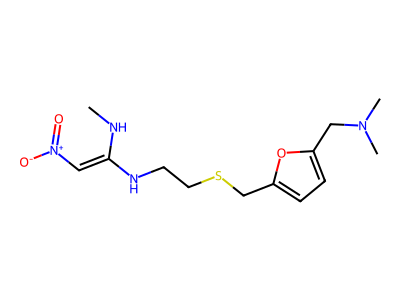
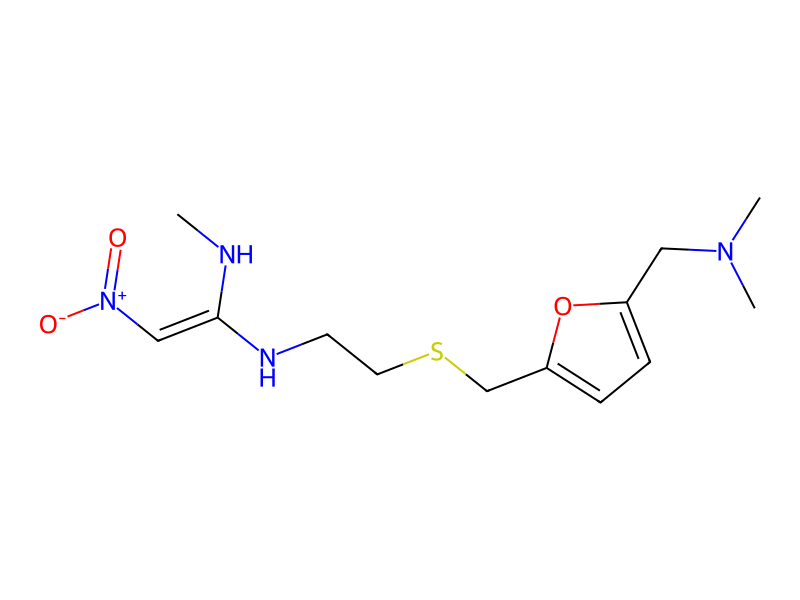
Cite this structure
Embed this structure
SMILES
CNC(=C[N+](=O)[O-])NCCSCc1ccc(CN(C)C)o1
InChI
InChI=1S/C13H22N4O3S/c1-14-13(9-17(18)19)15-6-7-21-10-12-5-4-11(20-12)8-16(2)3/h4-5,9,14-15H,6-8,10H2,1-3H3
Molecular Formula
C13H22N4O3S
HBD / HBA
2 / 7
घूर्णनीय बंधन
9
भारी परमाणु
21
Ranitidine can modestly increase warfarin plasma levels and INR by inhibiting CYP2C9-mediated warfarin metabolism, though the magnitude is smaller than with cimetidine.
Ranitidine may reduce the absorption rate of cephalexin by raising gastric pH, but overall bioavailability is not substantially altered, making this interaction clinically insignificant.
Ranitidine competitively inhibits OCT2-mediated renal tubular secretion of metformin, modestly increasing metformin plasma concentrations.
Ranitidine can modestly increase diazepam bioavailability by raising gastric pH and weakly inhibiting hepatic CYP2C19-mediated diazepam metabolism.
Ranitidine may slightly increase phenytoin bioavailability through modest inhibition of CYP2C9, though the interaction is less significant than with cimetidine.
No side effects recorded
Side effect data is not yet available for this drug.
अक्सर पूछे जाने वाले प्रश्न
A histamine H2 blocker that reduces stomach acid production, formerly widely used to treat GERD, ulcers, and heartburn. It has largely been withdrawn from markets due to concerns about a potential contaminant that may form during storage.
Competitive H2 receptor antagonist.
Key pharmacokinetic parameters for Ranitidine: Half-life: 2-3 hours.
Yes, Ranitidine is an approved drug. It has reached clinical phase 4. It is classified as a Small molecule.
Related Drugs
References & Data Sources
- ChEMBL — European Bioinformatics Institute (EBI). CHEMBL1790041. Open-access bioactivity database.
- PubChem — National Center for Biotechnology Information (NCBI). CID 3001055. Chemical information database.
Data aggregated from publicly available pharmacological databases. Last updated 2026-03-28.
Embed This Widget
Add the script tag and a data attribute to embed this widget.
<script src="https://cdn.jsdelivr.net/npm/drugfyi-embed@1/dist/embed.min.js" defer></script>
<div data-drugfyi="drug" data-slug="ranitidine"></div>Embed via iframe for maximum compatibility.
<iframe src="https://drugfyi.com/iframe/drug/ranitidine/" width="420" height="400" frameborder="0" style="border:0;border-radius:10px;max-width:100%" loading="lazy"></iframe>Paste this URL in WordPress, Medium, or any oEmbed-compatible platform.
https://drugfyi.com/drug/ranitidine/Add a dynamic SVG badge to your README or docs.
[](https://drugfyi.com/drug/ranitidine/)Use the native HTML custom element.
<script src="https://cdn.jsdelivr.net/npm/drugfyi-embed@1/dist/embed.min.js" defer></script>
<drugfyi-drug slug="ranitidine"></drugfyi-drug>