Tacrine
Tacrine (tetrahydroaminoacridine, THA) is a first-generation reversible acetylcholinesterase inhibitor used historically for symptomatic treatment of mild-to-moderate Alzheimer's disease, acting by inhibiting both acetylcholinesterase (AChE) and butyrylcholinesterase to increase acetylcholine levels in cholinergic synapses in the cortex and hippocampus. It also has additional activities including NMDA receptor antagonism, potassium channel blockade, and monoamine oxidase inhibition. Due to high hepatotoxicity risk and the availability of better-tolerated cholinesterase inhibitors, it has been largely discontinued.
आणविक भार
198.2600 g/mol
LogP
2.70
TPSA
38.90 Ų
लिपिंस्की RO5
उत्तीर्ण
चिकित्सीय क्षेत्र
क्रिया का तंत्र
Inhibits acetylcholinesterase, the enzyme that hydrolyzes acetylcholine in the synaptic cleft. This increases acetylcholine availability at cholinergic synapses, enhancing cholinergic neurotransmission.
Pharmacokinetics (PK)
Pharmacodynamics (PD)
Inhibits acetylcholinesterase, the enzyme that hydrolyzes acetylcholine in the synaptic cleft. This increases acetylcholine availability at cholinergic synapses, enhancing cholinergic neurotransmission.
2D संरचना
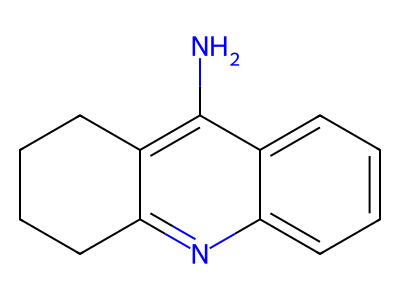
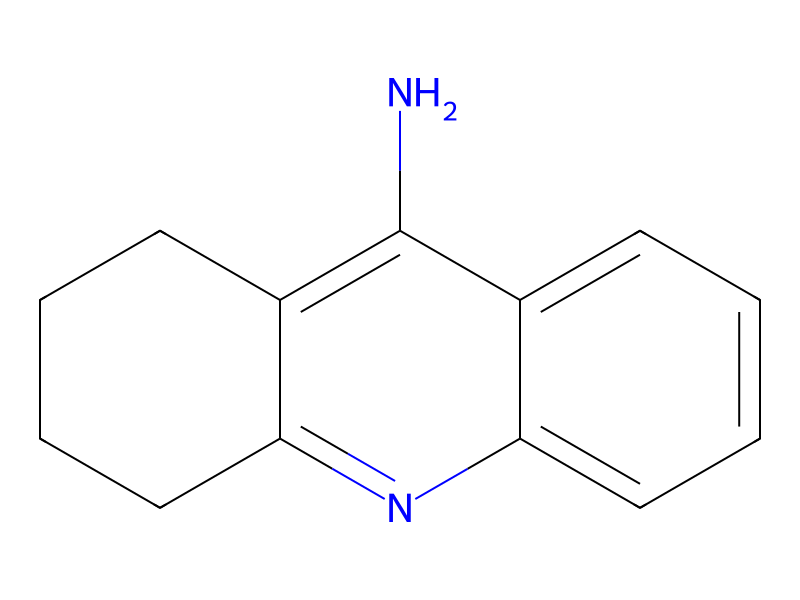
Cite this structure
Embed this structure
SMILES
Nc1c2c(nc3ccccc13)CCCC2
InChI
InChI=1S/C13H14N2/c14-13-9-5-1-3-7-11(9)15-12-8-4-2-6-10(12)13/h1,3,5,7H,2,4,6,8H2,(H2,14,15)
Molecular Formula
C13H14N2
HBD / HBA
1 / 2
घूर्णनीय बंधन
0
भारी परमाणु
15
No targets recorded
Target interaction data is not yet available for this drug.
No interactions recorded
Drug interaction data is not yet available for this compound.
No side effects recorded
Side effect data is not yet available for this drug.
अक्सर पूछे जाने वाले प्रश्न
Tacrine (tetrahydroaminoacridine, THA) is a first-generation reversible acetylcholinesterase inhibitor used historically for symptomatic treatment of mild-to-moderate Alzheimer's disease, acting by inhibiting both acetylcholinesterase (AChE) and butyrylcholinesterase to increase acetylcholine levels in cholinergic synapses in the cortex and hippocampus. It also has additional activities including NMDA receptor antagonism, potassium channel blockade, and monoamine oxidase inhibition. Due to high hepatotoxicity risk and the availability of better-tolerated cholinesterase inhibitors, it has been largely discontinued.
Inhibits acetylcholinesterase, the enzyme that hydrolyzes acetylcholine in the synaptic cleft. This increases acetylcholine availability at cholinergic synapses, enhancing cholinergic neurotransmission.
Yes, Tacrine is an approved drug. It has reached clinical phase 4. It is classified as a Small molecule.
References & Data Sources
- ChEMBL — European Bioinformatics Institute (EBI). CHEMBL95. Open-access bioactivity database.
- PubChem — National Center for Biotechnology Information (NCBI). CID 1935. Chemical information database.
Data aggregated from publicly available pharmacological databases. Last updated 2026-03-28.
Embed This Widget
Add the script tag and a data attribute to embed this widget.
<script src="https://cdn.jsdelivr.net/npm/drugfyi-embed@1/dist/embed.min.js" defer></script>
<div data-drugfyi="drug" data-slug="tacrine"></div>Embed via iframe for maximum compatibility.
<iframe src="https://drugfyi.com/iframe/drug/tacrine/" width="420" height="400" frameborder="0" style="border:0;border-radius:10px;max-width:100%" loading="lazy"></iframe>Paste this URL in WordPress, Medium, or any oEmbed-compatible platform.
https://drugfyi.com/drug/tacrine/Add a dynamic SVG badge to your README or docs.
[](https://drugfyi.com/drug/tacrine/)Use the native HTML custom element.
<script src="https://cdn.jsdelivr.net/npm/drugfyi-embed@1/dist/embed.min.js" defer></script>
<drugfyi-drug slug="tacrine"></drugfyi-drug>