Tacrolimus
Binding the intracellular protein FKBP12, tacrolimus forms a complex that inhibits calcineurin and, in turn, blocks the transcription of interleukin-2. Cutting off this signal prevents T cells from activating, which is why the drug is used to stop the body from rejecting a transplanted kidney, liver, or heart. The same immune restraint also treats stubborn inflammatory skin conditions such as eczema. A large macrolide-type molecule (C44H69NO12) with a half-life of about 12 hours, it is a potent calcineurin inhibitor whose blood levels and effect on kidney function are tracked closely during treatment. By targeting the specific pathway of T-cell activation, it suppresses immunity selectively rather than broadly. Tacrolimus is an approved immunosuppressant that is a mainstay of solid-organ transplantation.
This medication suppresses the immune system to prevent the body from rejecting a transplanted organ such as a kidney, liver, or heart. It is also used to treat certain immune-related skin conditions like eczema when other treatments have not worked. Regular blood tests are needed to monitor drug levels and kidney function.
आणविक भार
804.0180 g/mol
LogP
2.70
TPSA
178.00 Ų
लिपिंस्की RO5
अनुत्तीर्ण
चिकित्सीय क्षेत्र
दवा वर्ग
Pharmacokinetics (PK)
Pharmacodynamics (PD)
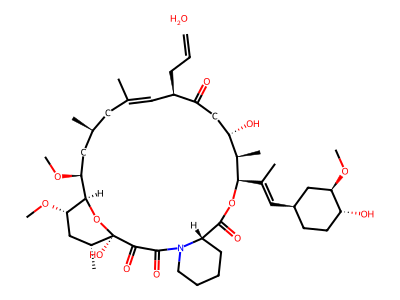
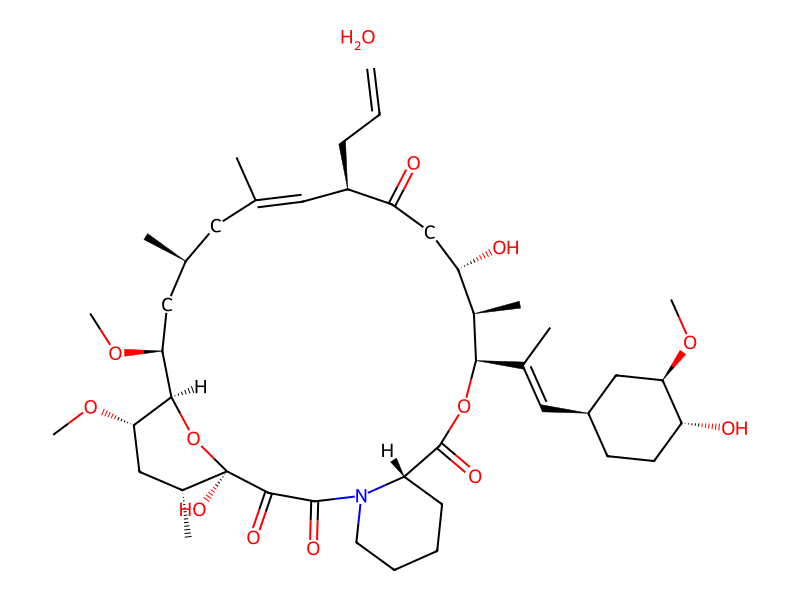
2D संरचना
Cite this structure
Embed this structure
SMILES
C=CC[C@@H]1/C=C(\C)C[C@H](C)C[C@H](OC)[C@H]2O[C@@](O)(C(=O)C(=O)N3CCCC[C@H]3C(=O)O[C@H](/C(C)=C/[C@@H]3CC[C@@H](O)[C@H](OC)C3)[C@H](C)[C@@H](O)CC1=O)[C@H](C)C[C@@H]2OC.O
InChI
InChI=1S/C44H69NO12.H2O/c1-10-13-31-19-25(2)18-26(3)20-37(54-8)40-38(55-9)22-28(5)44(52,57-40)41(49)42(50)45-17-12-11-14-32(45)43(51)56-39(29(6)34(47)24-35(31)48)27(4)21-30-15-16-33(46)36(23-30)53-7;/h10,19,21,26,28-34,36-40,46-47,52H,1,11-18,20,22-24H2,2-9H3;1H2/b25-19+,27-21+;/t26-,28+,29+,30-,31+,32-,33+,34-,36+,37-,38-,39+,40+,44+;/m0./s1
Molecular Formula
C44H69NO12
HBD / HBA
3 / 12
घूर्णनीय बंधन
7
भारी परमाणु
57
Trimethoprim impairs renal potassium excretion and may inhibit tubular secretion of tacrolimus, collectively increasing the risk of hyperkalemia and tacrolimus nephrotoxicity.
Fluconazole markedly inhibits CYP3A4-mediated tacrolimus metabolism, causing 2- to 4-fold elevations in tacrolimus trough levels and substantial risk of nephrotoxicity and neurotoxicity.
Concurrent use of cyclosporine and tacrolimus dramatically amplifies nephrotoxicity and is generally contraindicated; both agents independently cause renal vasoconstriction and tubular injury.
Phenytoin is a strong CYP3A4 inducer that can reduce tacrolimus exposure by more than 50%, putting transplant patients at risk for graft rejection.
Carbamazepine, a potent CYP3A4 inducer, substantially decreases tacrolimus blood concentrations, risking acute rejection in transplant recipients.
Tacrolimus may mildly prolong the QT interval; metoprolol's bradycardic effect may compound this modestly, though clinically significant arrhythmia is uncommon at standard doses.
Omeprazole inhibits CYP2C19 and weakly inhibits CYP3A4, leading to modest increases in tacrolimus exposure particularly in CYP2C19 poor metabolisers.
Diltiazem inhibits CYP3A4 and P-glycoprotein, increasing tacrolimus blood concentrations by 40–70% and heightening the risk of dose-related tacrolimus toxicity.
No side effects recorded
Side effect data is not yet available for this drug.
अक्सर पूछे जाने वाले प्रश्न
This medication suppresses the immune system to prevent the body from rejecting a transplanted organ such as a kidney, liver, or heart. It is also used to treat certain immune-related skin conditions like eczema when other treatments have not worked. Regular blood tests are needed to monitor drug levels and kidney function.
Key pharmacokinetic parameters for Tacrolimus: Half-life: 12 hours.
Yes, Tacrolimus is an approved drug. It has reached clinical phase 4. It is classified as a Small molecule.
Related Drugs
References & Data Sources
- ChEMBL — European Bioinformatics Institute (EBI). CHEMBL3989887. Open-access bioactivity database.
- PubChem — National Center for Biotechnology Information (NCBI). CID 445643. Chemical information database.
Data aggregated from publicly available pharmacological databases. Last updated 2026-08-20.
Embed This Widget
Add the script tag and a data attribute to embed this widget.
<script src="https://cdn.jsdelivr.net/npm/drugfyi-embed@1/dist/embed.min.js" defer></script>
<div data-drugfyi="drug" data-slug="tacrolimus"></div>Embed via iframe for maximum compatibility.
<iframe src="https://drugfyi.com/iframe/drug/tacrolimus/" width="420" height="400" frameborder="0" style="border:0;border-radius:10px;max-width:100%" loading="lazy"></iframe>Paste this URL in WordPress, Medium, or any oEmbed-compatible platform.
https://drugfyi.com/drug/tacrolimus/Add a dynamic SVG badge to your README or docs.
<a href="https://drugfyi.com/drug/tacrolimus/" rel="nofollow noopener"><img src="https://drugfyi.com/badge/entity/tacrolimus.svg" alt="DrugFYI"></a>Use the native HTML custom element.
<script src="https://cdn.jsdelivr.net/npm/drugfyi-embed@1/dist/embed.min.js" defer></script>
<drugfyi-drug slug="tacrolimus"></drugfyi-drug>