Acrisorcin
A topical antifungal agent used historically to treat tinea versicolor, a fungal skin infection that causes patches of discolored skin on the trunk and shoulders. It works by disrupting the cell membrane of the yeast responsible for the infection. It is rarely used today, having been largely supplanted by more effective and better-tolerated topical and oral antifungal treatments.
Berat Molekul
388,5000 g/mol
TPSA
79,40 Ų
Area Terapeutik
Mekanisme Kerja
Applied directly to the skin or mucous membranes, where it exerts its therapeutic effect locally at the site of application with minimal systemic absorption.
Pharmacokinetics (PK)
Pharmacodynamics (PD)
Applied directly to the skin or mucous membranes, where it exerts its therapeutic effect locally at the site of application with minimal systemic absorption.
Struktur 2D
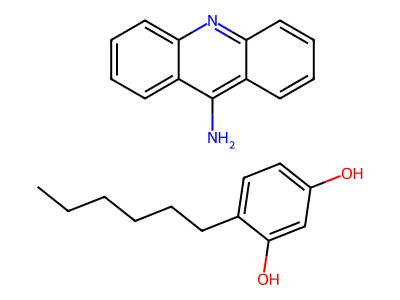
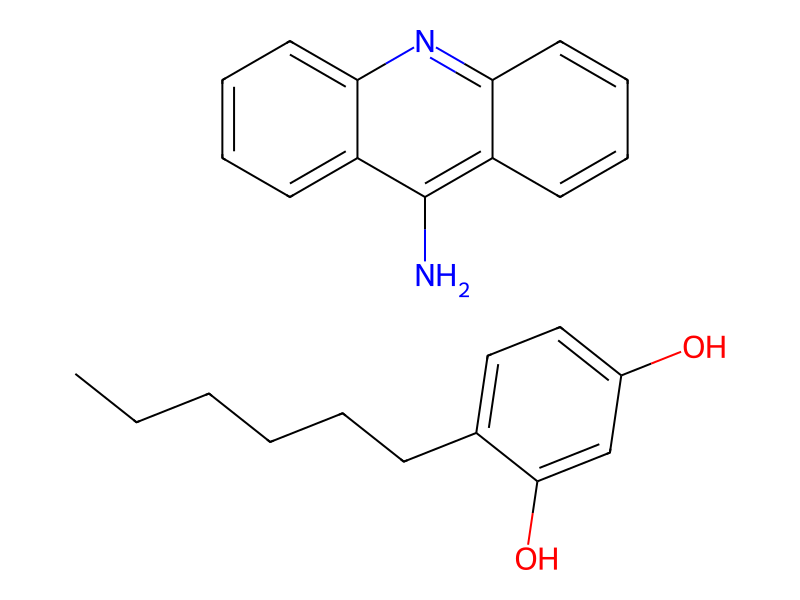
Cite this structure
Embed this structure
SMILES
CCCCCCc1ccc(O)cc1O.Nc1c2ccccc2nc2ccccc12
InChI
InChI=1S/C13H10N2.C12H18O2/c14-13-9-5-1-3-7-11(9)15-12-8-4-2-6-10(12)13;1-2-3-4-5-6-10-7-8-11(13)9-12(10)14/h1-8H,(H2,14,15);7-9,13-14H,2-6H2,1H3
Molecular Formula
C25H28N2O2
HBD / HBA
3 / 4
Ikatan yang Dapat Dirotasi
5
Atom Berat
29
No targets recorded
Target interaction data is not yet available for this drug.
No interactions recorded
Drug interaction data is not yet available for this compound.
No side effects recorded
Side effect data is not yet available for this drug.
Pertanyaan yang Sering Diajukan
A topical antifungal agent used historically to treat tinea versicolor, a fungal skin infection that causes patches of discolored skin on the trunk and shoulders. It works by disrupting the cell membrane of the yeast responsible for the infection. It is rarely used today, having been largely supplanted by more effective and better-tolerated topical and oral antifungal treatments.
Applied directly to the skin or mucous membranes, where it exerts its therapeutic effect locally at the site of application with minimal systemic absorption.
Yes, Acrisorcin is an approved drug. It has reached clinical phase 4. It is classified as a Small molecule.
References & Data Sources
- ChEMBL — European Bioinformatics Institute (EBI). CHEMBL1201038. Open-access bioactivity database.
- PubChem — National Center for Biotechnology Information (NCBI). CID 24144. Chemical information database.
Data aggregated from publicly available pharmacological databases. Last updated 2026-03-04.
Embed This Widget
Add the script tag and a data attribute to embed this widget.
<script src="https://cdn.jsdelivr.net/npm/drugfyi-embed@1/dist/embed.min.js" defer></script>
<div data-drugfyi="drug" data-slug="acrisorcin"></div>Embed via iframe for maximum compatibility.
<iframe src="https://drugfyi.com/iframe/drug/acrisorcin/" width="420" height="400" frameborder="0" style="border:0;border-radius:10px;max-width:100%" loading="lazy"></iframe>Paste this URL in WordPress, Medium, or any oEmbed-compatible platform.
https://drugfyi.com/drug/acrisorcin/Add a dynamic SVG badge to your README or docs.
[](https://drugfyi.com/drug/acrisorcin/)Use the native HTML custom element.
<script src="https://cdn.jsdelivr.net/npm/drugfyi-embed@1/dist/embed.min.js" defer></script>
<drugfyi-drug slug="acrisorcin"></drugfyi-drug>