Cefonicid
A prolonged half-life is the distinguishing pharmacokinetic feature of cefonicid among second-generation cephalosporins, permitting once-daily intramuscular administration where related agents require more frequent dosing. Antibacterial action follows the class mechanism: binding to penicillin-binding proteins arrests the final transpeptidation step of peptidoglycan assembly, leaving the wall defective and the organism osmotically unstable until lysis occurs. Coverage extends across many gram-positive and gram-negative species, supporting use in mild to moderate infection and in surgical prophylaxis. The extended dosing interval is of practical value in outpatient parenteral antibiotic therapy. The molecule is C18H18N6O8S3 with a mass near 542.6 g/mol, approved and developed through the final phase.
A second-generation cephalosporin antibiotic with a prolonged half-life that allows for once-daily intramuscular dosing, used for mild to moderate infections and surgical prophylaxis. It is effective against many gram-positive and gram-negative bacteria. Its extended dosing interval offers practical convenience in outpatient parenteral antibiotic therapy.
Berat Molekul
542,6000 g/mol
LogP
-1,90
TPSA
264,00 Ų
Lipinski RO5
Gagal
Area Terapeutik
Mekanisme Kerja
Disrupts bacterial cell wall synthesis by binding to penicillin-binding proteins (PBPs), inhibiting the final transpeptidation step of peptidoglycan synthesis. The resulting cell wall defects cause osmotic instability and bacteriolysis.
Pharmacokinetics (PK)
Pharmacodynamics (PD)
Disrupts bacterial cell wall synthesis by binding to penicillin-binding proteins (PBPs), inhibiting the final transpeptidation step of peptidoglycan synthesis. The resulting cell wall defects cause osmotic instability and bacteriolysis.
Struktur 2D
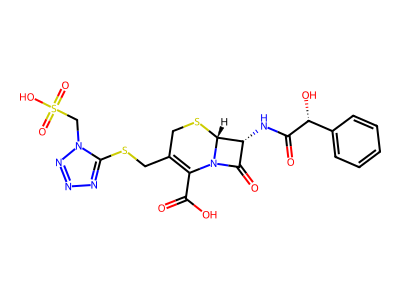
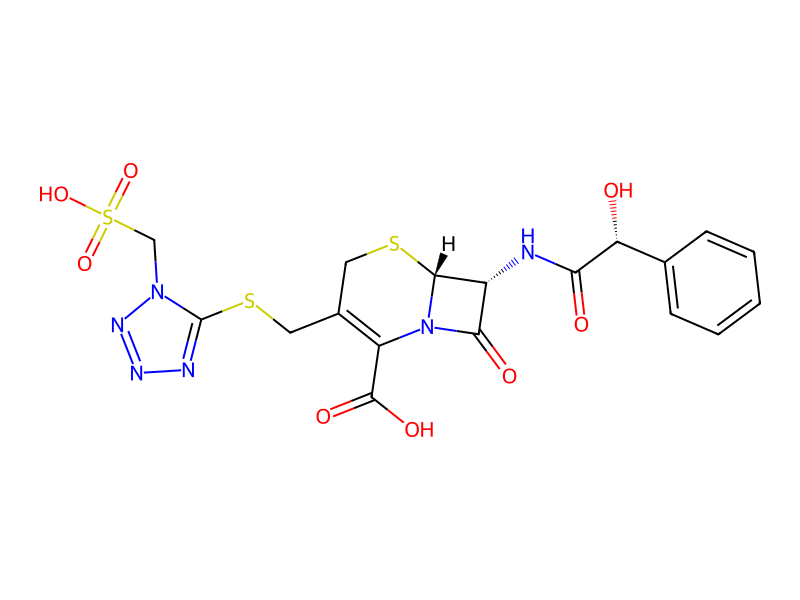
Cite this structure
Embed this structure
SMILES
O=C(O)C1=C(CSc2nnnn2CS(=O)(=O)O)CS[C@@H]2[C@H](NC(=O)[C@H](O)c3ccccc3)C(=O)N12
InChI
InChI=1S/C18H18N6O8S3/c25-13(9-4-2-1-3-5-9)14(26)19-11-15(27)24-12(17(28)29)10(6-33-16(11)24)7-34-18-20-21-22-23(18)8-35(30,31)32/h1-5,11,13,16,25H,6-8H2,(H,19,26)(H,28,29)(H,30,31,32)/t11-,13-,16-/m1/s1
Molecular Formula
C18H18N6O8S3
HBD / HBA
4 / 13
Ikatan yang Dapat Dirotasi
9
Atom Berat
35
No targets recorded
Target interaction data is not yet available for this drug.
No interactions recorded
Drug interaction data is not yet available for this compound.
No side effects recorded
Side effect data is not yet available for this drug.
Pertanyaan yang Sering Diajukan
A second-generation cephalosporin antibiotic with a prolonged half-life that allows for once-daily intramuscular dosing, used for mild to moderate infections and surgical prophylaxis. It is effective against many gram-positive and gram-negative bacteria. Its extended dosing interval offers practical convenience in outpatient parenteral antibiotic therapy.
Disrupts bacterial cell wall synthesis by binding to penicillin-binding proteins (PBPs), inhibiting the final transpeptidation step of peptidoglycan synthesis. The resulting cell wall defects cause osmotic instability and bacteriolysis.
Yes, Cefonicid is an approved drug. It has reached clinical phase 4. It is classified as a Small molecule.
References & Data Sources
- ChEMBL — European Bioinformatics Institute (EBI). CHEMBL1601. Open-access bioactivity database.
- PubChem — National Center for Biotechnology Information (NCBI). CID 43594. Chemical information database.
Data aggregated from publicly available pharmacological databases. Last updated 2026-08-20.
Embed This Widget
Add the script tag and a data attribute to embed this widget.
<script src="https://cdn.jsdelivr.net/npm/drugfyi-embed@1/dist/embed.min.js" defer></script>
<div data-drugfyi="drug" data-slug="cefonicid"></div>Embed via iframe for maximum compatibility.
<iframe src="https://drugfyi.com/iframe/drug/cefonicid/" width="420" height="400" frameborder="0" style="border:0;border-radius:10px;max-width:100%" loading="lazy"></iframe>Paste this URL in WordPress, Medium, or any oEmbed-compatible platform.
https://drugfyi.com/drug/cefonicid/Add a dynamic SVG badge to your README or docs.
[](https://drugfyi.com/drug/cefonicid/)Use the native HTML custom element.
<script src="https://cdn.jsdelivr.net/npm/drugfyi-embed@1/dist/embed.min.js" defer></script>
<drugfyi-drug slug="cefonicid"></drugfyi-drug>