Chloramphenicol Succinic Acid
An ester form of chloramphenicol used as a prodrug for parenteral administration, requiring hydrolysis to the active drug in the body. Like other parenteral chloramphenicol preparations, it carries the same risk of aplastic anemia and gray baby syndrome in neonates. Its use is generally reserved for severe infections where benefits outweigh the serious risks.
治療領域
作用機序
Administered as an inactive precursor that is metabolically converted to its active form in the body. This prodrug design improves bioavailability, absorption, or targeted delivery compared to the active compound.
Pharmacokinetics (PK)
Pharmacodynamics (PD)
Administered as an inactive precursor that is metabolically converted to its active form in the body. This prodrug design improves bioavailability, absorption, or targeted delivery compared to the active compound.
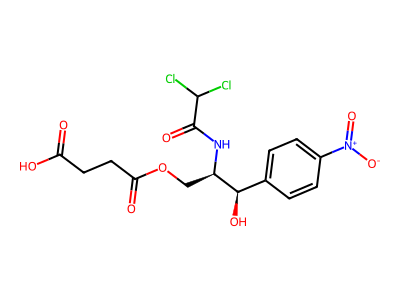
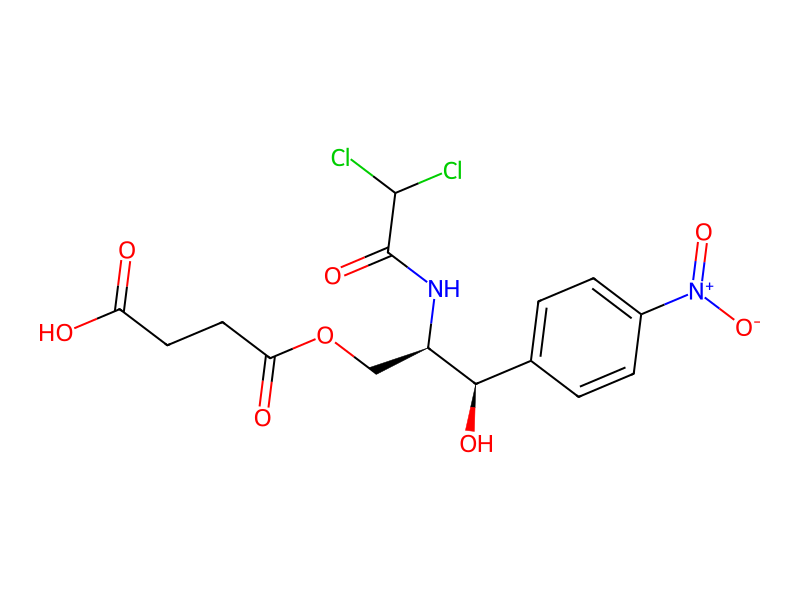
2D構造
Cite this structure
Embed this structure
SMILES
O=C(O)CCC(=O)OC[C@@H](NC(=O)C(Cl)Cl)[C@H](O)c1ccc([N+](=O)[O-])cc1
InChI
InChI=1S/C15H16Cl2N2O8/c16-14(17)15(24)18-10(7-27-12(22)6-5-11(20)21)13(23)8-1-3-9(4-2-8)19(25)26/h1-4,10,13-14,23H,5-7H2,(H,18,24)(H,20,21)/t10-,13-/m1/s1
HBD / HBA
- / -
No targets recorded
Target interaction data is not yet available for this drug.
No interactions recorded
Drug interaction data is not yet available for this compound.
No side effects recorded
Side effect data is not yet available for this drug.
よくある質問
An ester form of chloramphenicol used as a prodrug for parenteral administration, requiring hydrolysis to the active drug in the body. Like other parenteral chloramphenicol preparations, it carries the same risk of aplastic anemia and gray baby syndrome in neonates. Its use is generally reserved for severe infections where benefits outweigh the serious risks.
Administered as an inactive precursor that is metabolically converted to its active form in the body. This prodrug design improves bioavailability, absorption, or targeted delivery compared to the active compound.
Yes, Chloramphenicol Succinic Acid is an approved drug. It has reached clinical phase 4. It is classified as a Small molecule.
References & Data Sources
- ChEMBL — European Bioinformatics Institute (EBI). CHEMBL1201281. Open-access bioactivity database.
Data aggregated from publicly available pharmacological databases. Last updated 2026-02-27.
Embed This Widget
Add the script tag and a data attribute to embed this widget.
<script src="https://cdn.jsdelivr.net/npm/drugfyi-embed@1/dist/embed.min.js" defer></script>
<div data-drugfyi="drug" data-slug="chloramphenicol-succinic-acid"></div>Embed via iframe for maximum compatibility.
<iframe src="https://drugfyi.com/iframe/drug/chloramphenicol-succinic-acid/" width="420" height="400" frameborder="0" style="border:0;border-radius:10px;max-width:100%" loading="lazy"></iframe>Paste this URL in WordPress, Medium, or any oEmbed-compatible platform.
https://drugfyi.com/drug/chloramphenicol-succinic-acid/Add a dynamic SVG badge to your README or docs.
[](https://drugfyi.com/drug/chloramphenicol-succinic-acid/)Use the native HTML custom element.
<script src="https://cdn.jsdelivr.net/npm/drugfyi-embed@1/dist/embed.min.js" defer></script>
<drugfyi-drug slug="chloramphenicol-succinic-acid"></drugfyi-drug>