Digoxin
Extracted from the foxglove plant, digoxin is a cardiac glycoside used to strengthen the failing heart's contraction and to slow the ventricular rate in atrial fibrillation and flutter. It inhibits the sodium-potassium ATPase pump in heart muscle, which indirectly raises intracellular calcium and increases the force of each beat, while its effects on the vagus nerve slow conduction through the atrioventricular node. A large steroidal glycoside (C41H64O14) with a long half-life of roughly 36 to 48 hours, it is notable for a narrow therapeutic window: concentrations only modestly above the effective range can provoke dangerous rhythm disturbances, so blood levels are monitored. One of the oldest heart medicines still in use, digoxin remains an approved option for selected patients with heart failure and rate control.
A cardiac glycoside derived from the foxglove plant used to treat heart failure and control heart rate in atrial fibrillation and flutter. It works by inhibiting the sodium-potassium ATPase pump, increasing the calcium available for heart muscle contraction. It has a narrow therapeutic window and blood levels must be monitored to avoid toxicity, which can cause dangerous heart rhythm disturbances.
分子量
780.9430 g/mol
LogP
1.30
TPSA
203.00 Ų
リピンスキーの五則
不適合
治療領域
薬物分類
作用機序
Inhibits Na+/K+-ATPase, increasing intracellular calcium.
Pharmacokinetics (PK)
Pharmacodynamics (PD)
Inhibits Na+/K+-ATPase, increasing intracellular calcium.
2D構造
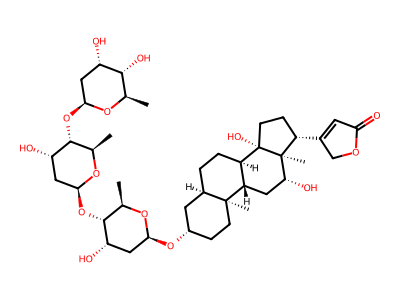
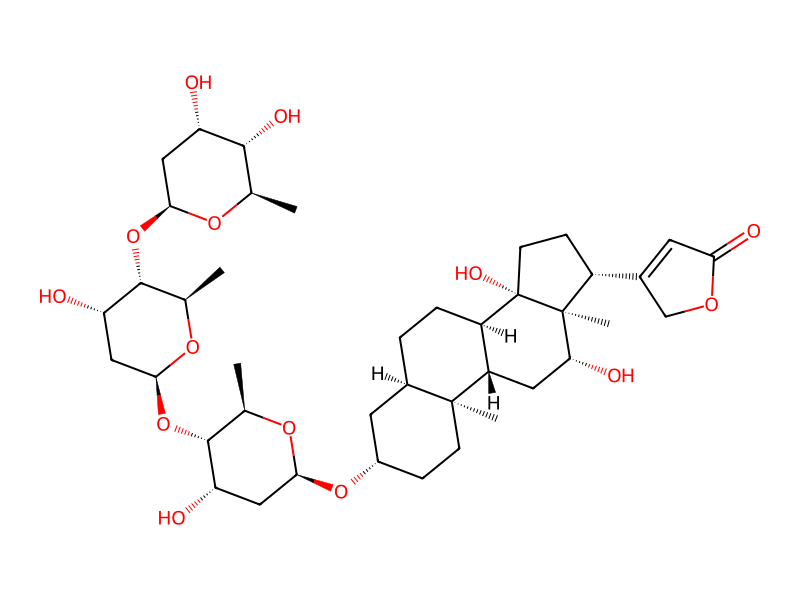
Cite this structure
Embed this structure
SMILES
C[C@H]1O[C@@H](O[C@H]2[C@@H](O)C[C@H](O[C@H]3[C@@H](O)C[C@H](O[C@H]4CC[C@@]5(C)[C@H](CC[C@@H]6[C@@H]5C[C@@H](O)[C@]5(C)[C@@H](C7=CC(=O)OC7)CC[C@]65O)C4)O[C@@H]3C)O[C@@H]2C)C[C@H](O)[C@@H]1O
InChI
InChI=1S/C41H64O14/c1-19-36(47)28(42)15-34(50-19)54-38-21(3)52-35(17-30(38)44)55-37-20(2)51-33(16-29(37)43)53-24-8-10-39(4)23(13-24)6-7-26-27(39)14-31(45)40(5)25(9-11-41(26,40)48)22-12-32(46)49-18-22/h12,19-21,23-31,33-38,42-45,47-48H,6-11,13-18H2,1-5H3/t19-,20-,21-,23-,24+,25-,26-,27+,28+,29+,30+,31-,33+,34+,35+,36-,37-,38-,39+,40+,41+/m1/s1
Molecular Formula
C41H64O14
HBD / HBA
6 / 14
回転可能結合数
7
重原子数
55
Valsartan may slightly increase digoxin plasma levels by reducing its renal clearance; the interaction is generally modest.
Sitagliptin modestly increases digoxin exposure through inhibition of P-glycoprotein-mediated renal tubular secretion, though the effect is unlikely to be clinically significant at therapeutic digoxin doses.
Spironolactone can increase digoxin levels by reducing its renal clearance and may cross-react with some digoxin immunoassays, confounding monitoring.
Diltiazem significantly increases digoxin plasma levels through P-gp inhibition and may additionally slow AV nodal conduction, exacerbating bradycardia or heart block.
Furosemide-induced hypokalemia and hypomagnesemia increase the risk of digoxin toxicity even when digoxin levels remain within the conventional therapeutic range.
Metoprolol adds to digoxin's rate-slowing effect at the AV node, increasing the risk of bradycardia and AV block in susceptible patients.
Albuterol-induced hypokalaemia can potentiate digoxin toxicity by increasing myocardial sensitivity to digoxin at any given plasma concentration.
Carvedilol increases digoxin plasma concentrations through P-gp inhibition and adds negative chronotropic and dromotropic effects, increasing the risk of bradycardia and AV block.
No side effects recorded
Side effect data is not yet available for this drug.
よくある質問
A cardiac glycoside derived from the foxglove plant used to treat heart failure and control heart rate in atrial fibrillation and flutter. It works by inhibiting the sodium-potassium ATPase pump, increasing the calcium available for heart muscle contraction. It has a narrow therapeutic window and blood levels must be monitored to avoid toxicity, which can cause dangerous heart rhythm disturbances.
Inhibits Na+/K+-ATPase, increasing intracellular calcium.
Key pharmacokinetic parameters for Digoxin: Half-life: 36-48 hours.
Yes, Digoxin is an approved drug. It has reached clinical phase 4. It is classified as a Small molecule.
Related Drugs
References & Data Sources
- ChEMBL — European Bioinformatics Institute (EBI). CHEMBL1751. Open-access bioactivity database.
- PubChem — National Center for Biotechnology Information (NCBI). CID 2724385. Chemical information database.
Data aggregated from publicly available pharmacological databases. Last updated 2026-03-04.
Embed This Widget
Add the script tag and a data attribute to embed this widget.
<script src="https://cdn.jsdelivr.net/npm/drugfyi-embed@1/dist/embed.min.js" defer></script>
<div data-drugfyi="drug" data-slug="digoxin"></div>Embed via iframe for maximum compatibility.
<iframe src="https://drugfyi.com/iframe/drug/digoxin/" width="420" height="400" frameborder="0" style="border:0;border-radius:10px;max-width:100%" loading="lazy"></iframe>Paste this URL in WordPress, Medium, or any oEmbed-compatible platform.
https://drugfyi.com/drug/digoxin/Add a dynamic SVG badge to your README or docs.
[](https://drugfyi.com/drug/digoxin/)Use the native HTML custom element.
<script src="https://cdn.jsdelivr.net/npm/drugfyi-embed@1/dist/embed.min.js" defer></script>
<drugfyi-drug slug="digoxin"></drugfyi-drug>