Oxyphenisatine
A stimulant laxative closely related to oxyphenisatin acetate, sharing the same mechanism and the same withdrawal history due to hepatotoxicity. It was used for constipation but discontinued due to liver injury risks.
分子量
317.3000 g/mol
LogP
3.20
TPSA
69.60 Ų
リピンスキーの五則
適合
治療領域
Pharmacokinetics (PK)
Pharmacodynamics (PD)
2D構造
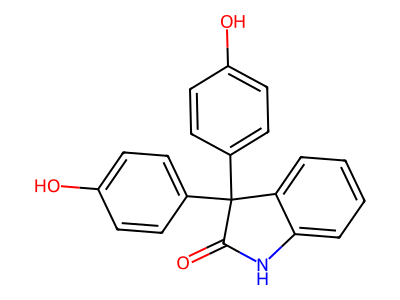
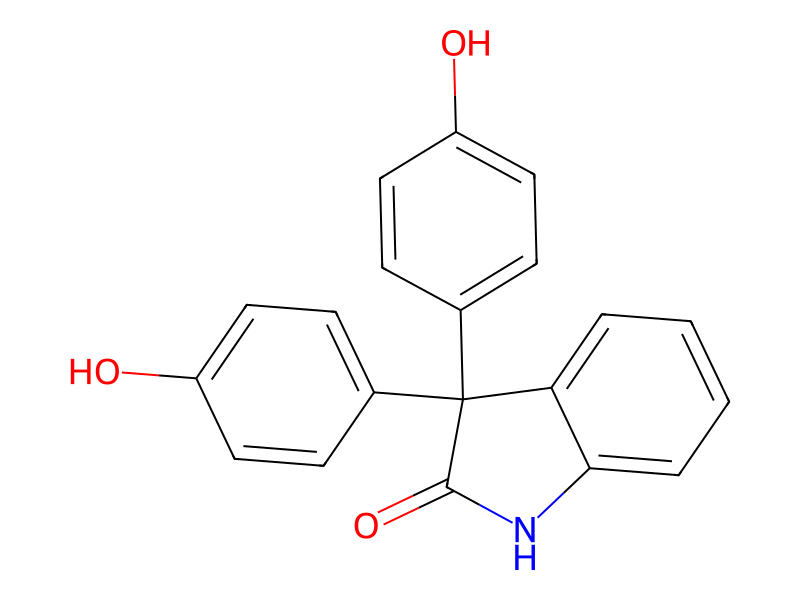
Cite this structure
Embed this structure
SMILES
O=C1Nc2ccccc2C1(c1ccc(O)cc1)c1ccc(O)cc1
InChI
InChI=1S/C20H15NO3/c22-15-9-5-13(6-10-15)20(14-7-11-16(23)12-8-14)17-3-1-2-4-18(17)21-19(20)24/h1-12,22-23H,(H,21,24)
Molecular Formula
C20H15NO3
HBD / HBA
3 / 3
回転可能結合数
2
重原子数
24
No targets recorded
Target interaction data is not yet available for this drug.
No interactions recorded
Drug interaction data is not yet available for this compound.
No side effects recorded
Side effect data is not yet available for this drug.
よくある質問
A stimulant laxative closely related to oxyphenisatin acetate, sharing the same mechanism and the same withdrawal history due to hepatotoxicity. It was used for constipation but discontinued due to liver injury risks.
Yes, Oxyphenisatine is an approved drug. It has reached clinical phase 4. It is classified as a Small molecule.
References & Data Sources
- ChEMBL — European Bioinformatics Institute (EBI). CHEMBL245807. Open-access bioactivity database.
- PubChem — National Center for Biotechnology Information (NCBI). CID 31315. Chemical information database.
Data aggregated from publicly available pharmacological databases. Last updated 2026-03-28.
Embed This Widget
Add the script tag and a data attribute to embed this widget.
<script src="https://cdn.jsdelivr.net/npm/drugfyi-embed@1/dist/embed.min.js" defer></script>
<div data-drugfyi="drug" data-slug="oxyphenisatine"></div>Embed via iframe for maximum compatibility.
<iframe src="https://drugfyi.com/iframe/drug/oxyphenisatine/" width="420" height="400" frameborder="0" style="border:0;border-radius:10px;max-width:100%" loading="lazy"></iframe>Paste this URL in WordPress, Medium, or any oEmbed-compatible platform.
https://drugfyi.com/drug/oxyphenisatine/Add a dynamic SVG badge to your README or docs.
[](https://drugfyi.com/drug/oxyphenisatine/)Use the native HTML custom element.
<script src="https://cdn.jsdelivr.net/npm/drugfyi-embed@1/dist/embed.min.js" defer></script>
<drugfyi-drug slug="oxyphenisatine"></drugfyi-drug>