Clindamycin Palmitate
An inactive form of the antibiotic clindamycin that is converted to its active parent compound after absorption. It is used to treat bacterial infections caused by certain anaerobic bacteria and gram-positive organisms, including skin and respiratory tract infections. This salt form is most commonly used in oral liquid preparations for easier dosing.
분자량
663.4000 g/mol
LogP
10.10
TPSA
134.00 Ų
리핀스키 5의 법칙
불통과
치료 영역
Pharmacokinetics (PK)
Pharmacodynamics (PD)
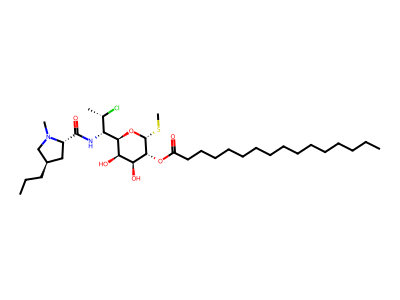
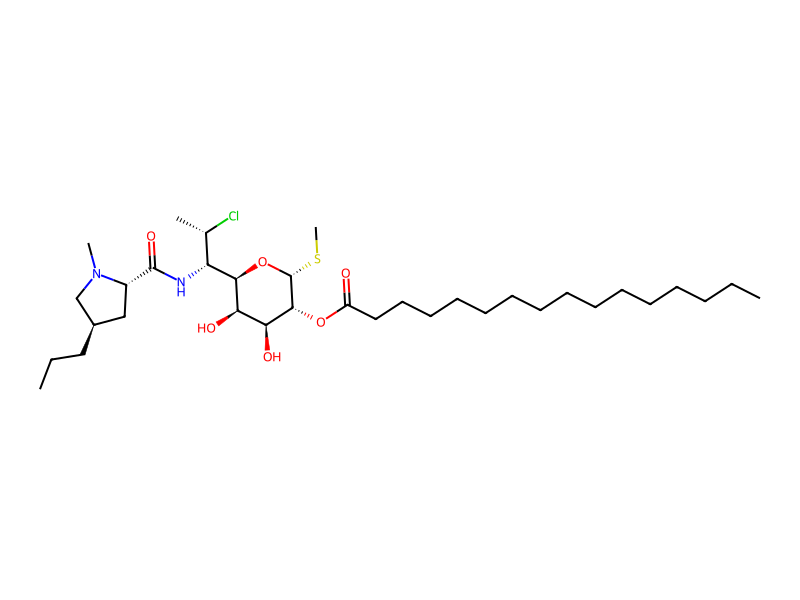
2D 구조
Cite this structure
Embed this structure
SMILES
CCCCCCCCCCCCCCCC(=O)O[C@@H]1[C@@H](O)[C@@H](O)[C@@H]([C@H](NC(=O)[C@@H]2C[C@@H](CCC)CN2C)[C@H](C)Cl)O[C@@H]1SC
InChI
InChI=1S/C34H63ClN2O6S/c1-6-8-9-10-11-12-13-14-15-16-17-18-19-21-27(38)42-32-30(40)29(39)31(43-34(32)44-5)28(24(3)35)36-33(41)26-22-25(20-7-2)23-37(26)4/h24-26,28-32,34,39-40H,6-23H2,1-5H3,(H,36,41)/t24-,25+,26-,28+,29+,30-,31+,32+,34+/m0/s1
Molecular Formula
C34H63ClN2O6S
HBD / HBA
3 / 8
회전 가능 결합
23
무거운 원자
44
No targets recorded
Target interaction data is not yet available for this drug.
No interactions recorded
Drug interaction data is not yet available for this compound.
No side effects recorded
Side effect data is not yet available for this drug.
자주 묻는 질문
An inactive form of the antibiotic clindamycin that is converted to its active parent compound after absorption. It is used to treat bacterial infections caused by certain anaerobic bacteria and gram-positive organisms, including skin and respiratory tract infections. This salt form is most commonly used in oral liquid preparations for easier dosing.
Yes, Clindamycin Palmitate is an approved drug. It has reached clinical phase 4. It is classified as a Small molecule.
References & Data Sources
- ChEMBL — European Bioinformatics Institute (EBI). CHEMBL1201289. Open-access bioactivity database.
- PubChem — National Center for Biotechnology Information (NCBI). CID 16052039. Chemical information database.
Data aggregated from publicly available pharmacological databases. Last updated 2026-03-04.
Embed This Widget
Add the script tag and a data attribute to embed this widget.
<script src="https://cdn.jsdelivr.net/npm/drugfyi-embed@1/dist/embed.min.js" defer></script>
<div data-drugfyi="drug" data-slug="clindamycin-palmitate"></div>Embed via iframe for maximum compatibility.
<iframe src="https://drugfyi.com/iframe/drug/clindamycin-palmitate/" width="420" height="400" frameborder="0" style="border:0;border-radius:10px;max-width:100%" loading="lazy"></iframe>Paste this URL in WordPress, Medium, or any oEmbed-compatible platform.
https://drugfyi.com/drug/clindamycin-palmitate/Add a dynamic SVG badge to your README or docs.
[](https://drugfyi.com/drug/clindamycin-palmitate/)Use the native HTML custom element.
<script src="https://cdn.jsdelivr.net/npm/drugfyi-embed@1/dist/embed.min.js" defer></script>
<drugfyi-drug slug="clindamycin-palmitate"></drugfyi-drug>