Polihexanide
Polihexanide (polyhexamethylene biguanide, PHMB) is a cationic polymeric biocide that disrupts bacterial cell membranes by binding to negatively charged phospholipids, increasing membrane permeability and causing cell lysis. It is used as an antiseptic and disinfectant in wound care, contact lens solutions, and surface disinfection, with a broad spectrum of activity against bacteria, fungi, and protozoa including Acanthamoeba.
Pharmacokinetics (PK)
Pharmacodynamics (PD)
2D 구조
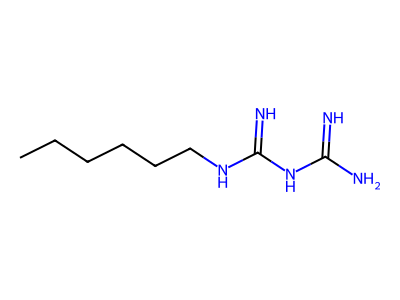
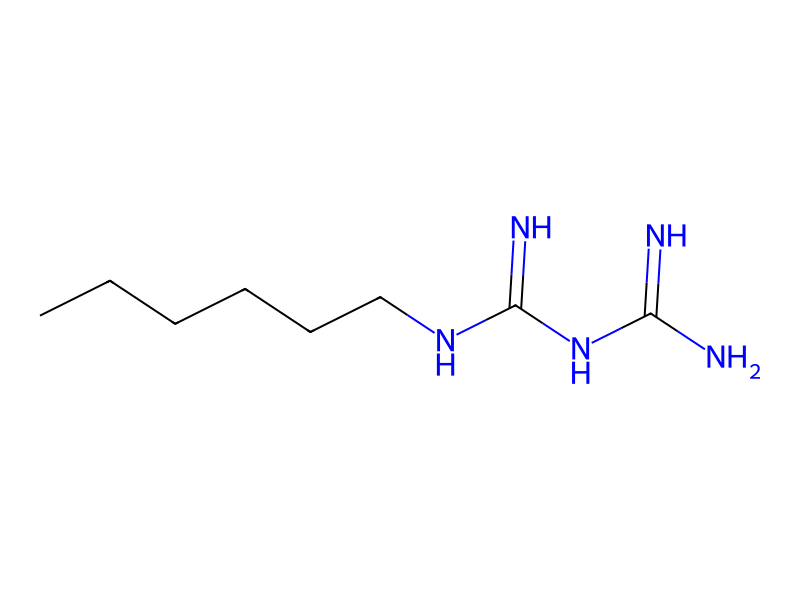
Cite this structure
Embed this structure
SMILES
CCCCCCNC(=N)NC(=N)N
InChI
InChI=1S/C8H19N5/c1-2-3-4-5-6-12-8(11)13-7(9)10/h2-6H2,1H3,(H6,9,10,11,12,13)
HBD / HBA
- / -
No targets recorded
Target interaction data is not yet available for this drug.
No interactions recorded
Drug interaction data is not yet available for this compound.
No side effects recorded
Side effect data is not yet available for this drug.
자주 묻는 질문
Polihexanide (polyhexamethylene biguanide, PHMB) is a cationic polymeric biocide that disrupts bacterial cell membranes by binding to negatively charged phospholipids, increasing membrane permeability and causing cell lysis. It is used as an antiseptic and disinfectant in wound care, contact lens solutions, and surface disinfection, with a broad spectrum of activity against bacteria, fungi, and protozoa including Acanthamoeba.
Yes, Polihexanide is an approved drug. It has reached clinical phase 4. It is classified as a Small molecule.
References & Data Sources
- ChEMBL — European Bioinformatics Institute (EBI). CHEMBL2106939. Open-access bioactivity database.
Data aggregated from publicly available pharmacological databases. Last updated 2026-02-27.
Embed This Widget
Add the script tag and a data attribute to embed this widget.
<script src="https://cdn.jsdelivr.net/npm/drugfyi-embed@1/dist/embed.min.js" defer></script>
<div data-drugfyi="drug" data-slug="polihexanide"></div>Embed via iframe for maximum compatibility.
<iframe src="https://drugfyi.com/iframe/drug/polihexanide/" width="420" height="400" frameborder="0" style="border:0;border-radius:10px;max-width:100%" loading="lazy"></iframe>Paste this URL in WordPress, Medium, or any oEmbed-compatible platform.
https://drugfyi.com/drug/polihexanide/Add a dynamic SVG badge to your README or docs.
[](https://drugfyi.com/drug/polihexanide/)Use the native HTML custom element.
<script src="https://cdn.jsdelivr.net/npm/drugfyi-embed@1/dist/embed.min.js" defer></script>
<drugfyi-drug slug="polihexanide"></drugfyi-drug>