Ziconotide
Ziconotide is a synthetic form of omega-conotoxin MVIIA, a peptide toxin from the cone snail Conus magus that selectively blocks N-type (Cav2.2) voltage-gated calcium channels in the superficial dorsal horn of the spinal cord, inhibiting the release of nociceptive neurotransmitters and reducing pain signal transmission. It is administered intrathecally (directly into the cerebrospinal fluid) for management of severe chronic pain in patients who are not candidates for systemic analgesics or have failed other treatments. It is the only intrathecal non-opioid calcium channel blocker approved for chronic pain.
분자량
2639.2000 g/mol
LogP
-14.00
TPSA
1310.00 Ų
리핀스키 5의 법칙
불통과
치료 영역
Pharmacokinetics (PK)
Pharmacodynamics (PD)
2D 구조
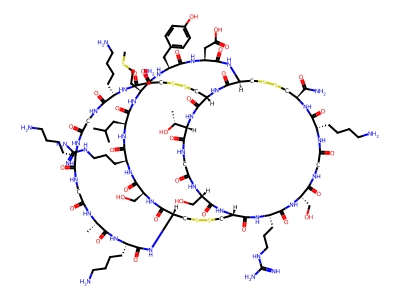
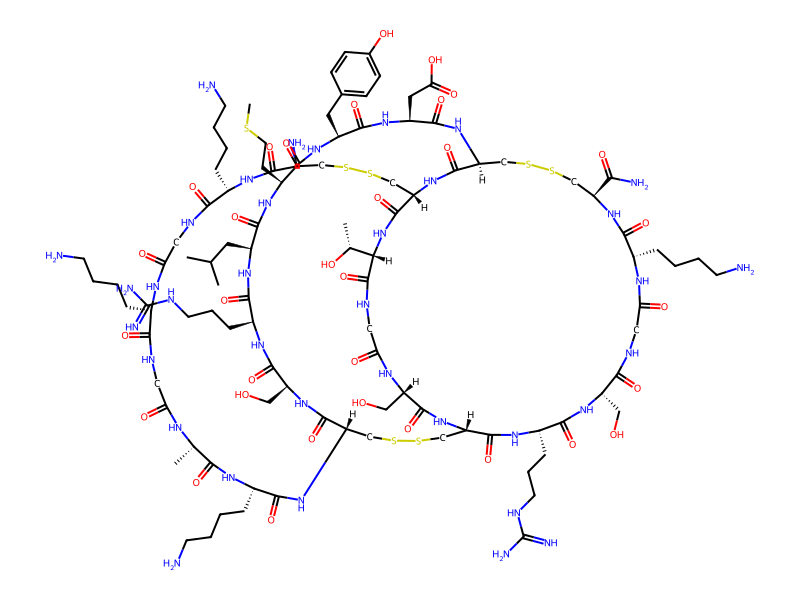
Cite this structure
Embed this structure
SMILES
CSCC[C@@H]1NC(=O)[C@H](CC(C)C)NC(=O)[C@H](CCCNC(=N)N)NC(=O)[C@H](CO)NC(=O)[C@@H]2CSSC[C@@H]3NC(=O)[C@H](CO)NC(=O)CNC(=O)[C@H]([C@@H](C)O)NC(=O)[C@H](CSSC[C@H](N)C(=O)N[C@@H](CCCCN)C(=O)NCC(=O)N[C@@H](CCCCN)C(=O)NCC(=O)N[C@@H](C)C(=O)N[C@@H](CCCCN)C(=O)N2)NC(=O)[C@H](CSSC[C@@H](C(N)=O)NC(=O)[C@H](CCCCN)NC(=O)CNC(=O)[C@H](CO)NC(=O)[C@H](CCCNC(=N)N)NC3=O)NC(=O)[C@H](CC(=O)O)NC(=O)[C@H](Cc2ccc(O)cc2)NC1=O
InChI
InChI=1S/C102H172N36O32S7/c1-50(2)34-63-91(161)127-62(26-33-171-5)90(160)129-64(35-53-22-24-54(143)25-23-53)92(162)130-65(36-78(148)149)93(163)135-72-48-175-173-45-69(80(108)150)133-86(156)58(18-8-12-29-105)121-76(146)39-117-85(155)66(41-139)131-88(158)61(21-15-32-114-102(111)112)126-96(166)70-46-176-177-47-71(97(167)132-68(43-141)95(165)125-60(87(157)128-63)20-14-31-113-101(109)110)134-89(159)59(19-9-13-30-106)123-81(151)51(3)119-74(144)37-115-83(153)56(16-6-10-27-103)120-75(145)38-116-84(154)57(17-7-11-28-104)124-82(152)55(107)44-172-174-49-73(137-98(72)168)99(169)138-79(52(4)142)100(170)118-40-77(147)122-67(42-140)94(164)136-70/h22-25,50-52,55-73,79,139-143H,6-21,26-49,103-107H2,1-5H3,(H2,108,150)(H,115,153)(H,116,154)(H,117,155)(H,118,170)(H,119,144)(H,120,145)(H,121,146)(H,122,147)(H,123,151)(H,124,152)(H,125,165)(H,126,166)(H,127,161)(H,128,157)(H,129,160)(H,130,162)(H,131,158)(H,132,167)(H,133,156)(H,134,159)(H,135,163)(H,136,164)(H,137,168)(H,138,169)(H,148,149)(H4,109,110,113)(H4,111,112,114)/t51-,52+,55-,56-,57-,58-,59-,60-,61-,62-,63-,64-,65-,66-,67-,68-,69-,70-,71-,72-,73-,79-/m0/s1
Molecular Formula
C102H172N36O32S7
HBD / HBA
42 / 46
회전 가능 결합
40
무거운 원자
177
No targets recorded
Target interaction data is not yet available for this drug.
No interactions recorded
Drug interaction data is not yet available for this compound.
No side effects recorded
Side effect data is not yet available for this drug.
자주 묻는 질문
Ziconotide is a synthetic form of omega-conotoxin MVIIA, a peptide toxin from the cone snail Conus magus that selectively blocks N-type (Cav2.2) voltage-gated calcium channels in the superficial dorsal horn of the spinal cord, inhibiting the release of nociceptive neurotransmitters and reducing pain signal transmission. It is administered intrathecally (directly into the cerebrospinal fluid) for management of severe chronic pain in patients who are not candidates for systemic analgesics or have failed other treatments. It is the only intrathecal non-opioid …
Yes, Ziconotide is an approved drug. It has reached clinical phase 4. It is classified as a Protein.
References & Data Sources
- ChEMBL — European Bioinformatics Institute (EBI). CHEMBL4594214. Open-access bioactivity database.
- PubChem — National Center for Biotechnology Information (NCBI). CID 16135415. Chemical information database.
Data aggregated from publicly available pharmacological databases. Last updated 2026-03-28.
Embed This Widget
Add the script tag and a data attribute to embed this widget.
<script src="https://cdn.jsdelivr.net/npm/drugfyi-embed@1/dist/embed.min.js" defer></script>
<div data-drugfyi="drug" data-slug="ziconotide"></div>Embed via iframe for maximum compatibility.
<iframe src="https://drugfyi.com/iframe/drug/ziconotide/" width="420" height="400" frameborder="0" style="border:0;border-radius:10px;max-width:100%" loading="lazy"></iframe>Paste this URL in WordPress, Medium, or any oEmbed-compatible platform.
https://drugfyi.com/drug/ziconotide/Add a dynamic SVG badge to your README or docs.
[](https://drugfyi.com/drug/ziconotide/)Use the native HTML custom element.
<script src="https://cdn.jsdelivr.net/npm/drugfyi-embed@1/dist/embed.min.js" defer></script>
<drugfyi-drug slug="ziconotide"></drugfyi-drug>