Acyclovir Sodium
The intravenous sodium salt form of acyclovir, used in hospital settings to treat severe or life-threatening herpes virus infections, including herpes encephalitis, neonatal herpes, and severe chickenpox in immunocompromised patients. It delivers the same antiviral action as oral acyclovir but at higher concentrations achievable through the bloodstream. Adequate hydration during infusion is important to protect the kidneys from crystallization of the drug.
Молекулярная масса
247,1900 g/mol
TPSA
122,00 Ų
Терапевтические области
Механизм действия
Guanosine analogue inhibiting viral DNA polymerase.
Pharmacokinetics (PK)
Pharmacodynamics (PD)
Guanosine analogue inhibiting viral DNA polymerase.
2D Структура
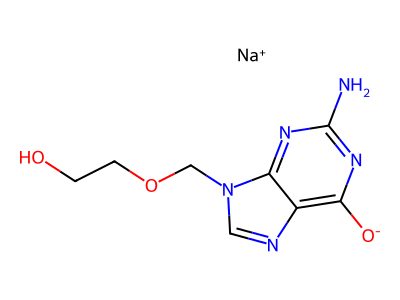
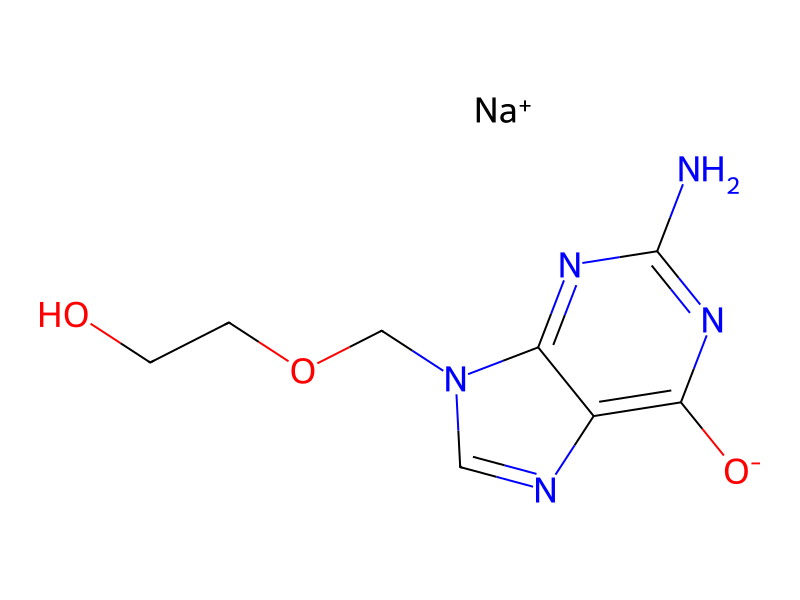
Cite this structure
Embed this structure
SMILES
Nc1nc([O-])c2ncn(COCCO)c2n1.[Na+]
InChI
InChI=1S/C8H11N5O3.Na/c9-8-11-6-5(7(15)12-8)10-3-13(6)4-16-2-1-14;/h3,14H,1-2,4H2,(H3,9,11,12,15);/q;+1/p-1
Molecular Formula
C8H10N5NaO3
HBD / HBA
2 / 7
Вращаемые Связи
4
Тяжёлые Атомы
17
No targets recorded
Target interaction data is not yet available for this drug.
No interactions recorded
Drug interaction data is not yet available for this compound.
No side effects recorded
Side effect data is not yet available for this drug.
Часто задаваемые вопросы
The intravenous sodium salt form of acyclovir, used in hospital settings to treat severe or life-threatening herpes virus infections, including herpes encephalitis, neonatal herpes, and severe chickenpox in immunocompromised patients. It delivers the same antiviral action as oral acyclovir but at higher concentrations achievable through the bloodstream. Adequate hydration during infusion is important to protect the kidneys from crystallization of the drug.
Guanosine analogue inhibiting viral DNA polymerase.
Yes, Acyclovir Sodium is an approved drug. It has reached clinical phase 4. It is classified as a Small molecule.
References & Data Sources
- ChEMBL — European Bioinformatics Institute (EBI). CHEMBL1200380. Open-access bioactivity database.
- PubChem — National Center for Biotechnology Information (NCBI). CID 23665721. Chemical information database.
Data aggregated from publicly available pharmacological databases. Last updated 2026-03-04.
Медицинский отказ от ответственности
This content is for educational and informational purposes only. It is not a substitute for professional medical advice, diagnosis, or treatment. Always consult a qualified healthcare provider before making medication decisions.
Embed This Widget
Add the script tag and a data attribute to embed this widget.
<script src="https://cdn.jsdelivr.net/npm/drugfyi-embed@1/dist/embed.min.js" defer></script>
<div data-drugfyi="drug" data-slug="acyclovir-sodium"></div>Embed via iframe for maximum compatibility.
<iframe src="https://drugfyi.com/iframe/drug/acyclovir-sodium/" width="420" height="400" frameborder="0" style="border:0;border-radius:10px;max-width:100%" loading="lazy"></iframe>Paste this URL in WordPress, Medium, or any oEmbed-compatible platform.
https://drugfyi.com/drug/acyclovir-sodium/Add a dynamic SVG badge to your README or docs.
<a href="https://drugfyi.com/drug/acyclovir-sodium/" rel="nofollow noopener"><img src="https://drugfyi.com/badge/entity/acyclovir-sodium.svg" alt="DrugFYI"></a>Use the native HTML custom element.
<script src="https://cdn.jsdelivr.net/npm/drugfyi-embed@1/dist/embed.min.js" defer></script>
<drugfyi-drug slug="acyclovir-sodium"></drugfyi-drug>