Sparteine
Sparteine is a quinolizidine alkaloid derived from lupine plants with antiarrhythmic properties, acting as a class Ia sodium channel blocker to slow cardiac conduction, and also possessing oxytocic properties used historically to stimulate uterine contractions during labor. Its antiarrhythmic activity is similar to quinidine and procainamide, prolonging the action potential and effective refractory period. It has largely been replaced by more selective and better-characterized antiarrhythmic agents.
Молекулярная масса
234,3800 g/mol
LogP
2,50
TPSA
6,50 Ų
Правило пяти Липинского
Соответствует
Pharmacokinetics (PK)
Pharmacodynamics (PD)
2D Структура
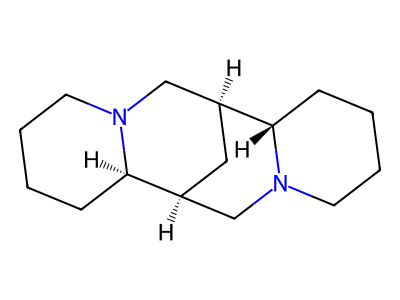
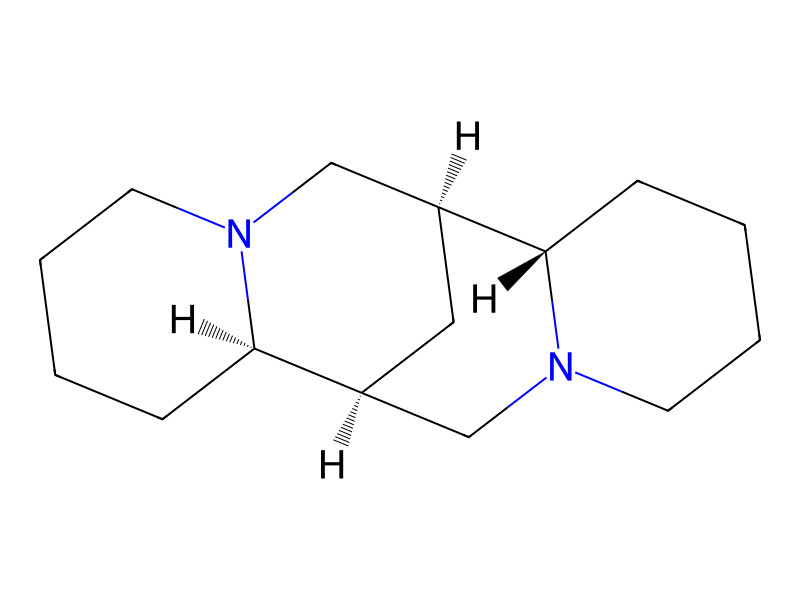
Cite this structure
Embed this structure
SMILES
C1CCN2C[C@@H]3C[C@@H](CN4CCCC[C@@H]34)[C@H]2C1
InChI
InChI=1S/C15H26N2/c1-3-7-16-11-13-9-12(14(16)5-1)10-17-8-4-2-6-15(13)17/h12-15H,1-11H2/t12-,13-,14-,15+/m0/s1
Molecular Formula
C15H26N2
HBD / HBA
- / 2
Вращаемые Связи
0
Тяжёлые Атомы
17
No targets recorded
Target interaction data is not yet available for this drug.
No interactions recorded
Drug interaction data is not yet available for this compound.
No side effects recorded
Side effect data is not yet available for this drug.
Часто задаваемые вопросы
Sparteine is a quinolizidine alkaloid derived from lupine plants with antiarrhythmic properties, acting as a class Ia sodium channel blocker to slow cardiac conduction, and also possessing oxytocic properties used historically to stimulate uterine contractions during labor. Its antiarrhythmic activity is similar to quinidine and procainamide, prolonging the action potential and effective refractory period. It has largely been replaced by more selective and better-characterized antiarrhythmic agents.
Yes, Sparteine is an approved drug. It has reached clinical phase 4. It is classified as a Small molecule.
References & Data Sources
- ChEMBL — European Bioinformatics Institute (EBI). CHEMBL1908847. Open-access bioactivity database.
- PubChem — National Center for Biotechnology Information (NCBI). CID 644020. Chemical information database.
Data aggregated from publicly available pharmacological databases. Last updated 2026-03-28.
Медицинский отказ от ответственности
This content is for educational and informational purposes only. It is not a substitute for professional medical advice, diagnosis, or treatment. Always consult a qualified healthcare provider before making medication decisions.
Embed This Widget
Add the script tag and a data attribute to embed this widget.
<script src="https://cdn.jsdelivr.net/npm/drugfyi-embed@1/dist/embed.min.js" defer></script>
<div data-drugfyi="drug" data-slug="sparteine"></div>Embed via iframe for maximum compatibility.
<iframe src="https://drugfyi.com/iframe/drug/sparteine/" width="420" height="400" frameborder="0" style="border:0;border-radius:10px;max-width:100%" loading="lazy"></iframe>Paste this URL in WordPress, Medium, or any oEmbed-compatible platform.
https://drugfyi.com/drug/sparteine/Add a dynamic SVG badge to your README or docs.
[](https://drugfyi.com/drug/sparteine/)Use the native HTML custom element.
<script src="https://cdn.jsdelivr.net/npm/drugfyi-embed@1/dist/embed.min.js" defer></script>
<drugfyi-drug slug="sparteine"></drugfyi-drug>