Cevimeline Hydrochloride
Xerostomia in Sjogren's syndrome is the indication for cevimeline hydrochloride, the salt form of a muscarinic agonist that stimulates residual exocrine tissue to secrete saliva. Because the action is cholinergic, conditions aggravated by parasympathetic stimulation call for caution: asthma, narrow-angle glaucoma and cardiovascular disease are the situations named in the product literature. Adequate fluid intake accompanies treatment so that the stimulated glands have substrate to draw upon. The salt reproduces the receptor pharmacology of the parent compound without modifying it. The formulation is recorded with the formula C20H38Cl2N2O3S2 and a mass near 489.6 g/mol, and it is an approved small-molecule agent developed through the final clinical phase.
The hydrochloride salt formulation of cevimeline provides the same muscarinic agonist activity as the parent compound, used for xerostomia in Sjögren's syndrome. It should be used cautiously in patients with asthma, narrow-angle glaucoma, or cardiovascular disease, as cholinergic stimulation may worsen these conditions. Adequate fluid intake is recommended to maximize its salivary stimulant benefit.
น้ำหนักโมเลกุล
489.6000 g/mol
TPSA
76.50 Ų
กลไกการออกฤทธิ์
A muscarinic acetylcholine receptor agonist with relative selectivity for the M3 subtype. Cevimeline stimulates M3 receptors on salivary and lacrimal gland epithelium, increasing exocrine secretion and relieving dry mouth and dry eyes. The same cholinergic stimulation accounts for sweating and nausea, and for the caution required in asthma, narrow-angle glaucoma and cardiovascular disease.
Pharmacokinetics (PK)
Pharmacodynamics (PD)
A muscarinic acetylcholine receptor agonist with relative selectivity for the M3 subtype. Cevimeline stimulates M3 receptors on salivary and lacrimal gland epithelium, increasing exocrine secretion and relieving dry mouth and …
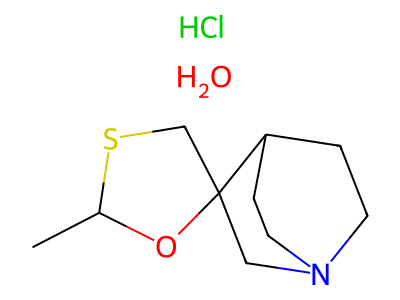
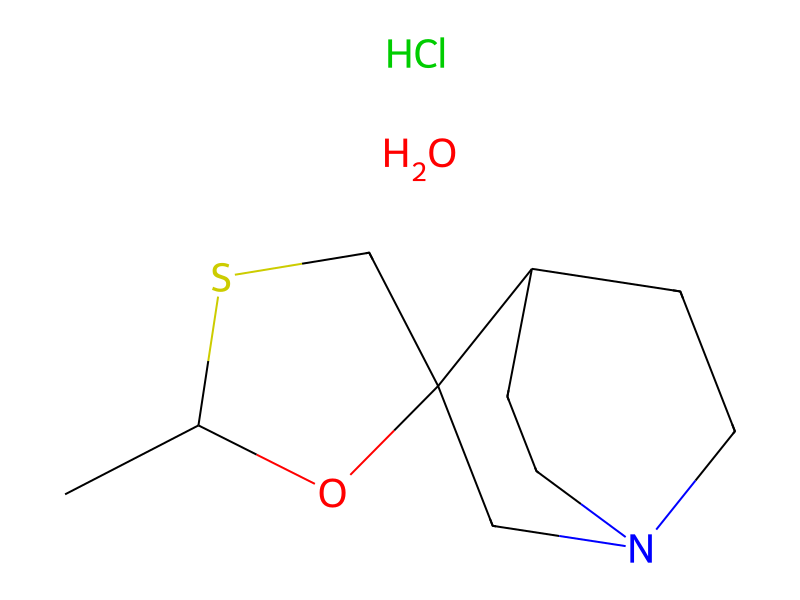
โครงสร้าง 2 มิติ
Cite this structure
Embed this structure
SMILES
CC1OC2(CS1)CN1CCC2CC1.Cl.O
InChI
InChI=1S/C10H17NOS.ClH.H2O/c1-8-12-10(7-13-8)6-11-4-2-9(10)3-5-11;;/h8-9H,2-7H2,1H3;1H;1H2
Molecular Formula
C20H38Cl2N2O3S2
HBD / HBA
3 / 7
พันธะที่หมุนได้
0
อะตอมหนัก
29
No targets recorded
Target interaction data is not yet available for this drug.
No interactions recorded
Drug interaction data is not yet available for this compound.
No side effects recorded
Side effect data is not yet available for this drug.
คำถามที่พบบ่อย
The hydrochloride salt formulation of cevimeline provides the same muscarinic agonist activity as the parent compound, used for xerostomia in Sjögren's syndrome. It should be used cautiously in patients with asthma, narrow-angle glaucoma, or cardiovascular disease, as cholinergic stimulation may worsen these conditions. Adequate fluid intake is recommended to maximize its salivary stimulant benefit.
A muscarinic acetylcholine receptor agonist with relative selectivity for the M3 subtype. Cevimeline stimulates M3 receptors on salivary and lacrimal gland epithelium, increasing exocrine secretion and relieving dry mouth and dry eyes. The same cholinergic stimulation accounts for sweating and nausea, and for the caution required in asthma, narrow-angle glaucoma and cardiovascular disease.
Yes, Cevimeline Hydrochloride is an approved drug. It has reached clinical phase 4. It is classified as a Small molecule.
References & Data Sources
- ChEMBL — European Bioinformatics Institute (EBI). CHEMBL2218917. Open-access bioactivity database.
- PubChem — National Center for Biotechnology Information (NCBI). CID 73416227. Chemical information database.
Data aggregated from publicly available pharmacological databases. Last updated 2026-08-20.
ข้อจำกัดความรับผิดชอบทางการแพทย์
This content is for educational and informational purposes only. It is not a substitute for professional medical advice, diagnosis, or treatment. Always consult a qualified healthcare provider before making medication decisions.
Embed This Widget
Add the script tag and a data attribute to embed this widget.
<script src="https://cdn.jsdelivr.net/npm/drugfyi-embed@1/dist/embed.min.js" defer></script>
<div data-drugfyi="drug" data-slug="cevimeline-hydrochloride"></div>Embed via iframe for maximum compatibility.
<iframe src="https://drugfyi.com/iframe/drug/cevimeline-hydrochloride/" width="420" height="400" frameborder="0" style="border:0;border-radius:10px;max-width:100%" loading="lazy"></iframe>Paste this URL in WordPress, Medium, or any oEmbed-compatible platform.
https://drugfyi.com/drug/cevimeline-hydrochloride/Add a dynamic SVG badge to your README or docs.
[](https://drugfyi.com/drug/cevimeline-hydrochloride/)Use the native HTML custom element.
<script src="https://cdn.jsdelivr.net/npm/drugfyi-embed@1/dist/embed.min.js" defer></script>
<drugfyi-drug slug="cevimeline-hydrochloride"></drugfyi-drug>