Clopidogrel
Clopidogrel prevents blood clots by irreversibly blocking the P2Y12 ADP receptor on the surface of platelets. Without ADP signaling, platelets are far less able to aggregate, and because the block is permanent for each cell, the antiplatelet effect lasts the platelet's lifespan of several days. This action reduces the risk of heart attack and stroke in people with cardiovascular disease and is standard after coronary stent placement. A thienopyridine small molecule (C16H16ClNO2S) with a measured half-life around 6 hours, it is itself a prodrug that requires liver conversion into its active form, so genetic and drug influences on that metabolism can affect how well it works. Clopidogrel is an approved antiplatelet agent central to modern cardiovascular prevention.
An antiplatelet drug that irreversibly blocks ADP receptors on platelets to prevent blood clots, reducing the risk of heart attack and stroke in patients with cardiovascular disease. It is commonly prescribed after coronary stent placement.
น้ำหนักโมเลกุล
321.8220 g/mol
LogP
3.80
TPSA
57.80 Ų
Lipinski RO5
ผ่าน
ด้านการรักษา
หมวดหมู่ยา
กลไกการออกฤทธิ์
Irreversibly blocks P2Y12 ADP receptor on platelets.
Pharmacokinetics (PK)
Pharmacodynamics (PD)
Irreversibly blocks P2Y12 ADP receptor on platelets.
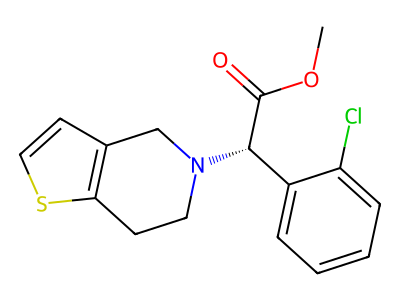
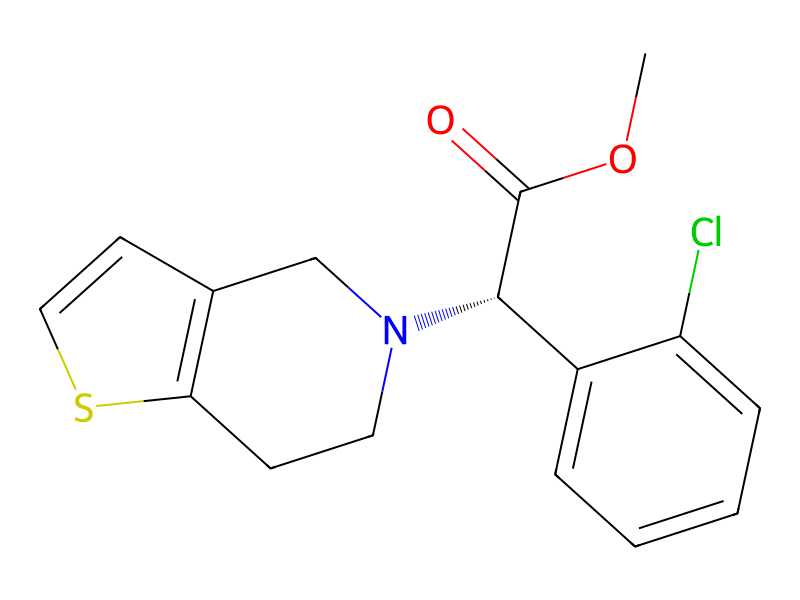
โครงสร้าง 2 มิติ
Cite this structure
Embed this structure
SMILES
COC(=O)[C@H](c1ccccc1Cl)N1CCc2sccc2C1
InChI
InChI=1S/C16H16ClNO2S/c1-20-16(19)15(12-4-2-3-5-13(12)17)18-8-6-14-11(10-18)7-9-21-14/h2-5,7,9,15H,6,8,10H2,1H3/t15-/m0/s1
Molecular Formula
C16H16ClNO2S
HBD / HBA
- / 4
พันธะที่หมุนได้
4
อะตอมหนัก
21
Combining rivaroxaban with clopidogrel substantially increases bleeding risk through simultaneous inhibition of factor Xa and platelet P2Y12 receptors.
Pantoprazole has minimal CYP2C19 inhibitory activity compared with omeprazole, making it the preferred PPI choice in patients on clopidogrel.
Omeprazole reduces the antiplatelet efficacy of clopidogrel by inhibiting its bioactivation via CYP2C19, potentially increasing thrombotic risk.
Lansoprazole, like omeprazole, inhibits CYP2C19 and reduces clopidogrel's antiplatelet efficacy, potentially increasing cardiovascular event risk.
Fluoxetine may reduce clopidogrel's antiplatelet efficacy by inhibiting CYP2C19-mediated bioactivation while also independently impairing platelet serotonin-mediated aggregation.
IV morphine delays and reduces the absorption of oral clopidogrel in acute coronary syndrome patients, potentially providing inadequate antiplatelet coverage during a critical window.
Triple antithrombotic therapy (apixaban + clopidogrel ± aspirin) carries the highest bleeding risk of any oral antithrombotic combination.
Dual antiplatelet therapy with aspirin and clopidogrel provides superior thrombotic protection post-ACS and post-PCI but approximately doubles the risk of major bleeding compared with aspirin alone.
No side effects recorded
Side effect data is not yet available for this drug.
คำถามที่พบบ่อย
An antiplatelet drug that irreversibly blocks ADP receptors on platelets to prevent blood clots, reducing the risk of heart attack and stroke in patients with cardiovascular disease. It is commonly prescribed after coronary stent placement.
Irreversibly blocks P2Y12 ADP receptor on platelets.
Key pharmacokinetic parameters for Clopidogrel: Half-life: 6 hours.
Yes, Clopidogrel is an approved drug. It has reached clinical phase 4. It is classified as a Small molecule.
Related Drugs
References & Data Sources
- ChEMBL — European Bioinformatics Institute (EBI). CHEMBL1771. Open-access bioactivity database.
- PubChem — National Center for Biotechnology Information (NCBI). CID 60606. Chemical information database.
Data aggregated from publicly available pharmacological databases. Last updated 2026-03-04.
ข้อจำกัดความรับผิดชอบทางการแพทย์
This content is for educational and informational purposes only. It is not a substitute for professional medical advice, diagnosis, or treatment. Always consult a qualified healthcare provider before making medication decisions.
Embed This Widget
Add the script tag and a data attribute to embed this widget.
<script src="https://cdn.jsdelivr.net/npm/drugfyi-embed@1/dist/embed.min.js" defer></script>
<div data-drugfyi="drug" data-slug="clopidogrel"></div>Embed via iframe for maximum compatibility.
<iframe src="https://drugfyi.com/iframe/drug/clopidogrel/" width="420" height="400" frameborder="0" style="border:0;border-radius:10px;max-width:100%" loading="lazy"></iframe>Paste this URL in WordPress, Medium, or any oEmbed-compatible platform.
https://drugfyi.com/drug/clopidogrel/Add a dynamic SVG badge to your README or docs.
[](https://drugfyi.com/drug/clopidogrel/)Use the native HTML custom element.
<script src="https://cdn.jsdelivr.net/npm/drugfyi-embed@1/dist/embed.min.js" defer></script>
<drugfyi-drug slug="clopidogrel"></drugfyi-drug>