Chlortetracycline
The first tetracycline antibiotic discovered, originally derived from the soil bacterium Streptomyces aureofaciens, inhibiting bacterial protein synthesis by blocking aminoacyl-tRNA binding to the ribosome. It was historically used to treat a wide range of bacterial infections but has been largely superseded in human medicine. It continues to see use in veterinary medicine and agriculture.
Moleküler Ağırlık
478,9000 g/mol
LogP
-1,30
TPSA
182,00 Ų
Lipinski RO5
Geçer
Terapötik Alanlar
Etki Mekanizması
Binds reversibly to the 30S ribosomal subunit, blocking the attachment of aminoacyl-tRNA to the ribosomal acceptor (A) site. This inhibits bacterial protein synthesis in a bacteriostatic manner.
Pharmacokinetics (PK)
Pharmacodynamics (PD)
Binds reversibly to the 30S ribosomal subunit, blocking the attachment of aminoacyl-tRNA to the ribosomal acceptor (A) site. This inhibits bacterial protein synthesis in a bacteriostatic manner.
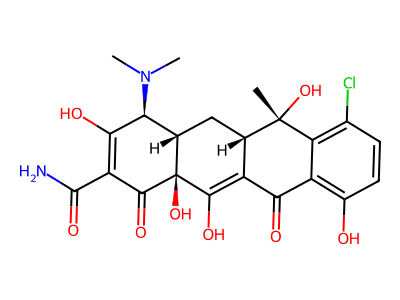
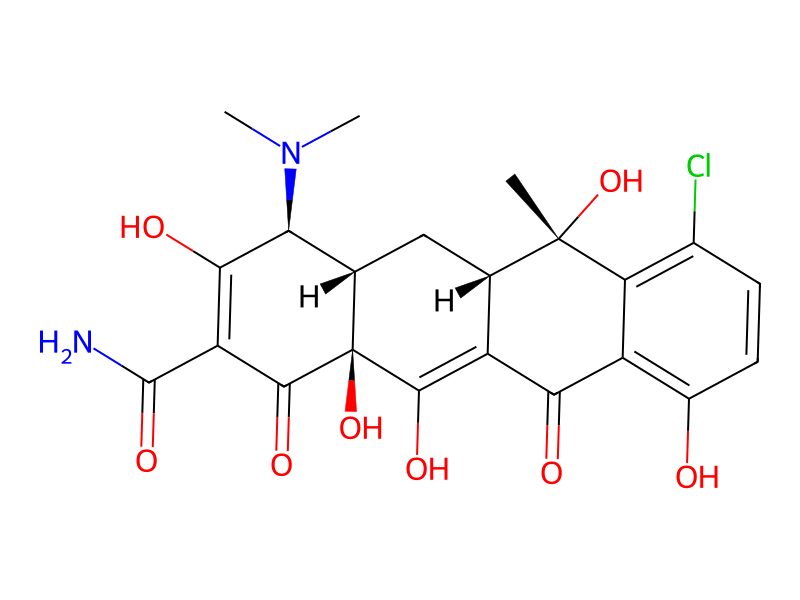
2D Yapı
Cite this structure
Embed this structure
SMILES
CN(C)[C@@H]1C(O)=C(C(N)=O)C(=O)[C@@]2(O)C(O)=C3C(=O)c4c(O)ccc(Cl)c4[C@@](C)(O)[C@H]3C[C@@H]12
InChI
InChI=1S/C22H23ClN2O8/c1-21(32)7-6-8-15(25(2)3)17(28)13(20(24)31)19(30)22(8,33)18(29)11(7)16(27)12-10(26)5-4-9(23)14(12)21/h4-5,7-8,15,26,28-29,32-33H,6H2,1-3H3,(H2,24,31)/t7-,8-,15-,21-,22-/m0/s1
Molecular Formula
C22H23ClN2O8
HBD / HBA
6 / 9
Döndürülebilir Bağlar
2
Ağır Atomlar
33
No targets recorded
Target interaction data is not yet available for this drug.
No interactions recorded
Drug interaction data is not yet available for this compound.
No side effects recorded
Side effect data is not yet available for this drug.
Sıkça Sorulan Sorular
The first tetracycline antibiotic discovered, originally derived from the soil bacterium Streptomyces aureofaciens, inhibiting bacterial protein synthesis by blocking aminoacyl-tRNA binding to the ribosome. It was historically used to treat a wide range of bacterial infections but has been largely superseded in human medicine. It continues to see use in veterinary medicine and agriculture.
Binds reversibly to the 30S ribosomal subunit, blocking the attachment of aminoacyl-tRNA to the ribosomal acceptor (A) site. This inhibits bacterial protein synthesis in a bacteriostatic manner.
Yes, Chlortetracycline is an approved drug. It has reached clinical phase 4. It is classified as a Small molecule.
References & Data Sources
- ChEMBL — European Bioinformatics Institute (EBI). CHEMBL404520. Open-access bioactivity database.
- PubChem — National Center for Biotechnology Information (NCBI). CID 54675777. Chemical information database.
Data aggregated from publicly available pharmacological databases. Last updated 2026-03-04.
Embed This Widget
Add the script tag and a data attribute to embed this widget.
<script src="https://cdn.jsdelivr.net/npm/drugfyi-embed@1/dist/embed.min.js" defer></script>
<div data-drugfyi="drug" data-slug="chlortetracycline"></div>Embed via iframe for maximum compatibility.
<iframe src="https://drugfyi.com/iframe/drug/chlortetracycline/" width="420" height="400" frameborder="0" style="border:0;border-radius:10px;max-width:100%" loading="lazy"></iframe>Paste this URL in WordPress, Medium, or any oEmbed-compatible platform.
https://drugfyi.com/drug/chlortetracycline/Add a dynamic SVG badge to your README or docs.
<a href="https://drugfyi.com/drug/chlortetracycline/" rel="nofollow noopener"><img src="https://drugfyi.com/badge/entity/chlortetracycline.svg" alt="DrugFYI"></a>Use the native HTML custom element.
<script src="https://cdn.jsdelivr.net/npm/drugfyi-embed@1/dist/embed.min.js" defer></script>
<drugfyi-drug slug="chlortetracycline"></drugfyi-drug>