Metaproterenol Sulfate
A sulfate salt form of metaproterenol, a bronchodilator used to treat and prevent bronchospasm in asthma and COPD.
Moleküler Ağırlık
520,6000 g/mol
TPSA
228,00 Ų
Terapötik Alanlar
Etki Mekanizması
Activates beta-2 adrenergic receptors on bronchial smooth muscle, stimulating adenylyl cyclase and increasing intracellular cAMP. This relaxes airway smooth muscle and produces bronchodilation.
Pharmacokinetics (PK)
Pharmacodynamics (PD)
Activates beta-2 adrenergic receptors on bronchial smooth muscle, stimulating adenylyl cyclase and increasing intracellular cAMP. This relaxes airway smooth muscle and produces bronchodilation.
2D Yapı
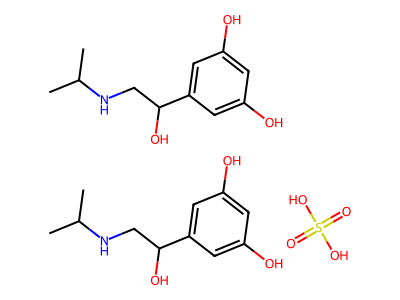
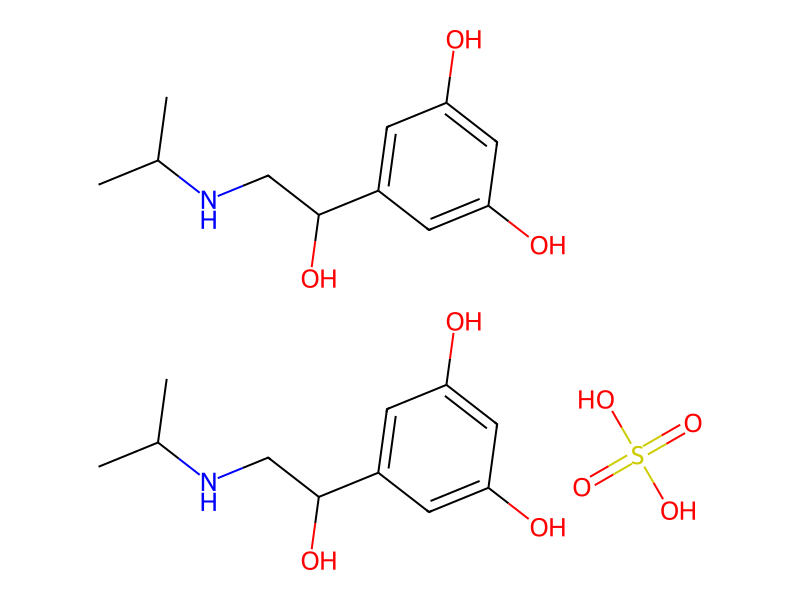
Cite this structure
Embed this structure
SMILES
CC(C)NCC(O)c1cc(O)cc(O)c1.CC(C)NCC(O)c1cc(O)cc(O)c1.O=S(=O)(O)O
InChI
InChI=1S/2C11H17NO3.H2O4S/c2*1-7(2)12-6-11(15)8-3-9(13)5-10(14)4-8;1-5(2,3)4/h2*3-5,7,11-15H,6H2,1-2H3;(H2,1,2,3,4)
Molecular Formula
C22H36N2O10S
HBD / HBA
10 / 12
Döndürülebilir Bağlar
8
Ağır Atomlar
35
No targets recorded
Target interaction data is not yet available for this drug.
No interactions recorded
Drug interaction data is not yet available for this compound.
No side effects recorded
Side effect data is not yet available for this drug.
Sıkça Sorulan Sorular
A sulfate salt form of metaproterenol, a bronchodilator used to treat and prevent bronchospasm in asthma and COPD.
Activates beta-2 adrenergic receptors on bronchial smooth muscle, stimulating adenylyl cyclase and increasing intracellular cAMP. This relaxes airway smooth muscle and produces bronchodilation.
Yes, Metaproterenol Sulfate is an approved drug. It has reached clinical phase 4. It is classified as a Small molecule.
References & Data Sources
- ChEMBL — European Bioinformatics Institute (EBI). CHEMBL1568057. Open-access bioactivity database.
- PubChem — National Center for Biotechnology Information (NCBI). CID 441333. Chemical information database.
Data aggregated from publicly available pharmacological databases. Last updated 2026-03-28.
Embed This Widget
Add the script tag and a data attribute to embed this widget.
<script src="https://cdn.jsdelivr.net/npm/drugfyi-embed@1/dist/embed.min.js" defer></script>
<div data-drugfyi="drug" data-slug="metaproterenol-sulfate"></div>Embed via iframe for maximum compatibility.
<iframe src="https://drugfyi.com/iframe/drug/metaproterenol-sulfate/" width="420" height="400" frameborder="0" style="border:0;border-radius:10px;max-width:100%" loading="lazy"></iframe>Paste this URL in WordPress, Medium, or any oEmbed-compatible platform.
https://drugfyi.com/drug/metaproterenol-sulfate/Add a dynamic SVG badge to your README or docs.
[](https://drugfyi.com/drug/metaproterenol-sulfate/)Use the native HTML custom element.
<script src="https://cdn.jsdelivr.net/npm/drugfyi-embed@1/dist/embed.min.js" defer></script>
<drugfyi-drug slug="metaproterenol-sulfate"></drugfyi-drug>