Famotidine
This medication works by blocking histamine H2 receptors in the stomach to reduce acid production, relieving heartburn, ulcers, and acid reflux. It is available both by prescription and over the counter.
分子量
337.5000 g/mol
LogP
-0.60
TPSA
238.00 Ų
Lipinski 五规则
符合
治疗领域
Pharmacokinetics (PK)
Pharmacodynamics (PD)
二维结构
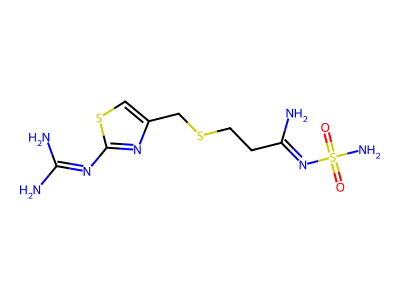
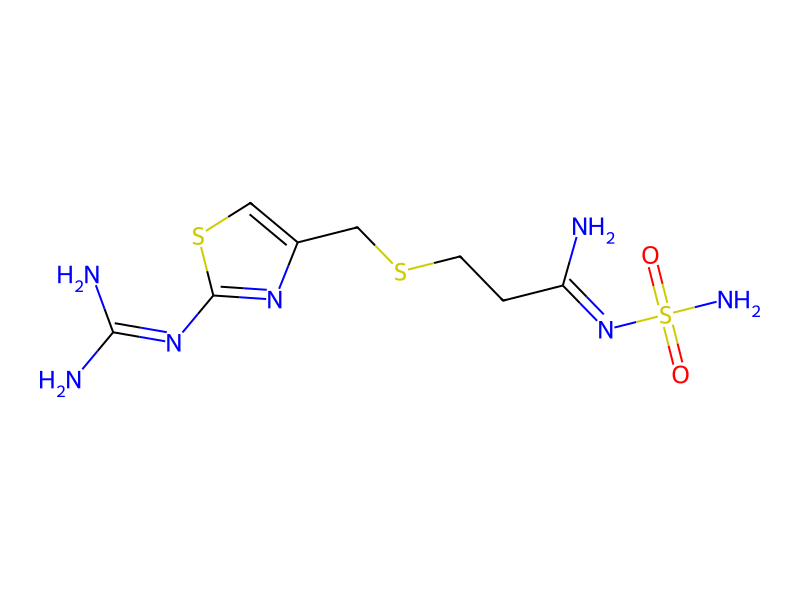
Cite this structure
Embed this structure
SMILES
NC(N)=Nc1nc(CSCC/C(N)=N/S(N)(=O)=O)cs1
InChI
InChI=1S/C8H15N7O2S3/c9-6(15-20(12,16)17)1-2-18-3-5-4-19-8(13-5)14-7(10)11/h4H,1-3H2,(H2,9,15)(H2,12,16,17)(H4,10,11,13,14)
Molecular Formula
C8H15N7O2S3
HBD / HBA
4 / 8
可旋转键数
7
重原子数
20
No targets recorded
Target interaction data is not yet available for this drug.
No interactions recorded
Drug interaction data is not yet available for this compound.
No side effects recorded
Side effect data is not yet available for this drug.
常见问题
This medication works by blocking histamine H2 receptors in the stomach to reduce acid production, relieving heartburn, ulcers, and acid reflux. It is available both by prescription and over the counter.
Yes, Famotidine is an approved drug. It has reached clinical phase 4. It is classified as a Small molecule.
References & Data Sources
- ChEMBL — European Bioinformatics Institute (EBI). CHEMBL902. Open-access bioactivity database.
- PubChem — National Center for Biotechnology Information (NCBI). CID 5702160. Chemical information database.
Data aggregated from publicly available pharmacological databases. Last updated 2026-03-04.
Embed This Widget
Add the script tag and a data attribute to embed this widget.
<script src="https://cdn.jsdelivr.net/npm/drugfyi-embed@1/dist/embed.min.js" defer></script>
<div data-drugfyi="drug" data-slug="famotidine"></div>Embed via iframe for maximum compatibility.
<iframe src="https://drugfyi.com/iframe/drug/famotidine/" width="420" height="400" frameborder="0" style="border:0;border-radius:10px;max-width:100%" loading="lazy"></iframe>Paste this URL in WordPress, Medium, or any oEmbed-compatible platform.
https://drugfyi.com/drug/famotidine/Add a dynamic SVG badge to your README or docs.
[](https://drugfyi.com/drug/famotidine/)Use the native HTML custom element.
<script src="https://cdn.jsdelivr.net/npm/drugfyi-embed@1/dist/embed.min.js" defer></script>
<drugfyi-drug slug="famotidine"></drugfyi-drug>