Tramadol
Acting through two mechanisms at once, tramadol both stimulates mu-opioid receptors and blocks the reuptake of serotonin and norepinephrine, combining a weak opioid effect with the monoamine action seen in some antidepressants. It is prescribed for moderate to moderately severe pain and is considered less potent than morphine. A small molecule (C16H25NO2) with a half-life of roughly 5 to 7 hours, its dual pharmacology brings distinctive risks: at higher doses or in combination with serotonergic medicines it can contribute to seizures and to serotonin excess, and like other opioids it can cause dependence and respiratory depression. These interactions make its use alongside antidepressants a particular concern. Tramadol is an approved analgesic occupying a middle ground between non-opioid pain relievers and stronger opioids.
This prescription pain reliever is used to treat moderate to moderately severe pain and works through a combination of opioid receptor binding and inhibition of serotonin and norepinephrine reuptake in the brain. It is considered a weaker opioid than morphine but still carries risks of dependence, respiratory depression, and seizures, especially at higher doses. It can interact dangerously with many other medications, including antidepressants.
الوزن الجزيئي
263,3750 g/mol
LogP
2,60
TPSA
32,70 Ų
قاعدة ليبينسكي للخمسة
ناجح
المجالات العلاجية
تصنيفات الأدوية
آلية العمل
Mu-opioid receptor agonist and serotonin-norepinephrine reuptake inhibitor.
Pharmacokinetics (PK)
Pharmacodynamics (PD)
Mu-opioid receptor agonist and serotonin-norepinephrine reuptake inhibitor.
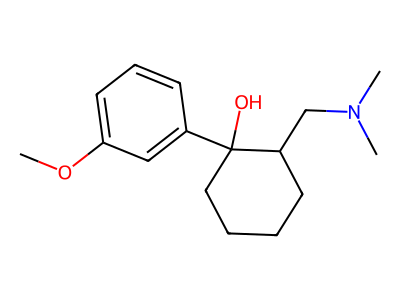
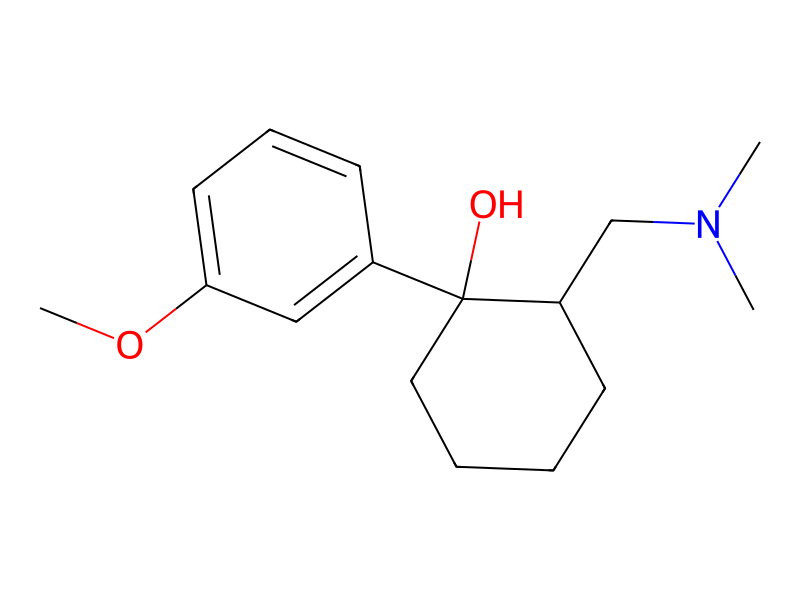
البنية ثنائية الأبعاد
Cite this structure
Embed this structure
SMILES
COc1cccc(C2(O)CCCCC2CN(C)C)c1
InChI
InChI=1S/C16H25NO2/c1-17(2)12-14-7-4-5-10-16(14,18)13-8-6-9-15(11-13)19-3/h6,8-9,11,14,18H,4-5,7,10,12H2,1-3H3
Molecular Formula
C16H25NO2
HBD / HBA
1 / 3
الروابط القابلة للدوران
4
الذرات الثقيلة
19
Venlafaxine and tramadol together pose a high risk of serotonin syndrome due to complementary serotonergic mechanisms.
Bupropion combined with tramadol increases the risk of both serotonin syndrome and seizures, representing a serious dual-hazard drug combination.
Combining escitalopram with tramadol substantially raises the risk of serotonin syndrome, a potentially life-threatening condition characterized by agitation, hyperthermia, tremor, and autonomic instability.
Sertraline and tramadol together significantly increase serotonergic tone, posing a clinically meaningful risk of serotonin syndrome.
Duloxetine, a serotonin-norepinephrine reuptake inhibitor, combined with tramadol markedly elevates the risk of serotonin syndrome.
Alprazolam combined with tramadol increases CNS and respiratory depression risk and may also increase seizure risk from the serotonergic interaction.
Diazepam and tramadol together produce additive CNS and respiratory depression with an FDA boxed warning for concomitant opioid-benzodiazepine use.
Fluoxetine combined with tramadol carries a high risk of serotonin syndrome and additionally reduces tramadol's analgesic efficacy via CYP2D6 inhibition.
No side effects recorded
Side effect data is not yet available for this drug.
الأسئلة الشائعة
This prescription pain reliever is used to treat moderate to moderately severe pain and works through a combination of opioid receptor binding and inhibition of serotonin and norepinephrine reuptake in the brain. It is considered a weaker opioid than morphine but still carries risks of dependence, respiratory depression, and seizures, especially at higher doses. It can interact dangerously with many other medications, including antidepressants.
Mu-opioid receptor agonist and serotonin-norepinephrine reuptake inhibitor.
Key pharmacokinetic parameters for Tramadol: Half-life: 5-7 hours.
Yes, Tramadol is an approved drug. It has reached clinical phase 4. It is classified as a Small molecule.
Related Drugs
Same Drug Class
Same Target
References & Data Sources
- ChEMBL — European Bioinformatics Institute (EBI). CHEMBL1237044. Open-access bioactivity database.
- PubChem — National Center for Biotechnology Information (NCBI). CID 33741. Chemical information database.
Data aggregated from publicly available pharmacological databases. Last updated 2026-03-28.
Embed This Widget
Add the script tag and a data attribute to embed this widget.
<script src="https://cdn.jsdelivr.net/npm/drugfyi-embed@1/dist/embed.min.js" defer></script>
<div data-drugfyi="drug" data-slug="tramadol"></div>Embed via iframe for maximum compatibility.
<iframe src="https://drugfyi.com/iframe/drug/tramadol/" width="420" height="400" frameborder="0" style="border:0;border-radius:10px;max-width:100%" loading="lazy"></iframe>Paste this URL in WordPress, Medium, or any oEmbed-compatible platform.
https://drugfyi.com/drug/tramadol/Add a dynamic SVG badge to your README or docs.
[](https://drugfyi.com/drug/tramadol/)Use the native HTML custom element.
<script src="https://cdn.jsdelivr.net/npm/drugfyi-embed@1/dist/embed.min.js" defer></script>
<drugfyi-drug slug="tramadol"></drugfyi-drug>