Carbamazepine
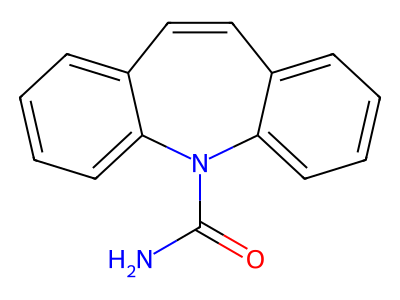
Prescribed for epileptic seizures, trigeminal neuralgia, and bipolar disorder, carbamazepine quiets abnormal neuronal firing by blocking voltage-gated sodium channels and holding them in an inactivated state. This blunts the rapid, repetitive discharges that drive both seizures and certain forms of nerve pain, which also underlies its use as a mood stabilizer. It is a tricyclic compound (C15H12N2O) reported with a half-life in the range of 25 to 65 hours. Two features shape its clinical profile: a wide network of drug interactions, and a rare but potentially fatal skin reaction, Stevens-Johnson syndrome, that warrants careful attention during treatment. An approved, long-established antiepileptic, it remains a reference agent for focal seizures and for trigeminal neuralgia.
An anticonvulsant and mood-stabilizing drug used to treat epileptic seizures, trigeminal neuralgia, and bipolar disorder. It works by blocking voltage-gated sodium channels to reduce abnormal electrical activity in the brain. It requires monitoring due to drug interactions and a rare but potentially fatal skin reaction called Stevens-Johnson syndrome.
Molekularmasse
236,2690 g/mol
LogP
2,50
TPSA
46,30 Ų
Lipinski-Regel der Fünf
Bestanden
Therapeutische Bereiche
Arzneimittelklassen
Wirkmechanismus
Voltage-gated sodium channel blocker.
Pharmacokinetics (PK)
Pharmacodynamics (PD)
Voltage-gated sodium channel blocker.
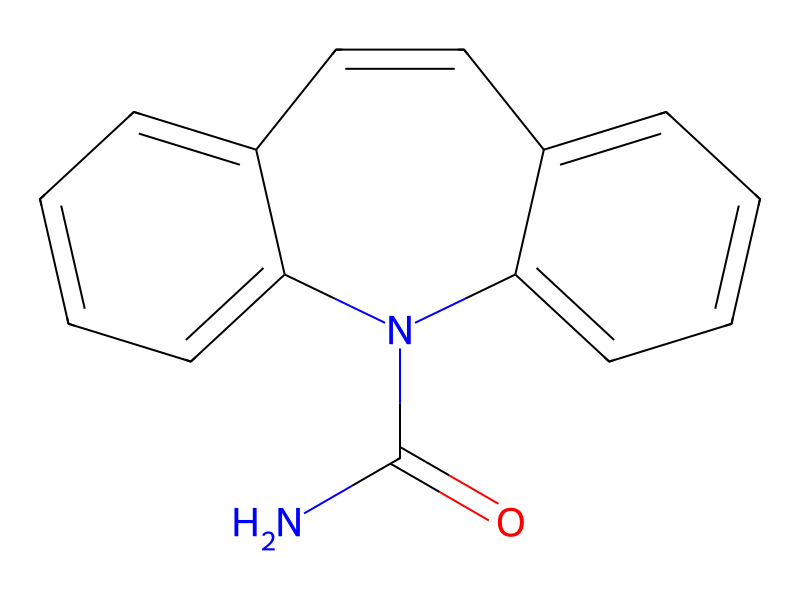
2D-Struktur
Cite this structure
Embed this structure
SMILES
NC(=O)N1c2ccccc2C=Cc2ccccc21
InChI
InChI=1S/C15H12N2O/c16-15(18)17-13-7-3-1-5-11(13)9-10-12-6-2-4-8-14(12)17/h1-10H,(H2,16,18)
Molecular Formula
C15H12N2O
HBD / HBA
1 / 1
Rotierbare Bindungen
0
Schwere Atome
18
Carbamazepine, a potent CYP3A4 inducer, substantially decreases tacrolimus blood concentrations, risking acute rejection in transplant recipients.
Carbamazepine dramatically reduces quetiapine plasma concentrations, potentially rendering antipsychotic treatment ineffective.
Carbamazepine markedly reduces warfarin plasma concentrations, potentially resulting in sub-therapeutic anticoagulation and increased thromboembolic risk.
Carbamazepine dramatically reduces cyclosporine plasma levels through potent CYP3A4 induction, placing transplant patients at severe rejection risk.
Carbamazepine may modestly affect glucose homeostasis and potentially interact with metformin's antidiabetic effect through metabolic mechanisms.
Carbamazepine and phenytoin have complex bidirectional interactions that can alter plasma levels of either drug in unpredictable ways.
Carbamazepine reduces valproic acid levels through enzyme induction, while valproic acid inhibits epoxide hydrolase, increasing the toxic carbamazepine-10,11-epoxide metabolite.
Carbamazepine reduces topiramate plasma concentrations by approximately 40% through enzyme induction, potentially impairing seizure control.
Carbamazepine significantly reduces venlafaxine plasma concentrations through CYP3A4 induction, potentially reducing antidepressant efficacy.
Carbamazepine may reduce levodopa efficacy through enzyme induction and pharmacodynamic antagonism, potentially worsening Parkinson's disease control.
Carbamazepine reduces omeprazole plasma concentrations through CYP3A4 induction, potentially reducing the efficacy of acid suppression therapy.
Carbamazepine is a potent CYP3A4 inducer that markedly increases dexamethasone clearance, reducing its plasma concentrations by 50–80% and risking loss of anti-inflammatory and immunosuppressive efficacy.
Carbamazepine, a potent enzyme inducer, significantly reduces sertraline plasma concentrations, potentially impairing antidepressant efficacy.
Carbamazepine substantially reduces duloxetine plasma levels through CYP1A2 and CYP3A4 induction, risking loss of antidepressant efficacy.
Carbamazepine reduces lamotrigine plasma concentrations by approximately 50% through enzyme induction, requiring lamotrigine dose adjustment.
Carbamazepine induces hepatic CYP enzymes involved in thyroid hormone metabolism, increasing levothyroxine clearance and potentially causing hypothyroid relapse in patients on replacement therapy.
Carbamazepine dramatically reduces aripiprazole plasma levels through potent CYP3A4 induction, potentially rendering antipsychotic treatment ineffective.
Carbamazepine induces CYP enzymes that convert acetaminophen to its hepatotoxic metabolite NAPQI, increasing the risk of acetaminophen-induced liver injury even at therapeutic doses.
No side effects recorded
Side effect data is not yet available for this drug.
Häufig gestellte Fragen
An anticonvulsant and mood-stabilizing drug used to treat epileptic seizures, trigeminal neuralgia, and bipolar disorder. It works by blocking voltage-gated sodium channels to reduce abnormal electrical activity in the brain. It requires monitoring due to drug interactions and a rare but potentially fatal skin reaction called Stevens-Johnson syndrome.
Voltage-gated sodium channel blocker.
Key pharmacokinetic parameters for Carbamazepine: Half-life: 25-65 hours.
Yes, Carbamazepine is an approved drug. It has reached clinical phase 4. It is classified as a Small molecule.
Related Drugs
References & Data Sources
- ChEMBL — European Bioinformatics Institute (EBI). CHEMBL108. Open-access bioactivity database.
- PubChem — National Center for Biotechnology Information (NCBI). CID 2554. Chemical information database.
Data aggregated from publicly available pharmacological databases. Last updated 2026-03-04.
Medizinischer Haftungsausschluss
This content is for educational and informational purposes only. It is not a substitute for professional medical advice, diagnosis, or treatment. Always consult a qualified healthcare provider before making medication decisions.
Embed This Widget
Add the script tag and a data attribute to embed this widget.
<script src="https://cdn.jsdelivr.net/npm/drugfyi-embed@1/dist/embed.min.js" defer></script>
<div data-drugfyi="drug" data-slug="carbamazepine"></div>Embed via iframe for maximum compatibility.
<iframe src="https://drugfyi.com/iframe/drug/carbamazepine/" width="420" height="400" frameborder="0" style="border:0;border-radius:10px;max-width:100%" loading="lazy"></iframe>Paste this URL in WordPress, Medium, or any oEmbed-compatible platform.
https://drugfyi.com/drug/carbamazepine/Add a dynamic SVG badge to your README or docs.
[](https://drugfyi.com/drug/carbamazepine/)Use the native HTML custom element.
<script src="https://cdn.jsdelivr.net/npm/drugfyi-embed@1/dist/embed.min.js" defer></script>
<drugfyi-drug slug="carbamazepine"></drugfyi-drug>