Escitalopram
Escitalopram is the active S-enantiomer of the antidepressant citalopram, isolated to concentrate the serotonin-reuptake-blocking activity in a single mirror-image form. By preventing serotonin from being reabsorbed into neurons, it raises synaptic serotonin and, over weeks, improves depressed mood and anxiety. It is used chiefly for major depressive disorder and generalized anxiety disorder. A fluorinated small molecule (C20H21FN2O) with a half-life of roughly 27 to 32 hours, it supports once-daily dosing and reaches steady state in about a week. Because the parent citalopram contains an inactive counterpart enantiomer, purifying the active form is intended to deliver the therapeutic effect at a lower total dose. Escitalopram is an approved first-line treatment among the selective serotonin reuptake inhibitors.
This antidepressant increases serotonin levels in the brain by blocking its reabsorption into nerve cells, helping to improve mood, anxiety, and related symptoms. It is used to treat major depressive disorder and generalized anxiety disorder.
Molekularmasse
324,3920 g/mol
LogP
3,20
TPSA
36,30 Ų
Lipinski-Regel der Fünf
Bestanden
Therapeutische Bereiche
Arzneimittelklassen
Wirkmechanismus
S-enantiomer of citalopram; selective serotonin reuptake inhibitor.
Pharmacokinetics (PK)
Pharmacodynamics (PD)
S-enantiomer of citalopram; selective serotonin reuptake inhibitor.
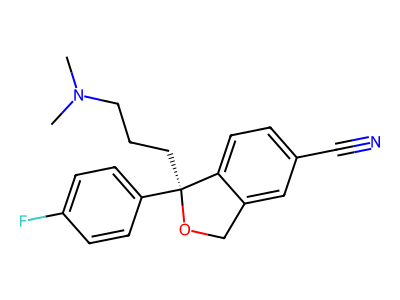
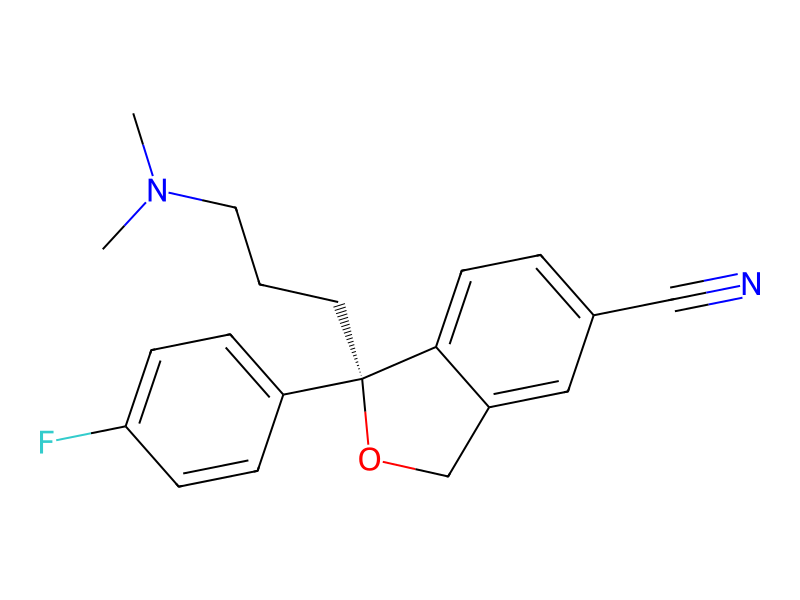
2D-Struktur
Cite this structure
Embed this structure
SMILES
CN(C)CCC[C@@]1(c2ccc(F)cc2)OCc2cc(C#N)ccc21
InChI
InChI=1S/C20H21FN2O/c1-23(2)11-3-10-20(17-5-7-18(21)8-6-17)19-9-4-15(13-22)12-16(19)14-24-20/h4-9,12H,3,10-11,14H2,1-2H3/t20-/m0/s1
Molecular Formula
C20H21FN2O
HBD / HBA
- / 4
Rotierbare Bindungen
5
Schwere Atome
24
Co-prescribing two SSRIs leads to additive serotonin excess with no therapeutic benefit and high risk of serotonin syndrome.
Combining escitalopram with tramadol substantially raises the risk of serotonin syndrome, a potentially life-threatening condition characterized by agitation, hyperthermia, tremor, and autonomic instability.
Both escitalopram and hydroxychloroquine prolong the QT interval; their concurrent use markedly increases the risk of potentially fatal arrhythmias.
Combining two SSRIs is generally contraindicated due to markedly elevated serotonin syndrome risk and no additional therapeutic benefit.
Escitalopram and ondansetron together carry dual risks: serotonin syndrome and additive QT interval prolongation, making this combination particularly dangerous.
Escitalopram and quetiapine both prolong the QT interval; concurrent use carries a substantial risk of torsades de pointes and sudden cardiac death.
Co-administration of escitalopram and sumatriptan may lead to serotonin syndrome, though clinical cases are less frequent than with tramadol combinations.
Escitalopram combined with lithium may augment serotonergic neurotransmission, increasing the risk of serotonin syndrome particularly at higher doses.
Azithromycin and escitalopram each prolong the QT interval; co-administration meaningfully increases the risk of torsades de pointes.
Combining aspirin with escitalopram increases the risk of GI bleeding through additive impairment of hemostasis.
No side effects recorded
Side effect data is not yet available for this drug.
Häufig gestellte Fragen
This antidepressant increases serotonin levels in the brain by blocking its reabsorption into nerve cells, helping to improve mood, anxiety, and related symptoms. It is used to treat major depressive disorder and generalized anxiety disorder.
S-enantiomer of citalopram; selective serotonin reuptake inhibitor.
Key pharmacokinetic parameters for Escitalopram: Half-life: 27-32 hours.
Yes, Escitalopram is an approved drug. It has reached clinical phase 4. It is classified as a Small molecule.
Related Drugs
Same Drug Class
References & Data Sources
- ChEMBL — European Bioinformatics Institute (EBI). CHEMBL1508. Open-access bioactivity database.
- PubChem — National Center for Biotechnology Information (NCBI). CID 146570. Chemical information database.
Data aggregated from publicly available pharmacological databases. Last updated 2026-03-04.
Medizinischer Haftungsausschluss
This content is for educational and informational purposes only. It is not a substitute for professional medical advice, diagnosis, or treatment. Always consult a qualified healthcare provider before making medication decisions.
Embed This Widget
Add the script tag and a data attribute to embed this widget.
<script src="https://cdn.jsdelivr.net/npm/drugfyi-embed@1/dist/embed.min.js" defer></script>
<div data-drugfyi="drug" data-slug="escitalopram"></div>Embed via iframe for maximum compatibility.
<iframe src="https://drugfyi.com/iframe/drug/escitalopram/" width="420" height="400" frameborder="0" style="border:0;border-radius:10px;max-width:100%" loading="lazy"></iframe>Paste this URL in WordPress, Medium, or any oEmbed-compatible platform.
https://drugfyi.com/drug/escitalopram/Add a dynamic SVG badge to your README or docs.
[](https://drugfyi.com/drug/escitalopram/)Use the native HTML custom element.
<script src="https://cdn.jsdelivr.net/npm/drugfyi-embed@1/dist/embed.min.js" defer></script>
<drugfyi-drug slug="escitalopram"></drugfyi-drug>