Cephaloridine
One of the earliest cephalosporin antibiotics, previously used parenterally for gram-positive bacterial infections, now obsolete due to significant nephrotoxicity that limits its safe use. Its renal tubular toxicity made it dangerous at therapeutic doses. It has been entirely replaced by safer cephalosporin generations.
Molekularmasse
415,5000 g/mol
LogP
1,90
TPSA
147,00 Ų
Lipinski-Regel der Fünf
Bestanden
Wirkmechanismus
Disrupts bacterial cell wall synthesis by binding to penicillin-binding proteins (PBPs), inhibiting the final transpeptidation step of peptidoglycan synthesis. The resulting cell wall defects cause osmotic instability and bacteriolysis.
Pharmacokinetics (PK)
Pharmacodynamics (PD)
Disrupts bacterial cell wall synthesis by binding to penicillin-binding proteins (PBPs), inhibiting the final transpeptidation step of peptidoglycan synthesis. The resulting cell wall defects cause osmotic instability and bacteriolysis.
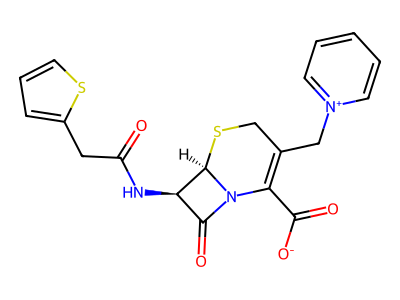
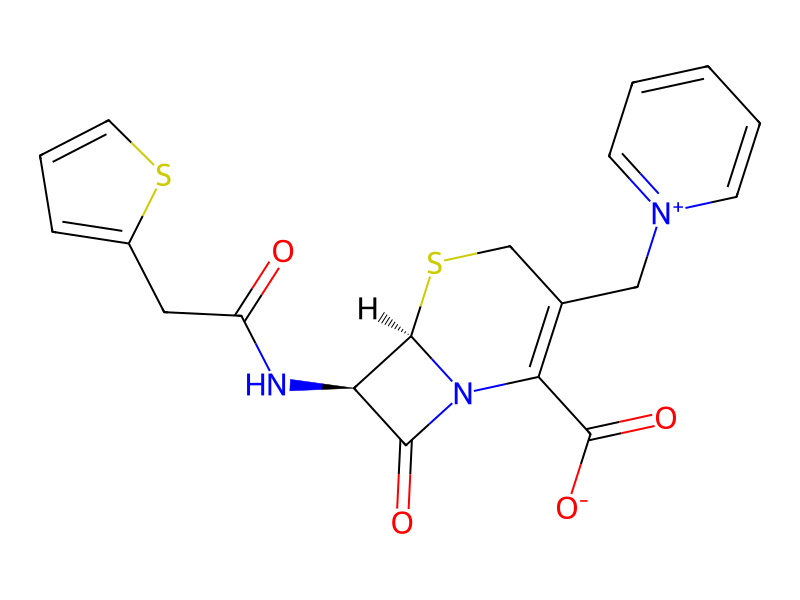
2D-Struktur
Cite this structure
Embed this structure
SMILES
O=C(Cc1cccs1)N[C@@H]1C(=O)N2C(C(=O)[O-])=C(C[n+]3ccccc3)CS[C@H]12
InChI
InChI=1S/C19H17N3O4S2/c23-14(9-13-5-4-8-27-13)20-15-17(24)22-16(19(25)26)12(11-28-18(15)22)10-21-6-2-1-3-7-21/h1-8,15,18H,9-11H2,(H-,20,23,25,26)/t15-,18-/m1/s1
Molecular Formula
C19H17N3O4S2
HBD / HBA
1 / 6
Rotierbare Bindungen
5
Schwere Atome
28
No targets recorded
Target interaction data is not yet available for this drug.
No interactions recorded
Drug interaction data is not yet available for this compound.
No side effects recorded
Side effect data is not yet available for this drug.
Häufig gestellte Fragen
One of the earliest cephalosporin antibiotics, previously used parenterally for gram-positive bacterial infections, now obsolete due to significant nephrotoxicity that limits its safe use. Its renal tubular toxicity made it dangerous at therapeutic doses. It has been entirely replaced by safer cephalosporin generations.
Disrupts bacterial cell wall synthesis by binding to penicillin-binding proteins (PBPs), inhibiting the final transpeptidation step of peptidoglycan synthesis. The resulting cell wall defects cause osmotic instability and bacteriolysis.
Yes, Cephaloridine is an approved drug. It has reached clinical phase 4. It is classified as a Small molecule.
References & Data Sources
- ChEMBL — European Bioinformatics Institute (EBI). CHEMBL316157. Open-access bioactivity database.
- PubChem — National Center for Biotechnology Information (NCBI). CID 5773. Chemical information database.
Data aggregated from publicly available pharmacological databases. Last updated 2026-03-04.
Medizinischer Haftungsausschluss
This content is for educational and informational purposes only. It is not a substitute for professional medical advice, diagnosis, or treatment. Always consult a qualified healthcare provider before making medication decisions.
Embed This Widget
Add the script tag and a data attribute to embed this widget.
<script src="https://cdn.jsdelivr.net/npm/drugfyi-embed@1/dist/embed.min.js" defer></script>
<div data-drugfyi="drug" data-slug="cephaloridine"></div>Embed via iframe for maximum compatibility.
<iframe src="https://drugfyi.com/iframe/drug/cephaloridine/" width="420" height="400" frameborder="0" style="border:0;border-radius:10px;max-width:100%" loading="lazy"></iframe>Paste this URL in WordPress, Medium, or any oEmbed-compatible platform.
https://drugfyi.com/drug/cephaloridine/Add a dynamic SVG badge to your README or docs.
[](https://drugfyi.com/drug/cephaloridine/)Use the native HTML custom element.
<script src="https://cdn.jsdelivr.net/npm/drugfyi-embed@1/dist/embed.min.js" defer></script>
<drugfyi-drug slug="cephaloridine"></drugfyi-drug>