Alfuzosin Hydrochloride
Relief of bladder outlet obstruction in benign prostatic hyperplasia is the therapeutic purpose of alfuzosin hydrochloride, the salt form of an alpha-1 adrenoceptor antagonist. Blockade of alpha-1 receptors relaxes smooth muscle in the prostate and bladder neck, widening the outflow tract so that urine flow improves and lower urinary tract symptoms diminish in men with the condition. The salt reproduces the pharmacology of the parent compound without altering its receptor selectivity or its site of action. Because the target is a vascular as well as a urinary receptor, the class is associated with blood-pressure-related effects. The compound is a small molecule, C19H28ClN5O4, of roughly 425.9 g/mol, approved and taken through the final phase of development.
The hydrochloride salt form of alfuzosin, an alpha-1 receptor antagonist used to relax smooth muscle in the prostate and bladder neck to relieve urinary obstruction caused by BPH. This formulation provides the same mechanism of action as the parent compound, improving urine flow and reducing bothersome lower urinary tract symptoms in men.
Molecular Weight
425.9000 g/mol
TPSA
112.00 Ų
Therapeutic Areas
Mechanism of Action
A selective alpha-1 adrenoceptor antagonist. Alfuzosin blocks alpha-1 receptors on prostatic and bladder-neck smooth muscle, relieving the dynamic component of bladder outlet obstruction in benign prostatic hyperplasia. Its extended-release formulation limits, but does not abolish, the vascular alpha-1 blockade responsible for dizziness and orthostatic hypotension.
Pharmacokinetics (PK)
Pharmacodynamics (PD)
A selective alpha-1 adrenoceptor antagonist. Alfuzosin blocks alpha-1 receptors on prostatic and bladder-neck smooth muscle, relieving the dynamic component of bladder outlet obstruction in benign prostatic hyperplasia. Its extended-release formulation …
2D Structure
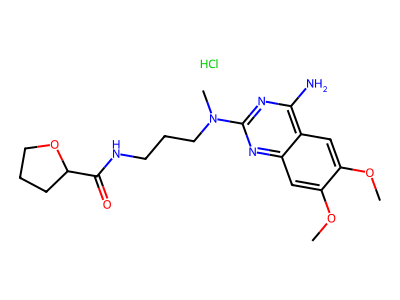
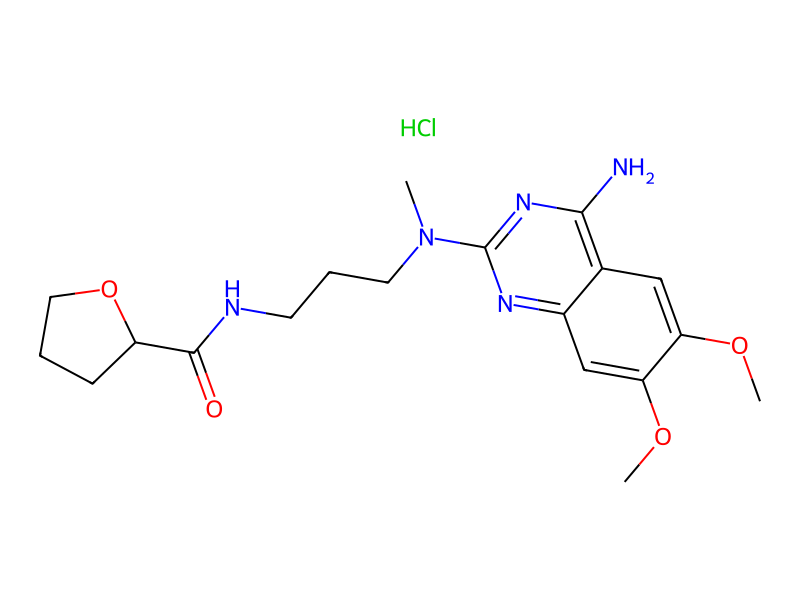
Cite this structure
Embed this structure
SMILES
COc1cc2nc(N(C)CCCNC(=O)C3CCCO3)nc(N)c2cc1OC.Cl
InChI
InChI=1S/C19H27N5O4.ClH/c1-24(8-5-7-21-18(25)14-6-4-9-28-14)19-22-13-11-16(27-3)15(26-2)10-12(13)17(20)23-19;/h10-11,14H,4-9H2,1-3H3,(H,21,25)(H2,20,22,23);1H
Molecular Formula
C19H28ClN5O4
HBD / HBA
3 / 8
Rotatable Bonds
8
Heavy Atoms
29
No targets recorded
Target interaction data is not yet available for this drug.
No interactions recorded
Drug interaction data is not yet available for this compound.
No side effects recorded
Side effect data is not yet available for this drug.
Frequently Asked Questions
The hydrochloride salt form of alfuzosin, an alpha-1 receptor antagonist used to relax smooth muscle in the prostate and bladder neck to relieve urinary obstruction caused by BPH. This formulation provides the same mechanism of action as the parent compound, improving urine flow and reducing bothersome lower urinary tract symptoms in men.
A selective alpha-1 adrenoceptor antagonist. Alfuzosin blocks alpha-1 receptors on prostatic and bladder-neck smooth muscle, relieving the dynamic component of bladder outlet obstruction in benign prostatic hyperplasia. Its extended-release formulation limits, but does not abolish, the vascular alpha-1 blockade responsible for dizziness and orthostatic hypotension.
Yes, Alfuzosin Hydrochloride is an approved drug. It has reached clinical phase 4. It is classified as a Small molecule.
References & Data Sources
- ChEMBL — European Bioinformatics Institute (EBI). CHEMBL1723. Open-access bioactivity database.
- PubChem — National Center for Biotechnology Information (NCBI). CID 71764. Chemical information database.
Data aggregated from publicly available pharmacological databases. Last updated 2026-08-20.
Embed This Widget
Add the script tag and a data attribute to embed this widget.
<script src="https://cdn.jsdelivr.net/npm/drugfyi-embed@1/dist/embed.min.js" defer></script>
<div data-drugfyi="drug" data-slug="alfuzosin-hydrochloride"></div>Embed via iframe for maximum compatibility.
<iframe src="https://drugfyi.com/iframe/drug/alfuzosin-hydrochloride/" width="420" height="400" frameborder="0" style="border:0;border-radius:10px;max-width:100%" loading="lazy"></iframe>Paste this URL in WordPress, Medium, or any oEmbed-compatible platform.
https://drugfyi.com/drug/alfuzosin-hydrochloride/Add a dynamic SVG badge to your README or docs.
[](https://drugfyi.com/drug/alfuzosin-hydrochloride/)Use the native HTML custom element.
<script src="https://cdn.jsdelivr.net/npm/drugfyi-embed@1/dist/embed.min.js" defer></script>
<drugfyi-drug slug="alfuzosin-hydrochloride"></drugfyi-drug>