Anisindione
An anticoagulant of the indanedione class that prevents blood clotting by blocking vitamin K-dependent clotting factor synthesis in the liver. It has largely been replaced by warfarin due to concerns about adverse effects.
Molecular Weight
252.2600 g/mol
LogP
2.90
TPSA
43.40 Ų
Lipinski RO5
Pass
Therapeutic Areas
Pharmacokinetics (PK)
Pharmacodynamics (PD)
2D Structure
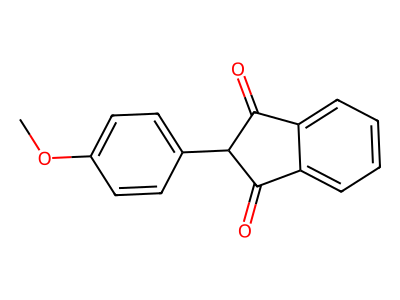
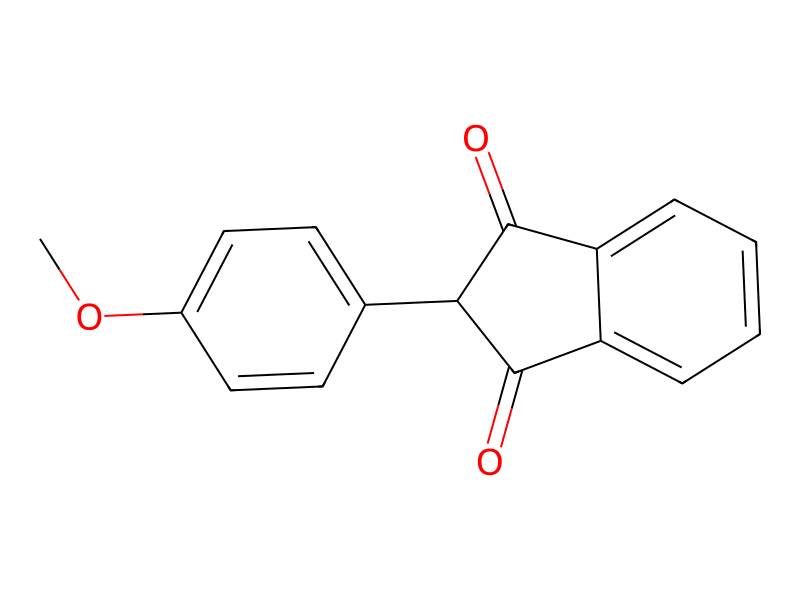
Cite this structure
Embed this structure
SMILES
COc1ccc(C2C(=O)c3ccccc3C2=O)cc1
InChI
InChI=1S/C16H12O3/c1-19-11-8-6-10(7-9-11)14-15(17)12-4-2-3-5-13(12)16(14)18/h2-9,14H,1H3
Molecular Formula
C16H12O3
HBD / HBA
- / 3
Rotatable Bonds
2
Heavy Atoms
19
No targets recorded
Target interaction data is not yet available for this drug.
No interactions recorded
Drug interaction data is not yet available for this compound.
No side effects recorded
Side effect data is not yet available for this drug.
Frequently Asked Questions
An anticoagulant of the indanedione class that prevents blood clotting by blocking vitamin K-dependent clotting factor synthesis in the liver. It has largely been replaced by warfarin due to concerns about adverse effects.
Yes, Anisindione is an approved drug. It has reached clinical phase 4. It is classified as a Small molecule.
References & Data Sources
- ChEMBL — European Bioinformatics Institute (EBI). CHEMBL712. Open-access bioactivity database.
- PubChem — National Center for Biotechnology Information (NCBI). CID 2197. Chemical information database.
Data aggregated from publicly available pharmacological databases. Last updated 2026-08-20.
Embed This Widget
Add the script tag and a data attribute to embed this widget.
<script src="https://cdn.jsdelivr.net/npm/drugfyi-embed@1/dist/embed.min.js" defer></script>
<div data-drugfyi="drug" data-slug="anisindione"></div>Embed via iframe for maximum compatibility.
<iframe src="https://drugfyi.com/iframe/drug/anisindione/" width="420" height="400" frameborder="0" style="border:0;border-radius:10px;max-width:100%" loading="lazy"></iframe>Paste this URL in WordPress, Medium, or any oEmbed-compatible platform.
https://drugfyi.com/drug/anisindione/Add a dynamic SVG badge to your README or docs.
[](https://drugfyi.com/drug/anisindione/)Use the native HTML custom element.
<script src="https://cdn.jsdelivr.net/npm/drugfyi-embed@1/dist/embed.min.js" defer></script>
<drugfyi-drug slug="anisindione"></drugfyi-drug>