Cerivastatin
Withdrawal in 2001 makes cerivastatin one of the most cited cases in post-marketing drug safety. The compound is a synthetic inhibitor of HMG-CoA reductase, the rate-limiting enzyme of the mevalonate pathway; blocking it depletes intracellular cholesterol, upregulates LDL receptor expression and lowers circulating LDL cholesterol, the mechanism shared by the statin class. Efficacy was not the problem. An unacceptably high incidence of potentially fatal rhabdomyolysis emerged after marketing, concentrated among patients also receiving gemfibrozil, and the manufacturer removed the drug from the world market voluntarily. The molecule is C26H34FNO5 with a mass near 459.5 g/mol, and its development had reached the final clinical phase.
A synthetic HMG-CoA reductase inhibitor (statin) used to lower LDL cholesterol and reduce cardiovascular risk. It was voluntarily withdrawn from the worldwide market in 2001 due to an unacceptably high incidence of potentially fatal rhabdomyolysis, particularly when combined with gemfibrozil. It represents an important pharmacovigilance case study in post-marketing drug safety.
Molecular Weight
459.5000 g/mol
LogP
3.60
TPSA
99.90 Ų
Lipinski RO5
Pass
Therapeutic Areas
Mechanism of Action
Competitively inhibits HMG-CoA reductase, the rate-limiting enzyme in the mevalonate pathway of cholesterol biosynthesis. This reduces intracellular cholesterol, upregulates LDL receptor expression, and lowers circulating LDL cholesterol.
Pharmacokinetics (PK)
Pharmacodynamics (PD)
Competitively inhibits HMG-CoA reductase, the rate-limiting enzyme in the mevalonate pathway of cholesterol biosynthesis. This reduces intracellular cholesterol, upregulates LDL receptor expression, and lowers circulating LDL cholesterol.
2D Structure
Cite this structure
Embed this structure
SMILES
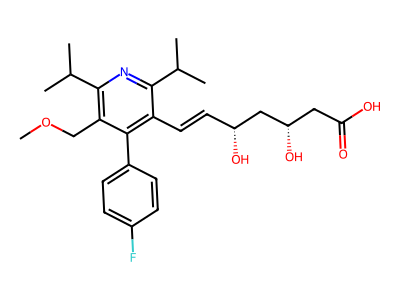
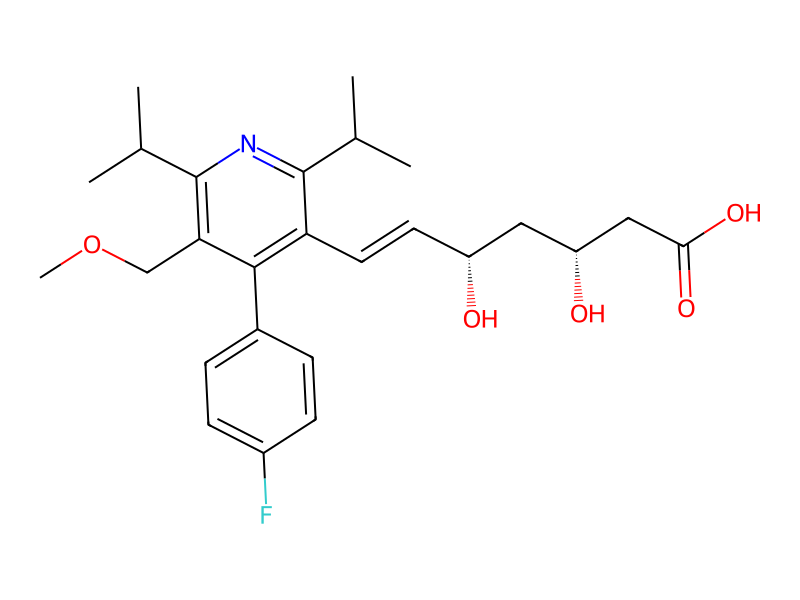
COCc1c(C(C)C)nc(C(C)C)c(/C=C/[C@@H](O)C[C@@H](O)CC(=O)O)c1-c1ccc(F)cc1
InChI
InChI=1S/C26H34FNO5/c1-15(2)25-21(11-10-19(29)12-20(30)13-23(31)32)24(17-6-8-18(27)9-7-17)22(14-33-5)26(28-25)16(3)4/h6-11,15-16,19-20,29-30H,12-14H2,1-5H3,(H,31,32)/b11-10+/t19-,20-/m1/s1
Molecular Formula
C26H34FNO5
HBD / HBA
3 / 7
Rotatable Bonds
11
Heavy Atoms
33
No targets recorded
Target interaction data is not yet available for this drug.
No interactions recorded
Drug interaction data is not yet available for this compound.
No side effects recorded
Side effect data is not yet available for this drug.
Frequently Asked Questions
A synthetic HMG-CoA reductase inhibitor (statin) used to lower LDL cholesterol and reduce cardiovascular risk. It was voluntarily withdrawn from the worldwide market in 2001 due to an unacceptably high incidence of potentially fatal rhabdomyolysis, particularly when combined with gemfibrozil. It represents an important pharmacovigilance case study in post-marketing drug safety.
Competitively inhibits HMG-CoA reductase, the rate-limiting enzyme in the mevalonate pathway of cholesterol biosynthesis. This reduces intracellular cholesterol, upregulates LDL receptor expression, and lowers circulating LDL cholesterol.
Yes, Cerivastatin is an approved drug. It has reached clinical phase 4. It is classified as a Small molecule.
References & Data Sources
- ChEMBL — European Bioinformatics Institute (EBI). CHEMBL1477. Open-access bioactivity database.
- PubChem — National Center for Biotechnology Information (NCBI). CID 446156. Chemical information database.
Data aggregated from publicly available pharmacological databases. Last updated 2026-08-20.
Embed This Widget
Add the script tag and a data attribute to embed this widget.
<script src="https://cdn.jsdelivr.net/npm/drugfyi-embed@1/dist/embed.min.js" defer></script>
<div data-drugfyi="drug" data-slug="cerivastatin"></div>Embed via iframe for maximum compatibility.
<iframe src="https://drugfyi.com/iframe/drug/cerivastatin/" width="420" height="400" frameborder="0" style="border:0;border-radius:10px;max-width:100%" loading="lazy"></iframe>Paste this URL in WordPress, Medium, or any oEmbed-compatible platform.
https://drugfyi.com/drug/cerivastatin/Add a dynamic SVG badge to your README or docs.
[](https://drugfyi.com/drug/cerivastatin/)Use the native HTML custom element.
<script src="https://cdn.jsdelivr.net/npm/drugfyi-embed@1/dist/embed.min.js" defer></script>
<drugfyi-drug slug="cerivastatin"></drugfyi-drug>