Finasteride
By inhibiting the type II 5-alpha-reductase enzyme that converts testosterone into the more potent dihydrotestosterone, finasteride reduces a hormone that drives prostate growth and male-pattern hair loss. It shrinks an enlarged prostate to relieve urinary symptoms and, at a lower dose, slows scalp hair loss. Marketed as Proscar and Propecia, the steroid derivative has the formula C23H36N2O2.
This medication works by blocking an enzyme that converts testosterone into a more potent hormone called dihydrotestosterone, which drives prostate growth and male-pattern hair loss. It is used to shrink an enlarged prostate and relieve urinary symptoms, as well as to treat male hair loss.
Molecular Weight
372.5490 g/mol
LogP
3.00
TPSA
58.20 Ų
Lipinski RO5
Pass
Therapeutic Areas
Drug Classes
Mechanism of Action
Competitive inhibitor of 5-alpha-reductase type II.
Pharmacokinetics (PK)
Pharmacodynamics (PD)
Competitive inhibitor of 5-alpha-reductase type II.
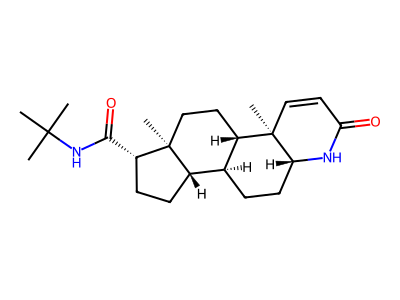
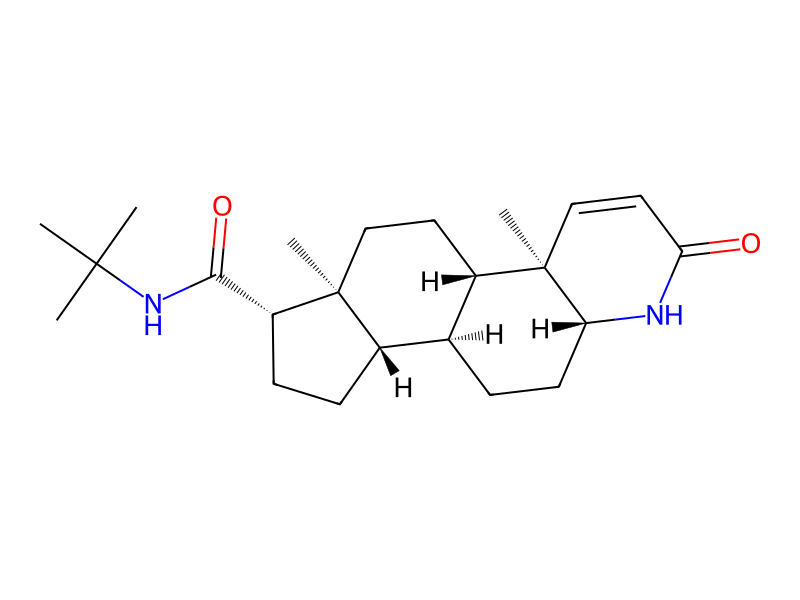
2D Structure
Cite this structure
Embed this structure
SMILES
CC(C)(C)NC(=O)[C@H]1CC[C@H]2[C@@H]3CC[C@H]4NC(=O)C=C[C@]4(C)[C@H]3CC[C@]12C
InChI
InChI=1S/C23H36N2O2/c1-21(2,3)25-20(27)17-8-7-15-14-6-9-18-23(5,13-11-19(26)24-18)16(14)10-12-22(15,17)4/h11,13-18H,6-10,12H2,1-5H3,(H,24,26)(H,25,27)/t14-,15-,16-,17+,18+,22-,23+/m0/s1
Molecular Formula
C23H36N2O2
HBD / HBA
2 / 2
Rotatable Bonds
2
Heavy Atoms
27
No targets recorded
Target interaction data is not yet available for this drug.
Finasteride and tamsulosin are deliberately combined (as Duodart/Jalyn) for BPH treatment; the combination provides additive symptom relief with no significant adverse pharmacokinetic interaction.
Fluconazole inhibits CYP3A4, which contributes to finasteride metabolism; co-administration may modestly increase finasteride plasma concentrations, though the clinical significance is generally low.
No clinically significant pharmacokinetic or pharmacodynamic interaction is established between doxycycline and finasteride; they are occasionally co-prescribed in patients with androgenetic alopecia and concomitant infections.
No side effects recorded
Side effect data is not yet available for this drug.
Frequently Asked Questions
This medication works by blocking an enzyme that converts testosterone into a more potent hormone called dihydrotestosterone, which drives prostate growth and male-pattern hair loss. It is used to shrink an enlarged prostate and relieve urinary symptoms, as well as to treat male hair loss.
Competitive inhibitor of 5-alpha-reductase type II.
Key pharmacokinetic parameters for Finasteride: Half-life: 5-6 hours.
Yes, Finasteride is an approved drug. It has reached clinical phase 4. It is classified as a Small molecule.
Related Drugs
Same Drug Class
References & Data Sources
- ChEMBL — European Bioinformatics Institute (EBI). CHEMBL710. Open-access bioactivity database.
- PubChem — National Center for Biotechnology Information (NCBI). CID 57363. Chemical information database.
Data aggregated from publicly available pharmacological databases. Last updated 2026-03-04.
Embed This Widget
Add the script tag and a data attribute to embed this widget.
<script src="https://cdn.jsdelivr.net/npm/drugfyi-embed@1/dist/embed.min.js" defer></script>
<div data-drugfyi="drug" data-slug="finasteride"></div>Embed via iframe for maximum compatibility.
<iframe src="https://drugfyi.com/iframe/drug/finasteride/" width="420" height="400" frameborder="0" style="border:0;border-radius:10px;max-width:100%" loading="lazy"></iframe>Paste this URL in WordPress, Medium, or any oEmbed-compatible platform.
https://drugfyi.com/drug/finasteride/Add a dynamic SVG badge to your README or docs.
[](https://drugfyi.com/drug/finasteride/)Use the native HTML custom element.
<script src="https://cdn.jsdelivr.net/npm/drugfyi-embed@1/dist/embed.min.js" defer></script>
<drugfyi-drug slug="finasteride"></drugfyi-drug>