Methapyrilene
An antihistamine formerly used to treat allergy symptoms and as a sleep aid, this medication was withdrawn from the market after studies showed it caused liver cancer in animals. It is no longer available for medical use.
Molecular Weight
261.3900 g/mol
LogP
2.60
TPSA
47.60 Ų
Lipinski RO5
Pass
Mechanism of Action
Competitively blocks histamine H1 receptors on effector cells, preventing histamine-mediated vasodilation, increased vascular permeability, bronchoconstriction, and pruritus. First-generation agents also cross the blood-brain barrier, causing sedation.
Pharmacokinetics (PK)
Pharmacodynamics (PD)
Competitively blocks histamine H1 receptors on effector cells, preventing histamine-mediated vasodilation, increased vascular permeability, bronchoconstriction, and pruritus. First-generation agents also cross the blood-brain barrier, causing sedation.
2D Structure
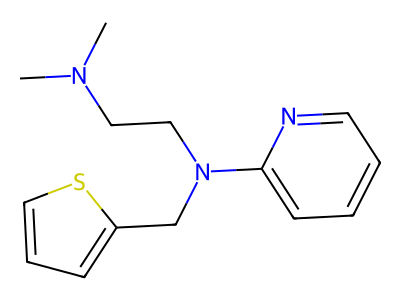
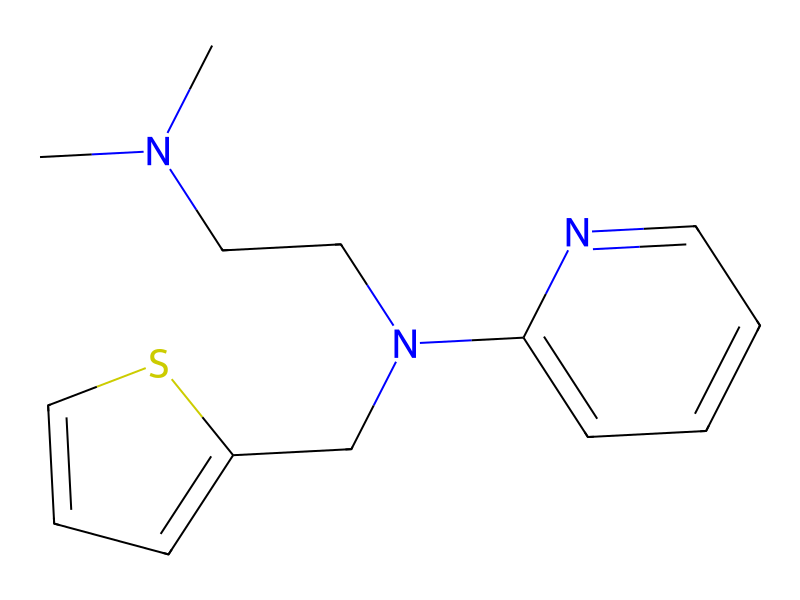
Cite this structure
Embed this structure
SMILES
CN(C)CCN(Cc1cccs1)c1ccccn1
InChI
InChI=1S/C14H19N3S/c1-16(2)9-10-17(12-13-6-5-11-18-13)14-7-3-4-8-15-14/h3-8,11H,9-10,12H2,1-2H3
Molecular Formula
C14H19N3S
HBD / HBA
- / 4
Rotatable Bonds
6
Heavy Atoms
18
No targets recorded
Target interaction data is not yet available for this drug.
No interactions recorded
Drug interaction data is not yet available for this compound.
No side effects recorded
Side effect data is not yet available for this drug.
Frequently Asked Questions
An antihistamine formerly used to treat allergy symptoms and as a sleep aid, this medication was withdrawn from the market after studies showed it caused liver cancer in animals. It is no longer available for medical use.
Competitively blocks histamine H1 receptors on effector cells, preventing histamine-mediated vasodilation, increased vascular permeability, bronchoconstriction, and pruritus. First-generation agents also cross the blood-brain barrier, causing sedation.
Yes, Methapyrilene is an approved drug. It has reached clinical phase 4. It is classified as a Small molecule.
References & Data Sources
- ChEMBL — European Bioinformatics Institute (EBI). CHEMBL1411979. Open-access bioactivity database.
- PubChem — National Center for Biotechnology Information (NCBI). CID 4098. Chemical information database.
Data aggregated from publicly available pharmacological databases. Last updated 2026-03-28.
Embed This Widget
Add the script tag and a data attribute to embed this widget.
<script src="https://cdn.jsdelivr.net/npm/drugfyi-embed@1/dist/embed.min.js" defer></script>
<div data-drugfyi="drug" data-slug="methapyrilene"></div>Embed via iframe for maximum compatibility.
<iframe src="https://drugfyi.com/iframe/drug/methapyrilene/" width="420" height="400" frameborder="0" style="border:0;border-radius:10px;max-width:100%" loading="lazy"></iframe>Paste this URL in WordPress, Medium, or any oEmbed-compatible platform.
https://drugfyi.com/drug/methapyrilene/Add a dynamic SVG badge to your README or docs.
[](https://drugfyi.com/drug/methapyrilene/)Use the native HTML custom element.
<script src="https://cdn.jsdelivr.net/npm/drugfyi-embed@1/dist/embed.min.js" defer></script>
<drugfyi-drug slug="methapyrilene"></drugfyi-drug>