Pancuronium Bromide
Temporary paralysis of skeletal muscle is the intended effect of pancuronium bromide, used during surgery and to facilitate mechanical ventilation. The agent acts at the neuromuscular junction, blocking transmission between motor nerve and muscle fibre so that contraction cannot occur; consciousness and sensation are unaffected, which is why it is given only alongside anaesthesia and sedation. Because ventilation itself depends on skeletal muscle, use is restricted to settings where the airway is controlled and respiration supported. The bromide salt carries the therapeutic properties of pancuronium without modification. Chemically the salt is C35H60Br2N2O4 with a mass near 732.7 g/mol, approved and developed through the final clinical phase.
A bromide salt form of pancuronium with the same therapeutic properties. This muscle relaxant is used during surgery or mechanical ventilation to temporarily paralyze muscles.
Molecular Weight
732.7000 g/mol
TPSA
52.60 Ų
Therapeutic Areas
Mechanism of Action
A long-acting non-depolarising neuromuscular blocking agent. Pancuronium competes with acetylcholine for nicotinic receptors at the motor end plate, preventing depolarisation and producing flaccid skeletal muscle paralysis that is reversed by acetylcholinesterase inhibitors such as neostigmine. Vagolytic and sympathomimetic activity accounts for the rise in heart rate seen after dosing.
Pharmacokinetics (PK)
Pharmacodynamics (PD)
A long-acting non-depolarising neuromuscular blocking agent. Pancuronium competes with acetylcholine for nicotinic receptors at the motor end plate, preventing depolarisation and producing flaccid skeletal muscle paralysis that is reversed by …
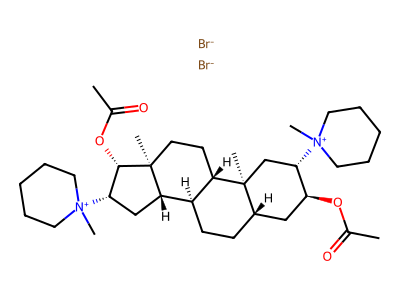
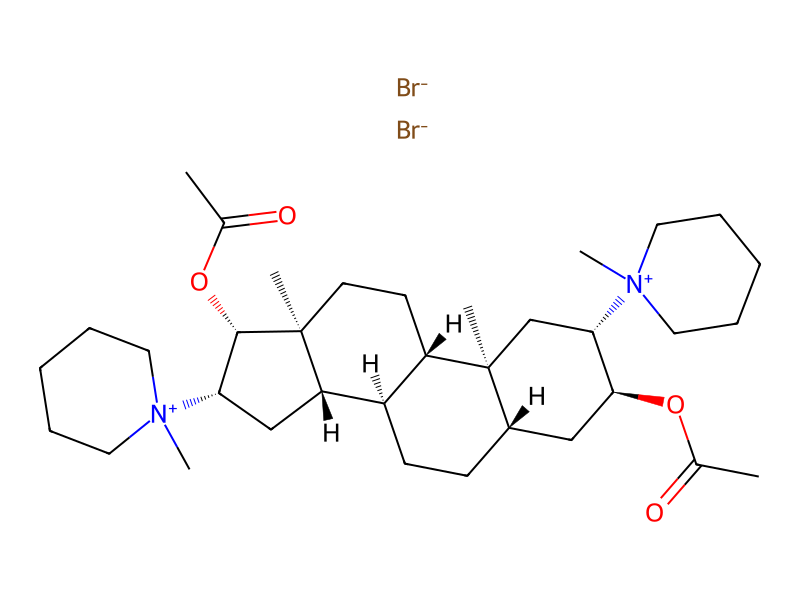
2D Structure
Cite this structure
Embed this structure
SMILES
CC(=O)O[C@H]1C[C@@H]2CC[C@@H]3[C@H](CC[C@@]4(C)[C@H]3C[C@H]([N+]3(C)CCCCC3)[C@@H]4OC(C)=O)[C@@]2(C)C[C@@H]1[N+]1(C)CCCCC1.[Br-].[Br-]
InChI
InChI=1S/C35H60N2O4.2BrH/c1-24(38)40-32-21-26-13-14-27-28(35(26,4)23-31(32)37(6)19-11-8-12-20-37)15-16-34(3)29(27)22-30(33(34)41-25(2)39)36(5)17-9-7-10-18-36;;/h26-33H,7-23H2,1-6H3;2*1H/q+2;;/p-2/t26-,27+,28-,29-,30-,31-,32-,33-,34-,35-;;/m0../s1
Molecular Formula
C35H60Br2N2O4
HBD / HBA
- / 6
Rotatable Bonds
6
Heavy Atoms
43
No targets recorded
Target interaction data is not yet available for this drug.
No interactions recorded
Drug interaction data is not yet available for this compound.
No side effects recorded
Side effect data is not yet available for this drug.
Frequently Asked Questions
A bromide salt form of pancuronium with the same therapeutic properties. This muscle relaxant is used during surgery or mechanical ventilation to temporarily paralyze muscles.
A long-acting non-depolarising neuromuscular blocking agent. Pancuronium competes with acetylcholine for nicotinic receptors at the motor end plate, preventing depolarisation and producing flaccid skeletal muscle paralysis that is reversed by acetylcholinesterase inhibitors such as neostigmine. Vagolytic and sympathomimetic activity accounts for the rise in heart rate seen after dosing.
Yes, Pancuronium Bromide is an approved drug. It has reached clinical phase 4. It is classified as a Small molecule.
References & Data Sources
- ChEMBL — European Bioinformatics Institute (EBI). CHEMBL1200757. Open-access bioactivity database.
- PubChem — National Center for Biotechnology Information (NCBI). CID 27350. Chemical information database.
Data aggregated from publicly available pharmacological databases. Last updated 2026-08-20.
Embed This Widget
Add the script tag and a data attribute to embed this widget.
<script src="https://cdn.jsdelivr.net/npm/drugfyi-embed@1/dist/embed.min.js" defer></script>
<div data-drugfyi="drug" data-slug="pancuronium-bromide"></div>Embed via iframe for maximum compatibility.
<iframe src="https://drugfyi.com/iframe/drug/pancuronium-bromide/" width="420" height="400" frameborder="0" style="border:0;border-radius:10px;max-width:100%" loading="lazy"></iframe>Paste this URL in WordPress, Medium, or any oEmbed-compatible platform.
https://drugfyi.com/drug/pancuronium-bromide/Add a dynamic SVG badge to your README or docs.
[](https://drugfyi.com/drug/pancuronium-bromide/)Use the native HTML custom element.
<script src="https://cdn.jsdelivr.net/npm/drugfyi-embed@1/dist/embed.min.js" defer></script>
<drugfyi-drug slug="pancuronium-bromide"></drugfyi-drug>