Primaquine Phosphate
Dormant liver stages are the reason primaquine phosphate occupies a distinct position in antimalarial therapy. Plasmodium vivax and Plasmodium ovale leave hypnozoites in hepatocytes that can reactivate weeks or months after the initial illness, and this agent eliminates them, preventing the relapses that blood-stage treatment alone cannot avert. It is used both for that radical cure and for prevention of the infections concerned. The phosphate salt carries the therapeutic properties of primaquine itself without altering them. Chemically the salt is recorded as C15H27N3O9P2 with a formula mass close to 455.3 g/mol. It is an approved small-molecule antiparasitic agent developed through the final clinical phase.
A phosphate salt form of primaquine with the same therapeutic properties. An antiparasitic medication used to treat and prevent certain types of malaria, particularly to eliminate the dormant liver stages of Plasmodium vivax and Plasmodium ovale that can cause the infection to relapse weeks or months later.
Peso molecular
455,3400 g/mol
TPSA
216,00 Ų
Áreas terapéuticas
Mecanismo de acción
An 8-aminoquinoline antimalarial. Primaquine is metabolised to redox-active quinoline-quinones that generate reactive oxygen species and disrupt the parasite's mitochondrial electron transport chain, killing the hepatic hypnozoites of Plasmodium vivax and P. ovale that cause relapse, as well as gametocytes. The same oxidative chemistry causes haemolysis in people with glucose-6-phosphate dehydrogenase deficiency.
Pharmacokinetics (PK)
Pharmacodynamics (PD)
An 8-aminoquinoline antimalarial. Primaquine is metabolised to redox-active quinoline-quinones that generate reactive oxygen species and disrupt the parasite's mitochondrial electron transport chain, killing the hepatic hypnozoites of Plasmodium vivax and …
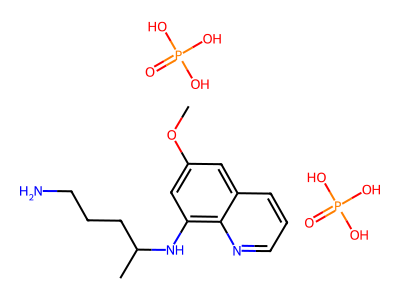
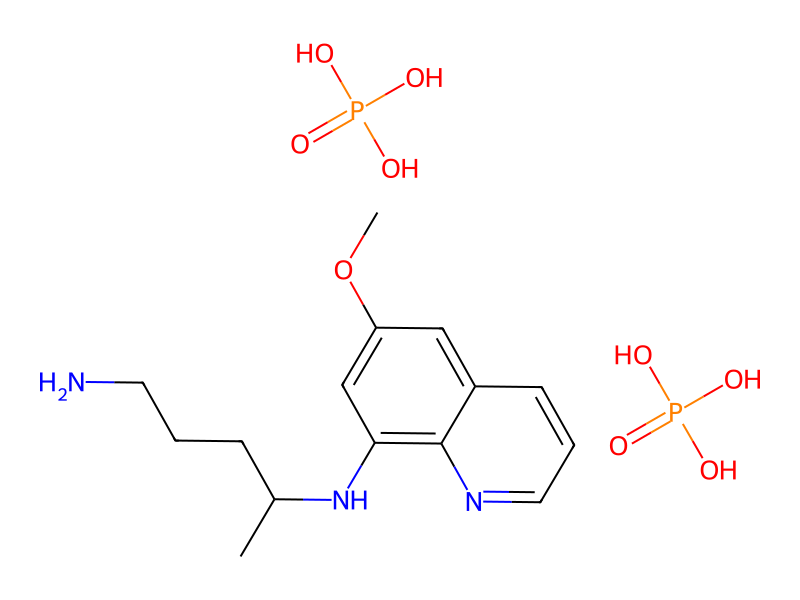
Estructura 2D
Cite this structure
Embed this structure
SMILES
COc1cc(NC(C)CCCN)c2ncccc2c1.O=P(O)(O)O.O=P(O)(O)O
InChI
InChI=1S/C15H21N3O.2H3O4P/c1-11(5-3-7-16)18-14-10-13(19-2)9-12-6-4-8-17-15(12)14;2*1-5(2,3)4/h4,6,8-11,18H,3,5,7,16H2,1-2H3;2*(H3,1,2,3,4)
Molecular Formula
C15H27N3O9P2
HBD / HBA
8 / 12
Enlaces Rotables
6
Átomos Pesados
29
No targets recorded
Target interaction data is not yet available for this drug.
No interactions recorded
Drug interaction data is not yet available for this compound.
No side effects recorded
Side effect data is not yet available for this drug.
Preguntas frecuentes
A phosphate salt form of primaquine with the same therapeutic properties. An antiparasitic medication used to treat and prevent certain types of malaria, particularly to eliminate the dormant liver stages of Plasmodium vivax and Plasmodium ovale that can cause the infection to relapse weeks or months later.
An 8-aminoquinoline antimalarial. Primaquine is metabolised to redox-active quinoline-quinones that generate reactive oxygen species and disrupt the parasite's mitochondrial electron transport chain, killing the hepatic hypnozoites of Plasmodium vivax and P. ovale that cause relapse, as well as gametocytes. The same oxidative chemistry causes haemolysis in people with glucose-6-phosphate dehydrogenase deficiency.
Yes, Primaquine Phosphate is an approved drug. It has reached clinical phase 4. It is classified as a Small molecule.
References & Data Sources
- ChEMBL — European Bioinformatics Institute (EBI). CHEMBL43128. Open-access bioactivity database.
- PubChem — National Center for Biotechnology Information (NCBI). CID 6135. Chemical information database.
Data aggregated from publicly available pharmacological databases. Last updated 2026-08-20.
Embed This Widget
Add the script tag and a data attribute to embed this widget.
<script src="https://cdn.jsdelivr.net/npm/drugfyi-embed@1/dist/embed.min.js" defer></script>
<div data-drugfyi="drug" data-slug="primaquine-phosphate"></div>Embed via iframe for maximum compatibility.
<iframe src="https://drugfyi.com/iframe/drug/primaquine-phosphate/" width="420" height="400" frameborder="0" style="border:0;border-radius:10px;max-width:100%" loading="lazy"></iframe>Paste this URL in WordPress, Medium, or any oEmbed-compatible platform.
https://drugfyi.com/drug/primaquine-phosphate/Add a dynamic SVG badge to your README or docs.
[](https://drugfyi.com/drug/primaquine-phosphate/)Use the native HTML custom element.
<script src="https://cdn.jsdelivr.net/npm/drugfyi-embed@1/dist/embed.min.js" defer></script>
<drugfyi-drug slug="primaquine-phosphate"></drugfyi-drug>