Abacavir Sulfate
The sulfate salt of abacavir carries the same antiretroviral activity and the same precautions as the parent nucleoside analogue, and is the form used in oral combination regimens for HIV infection. It is never given alone; treatment pairs it with other antiretroviral agents to suppress viral replication and limit the emergence of resistance. The defining safety consideration is genetic: carriage of the HLA-B*5701 allele predicts a hypersensitivity reaction that can be life-threatening, so screening for that variant precedes any exposure to the drug. This pharmacogenomic screening requirement is one of the earliest routine examples in antiretroviral practice. The salt has the formula C28H38N12O6S, a mass close to 670.7 g/mol, and is an approved small molecule.
The sulfate salt form of abacavir, an antiretroviral medicine used to treat HIV infection with the same mechanism and precautions as abacavir itself. It is taken orally, usually once or twice daily as part of a combination HIV therapy regimen. Patients should be screened for the HLA-B*5701 gene variant before starting treatment to avoid a potentially life-threatening hypersensitivity reaction.
Masse moléculaire
670,7000 g/mol
TPSA
287,00 Ų
Aires thérapeutiques
Pharmacokinetics (PK)
Pharmacodynamics (PD)
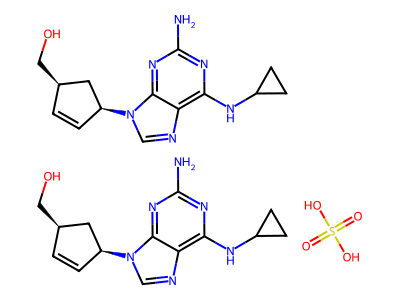
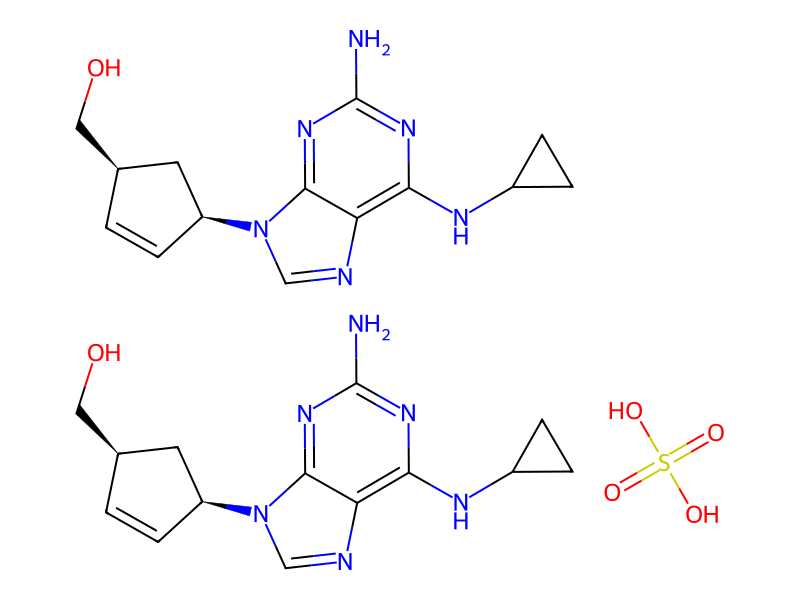
Structure 2D
Cite this structure
Embed this structure
SMILES
Nc1nc(NC2CC2)c2ncn([C@H]3C=C[C@@H](CO)C3)c2n1.Nc1nc(NC2CC2)c2ncn([C@H]3C=C[C@@H](CO)C3)c2n1.O=S(=O)(O)O
InChI
InChI=1S/2C14H18N6O.H2O4S/c2*15-14-18-12(17-9-2-3-9)11-13(19-14)20(7-16-11)10-4-1-8(5-10)6-21;1-5(2,3)4/h2*1,4,7-10,21H,2-3,5-6H2,(H3,15,17,18,19);(H2,1,2,3,4)/t2*8-,10+;/m11./s1
Molecular Formula
C28H38N12O6S
HBD / HBA
8 / 16
Liaisons Rotatives
8
Atomes Lourds
47
No targets recorded
Target interaction data is not yet available for this drug.
No interactions recorded
Drug interaction data is not yet available for this compound.
No side effects recorded
Side effect data is not yet available for this drug.
Foire aux questions
The sulfate salt form of abacavir, an antiretroviral medicine used to treat HIV infection with the same mechanism and precautions as abacavir itself. It is taken orally, usually once or twice daily as part of a combination HIV therapy regimen. Patients should be screened for the HLA-B*5701 gene variant before starting treatment to avoid a potentially life-threatening hypersensitivity reaction.
Yes, Abacavir Sulfate is an approved drug. It has reached clinical phase 4. It is classified as a Small molecule.
References & Data Sources
- ChEMBL — European Bioinformatics Institute (EBI). CHEMBL4303288. Open-access bioactivity database.
- PubChem — National Center for Biotechnology Information (NCBI). CID 441384. Chemical information database.
Data aggregated from publicly available pharmacological databases. Last updated 2026-08-20.
Embed This Widget
Add the script tag and a data attribute to embed this widget.
<script src="https://cdn.jsdelivr.net/npm/drugfyi-embed@1/dist/embed.min.js" defer></script>
<div data-drugfyi="drug" data-slug="abacavir-sulfate"></div>Embed via iframe for maximum compatibility.
<iframe src="https://drugfyi.com/iframe/drug/abacavir-sulfate/" width="420" height="400" frameborder="0" style="border:0;border-radius:10px;max-width:100%" loading="lazy"></iframe>Paste this URL in WordPress, Medium, or any oEmbed-compatible platform.
https://drugfyi.com/drug/abacavir-sulfate/Add a dynamic SVG badge to your README or docs.
[](https://drugfyi.com/drug/abacavir-sulfate/)Use the native HTML custom element.
<script src="https://cdn.jsdelivr.net/npm/drugfyi-embed@1/dist/embed.min.js" defer></script>
<drugfyi-drug slug="abacavir-sulfate"></drugfyi-drug>