Clindamycin
By binding the 50S ribosomal subunit and blocking protein synthesis, clindamycin arrests bacterial growth, and it is especially valued against anaerobic bacteria and certain drug-resistant organisms. It treats skin, respiratory, and soft-tissue infections. Marketed as Cleocin and in topical acne products, the compound has the formula C18H33ClN2O5S. Disruption of gut flora can predispose to Clostridioides difficile colitis, a recognized risk of its use.
An antibiotic that stops bacterial growth by blocking protein synthesis, effective against a wide range of skin, respiratory, and soft tissue infections. It is particularly valued for treating infections caused by anaerobic bacteria and certain drug-resistant organisms.
Masse moléculaire
424,9830 g/mol
LogP
2,20
TPSA
128,00 Ų
Règle des 5 de Lipinski
Conforme
Aires thérapeutiques
Classes de médicaments
Mécanisme d'action
Binds 50S ribosomal subunit inhibiting protein synthesis.
Pharmacokinetics (PK)
Pharmacodynamics (PD)
Binds 50S ribosomal subunit inhibiting protein synthesis.
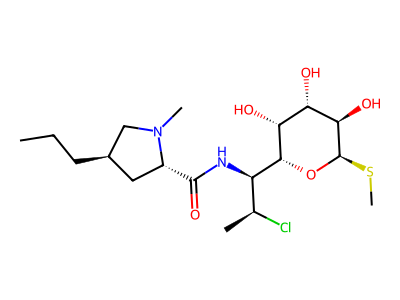
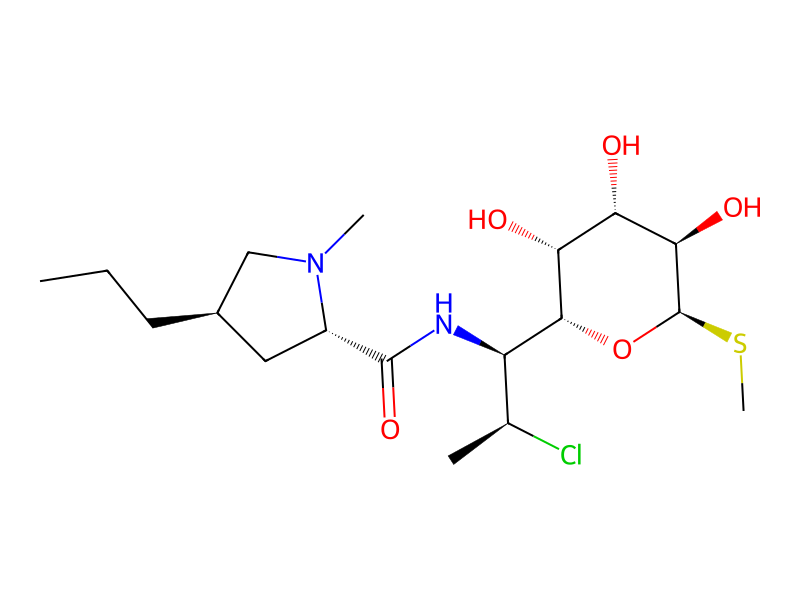
Structure 2D
Cite this structure
Embed this structure
SMILES
CCC[C@@H]1C[C@@H](C(=O)N[C@@H]([C@H]2O[C@H](SC)[C@H](O)[C@@H](O)[C@H]2O)[C@H](C)Cl)N(C)C1
InChI
InChI=1S/C18H33ClN2O5S/c1-5-6-10-7-11(21(3)8-10)17(25)20-12(9(2)19)16-14(23)13(22)15(24)18(26-16)27-4/h9-16,18,22-24H,5-8H2,1-4H3,(H,20,25)/t9-,10+,11-,12+,13-,14+,15+,16+,18+/m0/s1
Molecular Formula
C18H33ClN2O5S
HBD / HBA
4 / 7
Liaisons Rotatives
7
Atomes Lourds
27
No targets recorded
Target interaction data is not yet available for this drug.
Clindamycin may reduce renal tubular secretion of methotrexate, raising methotrexate levels and increasing the risk of haematological and GI toxicity.
Clindamycin may enhance the anticoagulant effect of warfarin by disrupting vitamin K-producing gut flora, leading to unpredictable INR elevations and increased bleeding risk during and shortly after the antibiotic course.
No side effects recorded
Side effect data is not yet available for this drug.
Foire aux questions
An antibiotic that stops bacterial growth by blocking protein synthesis, effective against a wide range of skin, respiratory, and soft tissue infections. It is particularly valued for treating infections caused by anaerobic bacteria and certain drug-resistant organisms.
Binds 50S ribosomal subunit inhibiting protein synthesis.
Key pharmacokinetic parameters for Clindamycin: Half-life: 2-3 hours.
Yes, Clindamycin is an approved drug. It has reached clinical phase 4. It is classified as a Small molecule.
Related Drugs
References & Data Sources
- ChEMBL — European Bioinformatics Institute (EBI). CHEMBL1753. Open-access bioactivity database.
- PubChem — National Center for Biotechnology Information (NCBI). CID 446598. Chemical information database.
Data aggregated from publicly available pharmacological databases. Last updated 2026-03-04.
Embed This Widget
Add the script tag and a data attribute to embed this widget.
<script src="https://cdn.jsdelivr.net/npm/drugfyi-embed@1/dist/embed.min.js" defer></script>
<div data-drugfyi="drug" data-slug="clindamycin"></div>Embed via iframe for maximum compatibility.
<iframe src="https://drugfyi.com/iframe/drug/clindamycin/" width="420" height="400" frameborder="0" style="border:0;border-radius:10px;max-width:100%" loading="lazy"></iframe>Paste this URL in WordPress, Medium, or any oEmbed-compatible platform.
https://drugfyi.com/drug/clindamycin/Add a dynamic SVG badge to your README or docs.
[](https://drugfyi.com/drug/clindamycin/)Use the native HTML custom element.
<script src="https://cdn.jsdelivr.net/npm/drugfyi-embed@1/dist/embed.min.js" defer></script>
<drugfyi-drug slug="clindamycin"></drugfyi-drug>