3,3',4',5-Tetrachlorosalicylanilide
Antiseptic soaps and skin preparations once contained 3,4',5-tetrachlorosalicylanilide, a halogenated antimicrobial that disrupts microbial cell membranes and denatures proteins on contact. That non-specific chemical action gives rapid broad-spectrum activity against bacteria and fungi on the skin surface, and it operates without a defined molecular receptor. Reports of skin sensitisation and of photosensitivity reactions in exposed individuals ended its widespread use, and the compound is now rarely encountered in medical or consumer products. Photocontact allergy associated with halogenated salicylanilides is a recognised episode in the history of cosmetic and antiseptic regulation. The molecule is C13H7Cl4NO2 with a mass near 351.0 g/mol.
An antimicrobial compound that was historically used in antiseptic soaps and skin preparations to kill bacteria and fungi on the skin's surface. It fell out of widespread use after concerns arose about skin sensitization and photosensitivity reactions in some individuals. Today it is rarely encountered in modern medical or consumer products.
Berat Molekul
351,0000 g/mol
LogP
5,90
TPSA
49,30 Ų
Lipinski RO5
Lulus
Area Terapeutik
Mekanisme Kerja
Disrupts microbial cell membranes and denatures proteins on contact, producing rapid broad-spectrum antimicrobial activity on skin and wound surfaces.
Pharmacokinetics (PK)
Pharmacodynamics (PD)
Disrupts microbial cell membranes and denatures proteins on contact, producing rapid broad-spectrum antimicrobial activity on skin and wound surfaces.
Struktur 2D
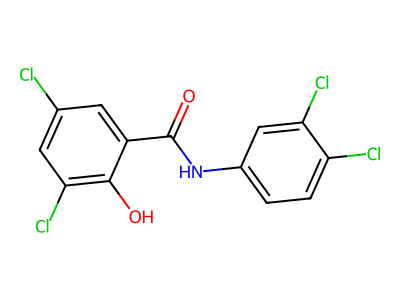
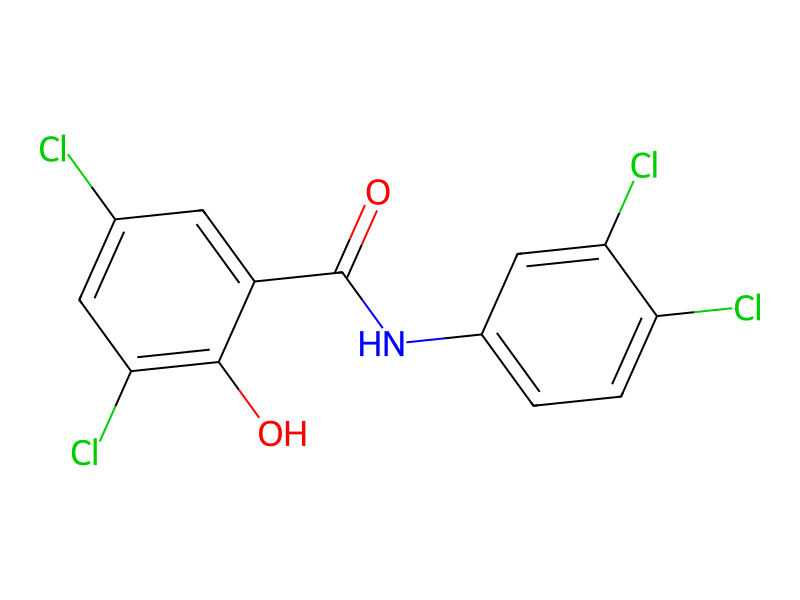
Cite this structure
Embed this structure
SMILES
O=C(Nc1ccc(Cl)c(Cl)c1)c1cc(Cl)cc(Cl)c1O
InChI
InChI=1S/C13H7Cl4NO2/c14-6-3-8(12(19)11(17)4-6)13(20)18-7-1-2-9(15)10(16)5-7/h1-5,19H,(H,18,20)
Molecular Formula
C13H7Cl4NO2
HBD / HBA
2 / 2
Ikatan yang Dapat Dirotasi
2
Atom Berat
20
No targets recorded
Target interaction data is not yet available for this drug.
No interactions recorded
Drug interaction data is not yet available for this compound.
No side effects recorded
Side effect data is not yet available for this drug.
Pertanyaan yang Sering Diajukan
An antimicrobial compound that was historically used in antiseptic soaps and skin preparations to kill bacteria and fungi on the skin's surface. It fell out of widespread use after concerns arose about skin sensitization and photosensitivity reactions in some individuals. Today it is rarely encountered in modern medical or consumer products.
Disrupts microbial cell membranes and denatures proteins on contact, producing rapid broad-spectrum antimicrobial activity on skin and wound surfaces.
Yes, 3,3',4',5-Tetrachlorosalicylanilide is an approved drug. It has reached clinical phase 4. It is classified as a Small molecule.
References & Data Sources
- ChEMBL — European Bioinformatics Institute (EBI). CHEMBL291338. Open-access bioactivity database.
- PubChem — National Center for Biotechnology Information (NCBI). CID 14385. Chemical information database.
Data aggregated from publicly available pharmacological databases. Last updated 2026-08-20.
Embed This Widget
Add the script tag and a data attribute to embed this widget.
<script src="https://cdn.jsdelivr.net/npm/drugfyi-embed@1/dist/embed.min.js" defer></script>
<div data-drugfyi="drug" data-slug="3345-tetrachlorosalicylanilide"></div>Embed via iframe for maximum compatibility.
<iframe src="https://drugfyi.com/iframe/drug/3345-tetrachlorosalicylanilide/" width="420" height="400" frameborder="0" style="border:0;border-radius:10px;max-width:100%" loading="lazy"></iframe>Paste this URL in WordPress, Medium, or any oEmbed-compatible platform.
https://drugfyi.com/drug/3345-tetrachlorosalicylanilide/Add a dynamic SVG badge to your README or docs.
[](https://drugfyi.com/drug/3345-tetrachlorosalicylanilide/)Use the native HTML custom element.
<script src="https://cdn.jsdelivr.net/npm/drugfyi-embed@1/dist/embed.min.js" defer></script>
<drugfyi-drug slug="3345-tetrachlorosalicylanilide"></drugfyi-drug>